
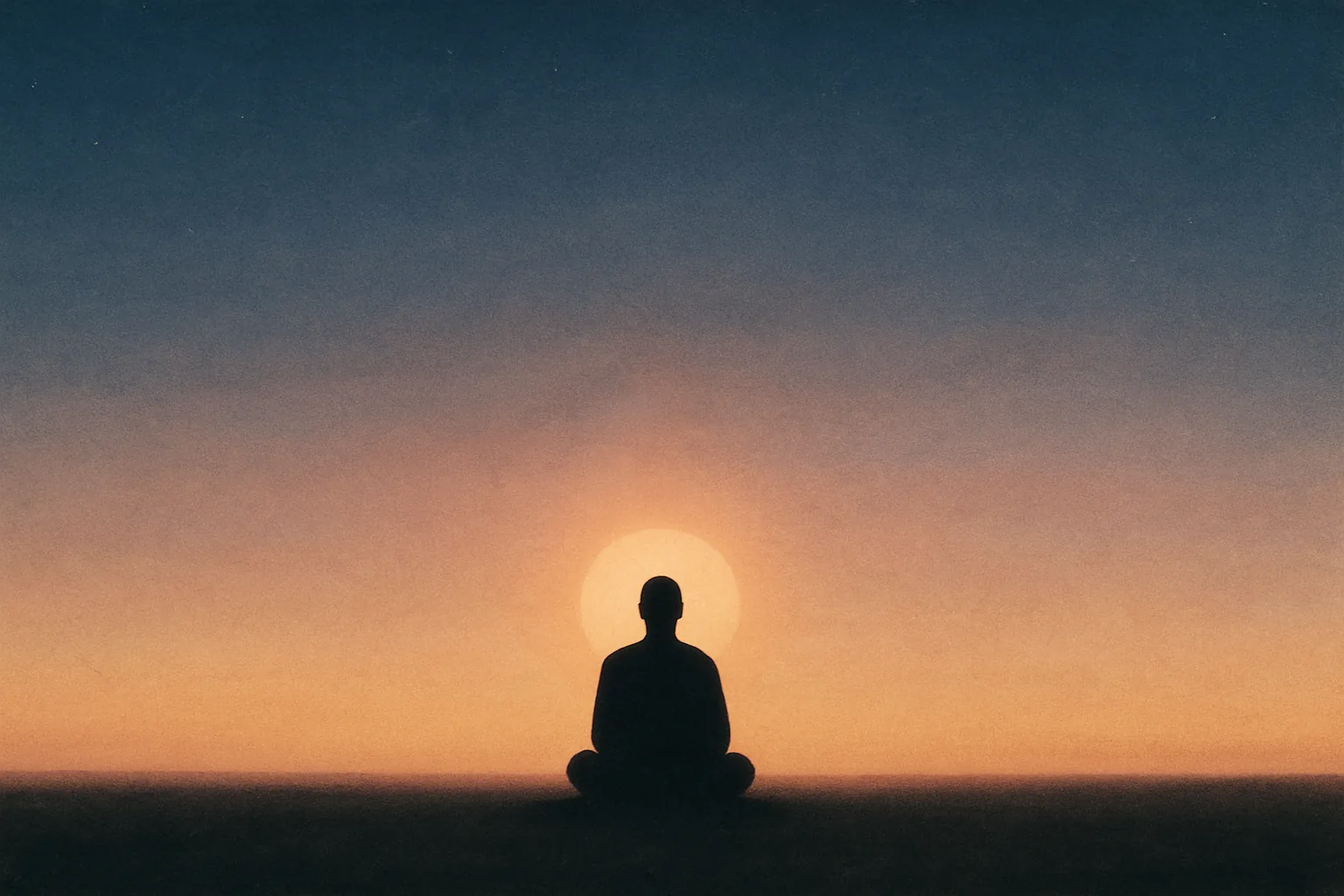
Going Beyond the Mind is an Osho-inspired meditation that turns you from solving the mind to simply stepping out of it. Rather than pruning one problem after another, you shift from content to consciousness itself. In Osho’s words, the key is constant remembrance—a living mindfulness that does not allow the past to repeat. This method uses a brief, deliberate “frustration” of the past to drop your old patterns in one gesture, and then settles you into pure witnessing where the mind has no nourishment to continue its mischief.
Rooted in the spirit of Tantra, this meditation is not therapy, analysis, or repair; it is an immediate movement beyond. You neither argue with thoughts nor decorate them—you watch. You neither choose parts of the past to keep nor polish your stories—you let the whole bundle fall. What remains is the simple radiance of presence: breath, body, space, silence. From here, mindfulness becomes a quiet, moment-to-moment companion in daily life, protecting you from the old mechanical loops and inviting a fearless freshness to each step.
Phase Instructions
First Stage: Drop the Past, Completely (10 minutes)
Sit comfortably with your spine upright. Let your eyes close or remain half open with a soft gaze. Breathe naturally through the nose. On each exhale, silently whisper inside, “Enough.” For 2–3 minutes, bring to mind your repetitive patterns—your ‘right’ choices and your ‘wrong’ choices—and feel them as a single, heavy garment you have outgrown. Now practice total frustration: do not select anything to keep. Sense the relief and humility of admitting, “All of it was from unawareness; I drop it all now.” Do not argue, justify, or explain. With every exhale, feel layers slipping off the body, face, and heart. By the final minutes, stop recalling specifics and rest in the clean resolve: the past is finished. Let the breath be easy and unforced.
Second Stage: Watch the Mind’s Machinery (15 minutes)
Keep the body still and relaxed. Allow the breath to find its own rhythm. Place gentle attention on the natural rise and fall of the abdomen. Do nothing to improve or regulate experience. As thoughts appear, label each one once, softly inside, as “mind,” and let it pass—like noticing a cloud without following its shape. Include sounds, sensations, and emotions in the same field of observation, without preference. Do not solve, suppress, or analyze. When you notice you’ve been carried away, simply return to the feel of the breath and the sense of sitting. Let awareness be panoramic and kind, as if listening to the whole room at once.
Third Stage: Step Out—Be the Witness (15 minutes)
Now, with eyes closed or softly open, imagine your thoughts streaming on a screen a step in front of you. Gently take one step back inside your inner space. On the exhale, silently affirm, “I am not the mind; I am the witness.” Do not fight thoughts; let them play without your participation. Feel the quiet interval between two thoughts; rest in that gap whenever it appears, even for a second. If emotion swells, feel it fully in the body while remaining a clear sky around it. Return again and again to the felt sense of being the seer—untouched, spacious, alert.
Fourth Stage: Remove the Mind’s Nourishment (10 minutes)
Withdraw interest from every story and feed attention only to the raw now: breath moving, chest expanding, the weight of the body, sounds arriving and fading. If a problem or plan tries to hook you, gently say inside, “Unnecessary,” and return to immediacy. Let incompletion remain incomplete. Notice how, without your engagement, thoughts lose fuel and settle by themselves. Do not expect silence—simply stop feeding noise. Recognize the natural ease that appears when nothing needs fixing.
Fifth Stage: Open-Eyed Integration—Constant Remembrance (10 minutes)
Slowly open your eyes. Keep the same witnessing while looking around. Let vision be soft; allow colors, shapes, and light to arrive. Move one hand, then the other, as if underwater—aware of every sensation. If possible, stand and take a few slow steps, maintaining the sense, “I am the witness.” Make a simple, clear commitment for the day: take three mindful pauses each hour. In each pause, feel a breath, sense the body, and recall, “Do not repeat the past; be mindful now.” Carry this remembrance into speaking, eating, walking, and resting. End with one deep inhale and a long, effortless exhale, sealing the taste of presence.
Core Benefits
- Shift from content to consciousness itself
- Immediate movement beyond therapy, analysis, or repair
- Settles into pure witnessing where the mind cannot continue its mischief
- Let the whole bundle of the past fall without choosing parts to keep
- Mindfulness becomes a quiet, moment-to-moment companion
What Osho Said About This Technique
Mind is a hoarder of bitterness. It collects sounds, hurts, insults. It goes on sulking over them for years. Psychologists are very aware of the fact that something said when you were only four years old may have hurt you so much that it is still there like a wound, still oozing pus. You don't allow it to be healed. You go on fingering the wound so you make it hurt again and again, again and again you create it, never giving it an opportunity to be healed by itself. If we look at our mind, it is nothing but wounds and wounds. Hence life becomes a hell; we collect only thorns. A man may have been loving to you for years, he may have been compassionate, kind and everything, and he says just one thing which hurts you, and years of love and friendship disappear.
For example, it brings you the experience that not the body, so clearly, so solidly, so categorically, that even if the whole world denies it, it cannot make any difference: you know from your innermost core you are not the body. It brings you the experience that you are not the mind either. And the moment you know you are neither the body nor the mind, suddenly a door opens. You have never been born and you are never going to die because only that which is born can die. The body was born, the mind was born -- they will die -- but you were before your birth and you will be after your death. Once this reality is revealed to you all fears and all miseries disappear. You become part of eternity. Only one thing remains and that is pure consciousness. And pure consciousness is nothing but godliness.
Meditation is going beyond time. Time is mind. Mind consists of past and future; mind has no experience of the present. It is thought that time has three tenses: past, present and future. I don't agree, my own experience is totally different; time consists only of two tenses, past and future. The present is not part of time, the present is part of eternity. It is a totally different thing. Past and future are horizontal and present is vertical. Mind lives horizontally, meditation is a vertical phenomenon. When you drop out of the past and the future, suddenly you enter into the present, and that is beyond time. And that is the beginning of god, of truth, the beginning of that which is.
People live identified with the body; that's how the body becomes an imprisonment. Rather than helping you to grow towards the infinite, your identification with the body makes you very finite, very small. And that is one of the fundamental causes of misery; the body will get old, then you will feel afraid, scared -- you are getting old; the body will be ill and then you will be in tremendous fear -- and sooner or later the body is going to die. You may not think about it, but it is there. You see people dying -- you cannot deny it; you may overlook it but you cannot deny it. You may no look at it, you may bypass it, but still it is there and deep down you know that you have to die.
[And to remind the next sannyasin of that promise Osho gave him the name Akash -- sky!] Mind is a very small thing, it is like a prison cell. And everybody is imprisoned in his own mind: in his prejudices, creeds, dogmas, religions, philosophies -- political and spiritual. Everybody is living in a very small dark cell. The cell is made of conditionings. Meditation means unconditioning the mind and never allowing it to be reconditioned. Otherwise it is very easy to move from one dark cell to another dark cell. A Hindu can become a Christian; that is very easy, there is no conversion. Instead of worshipping Krishna he starts worshipping Christ. In fact linguists say that the word 'Christ' comes from the word 'Krishna'; they are not different words, their root is the same. So you have changed from one cell to another. A Christian can become a Hindu.
Common Questions
This meditation immediately moves beyond therapy, analysis, or repair by focusing on witnessing rather than interacting with thoughts.
It means moving your focus away from solving problems one by one to embracing the awareness and mindfulness of the present moment.
The meditation uses a brief 'frustration' to drop old patterns in one gesture, allowing you to settle into witnessing without nourishing past patterns.
The simple radiance of presence, including breath, body, space, and silence, is what remains.