
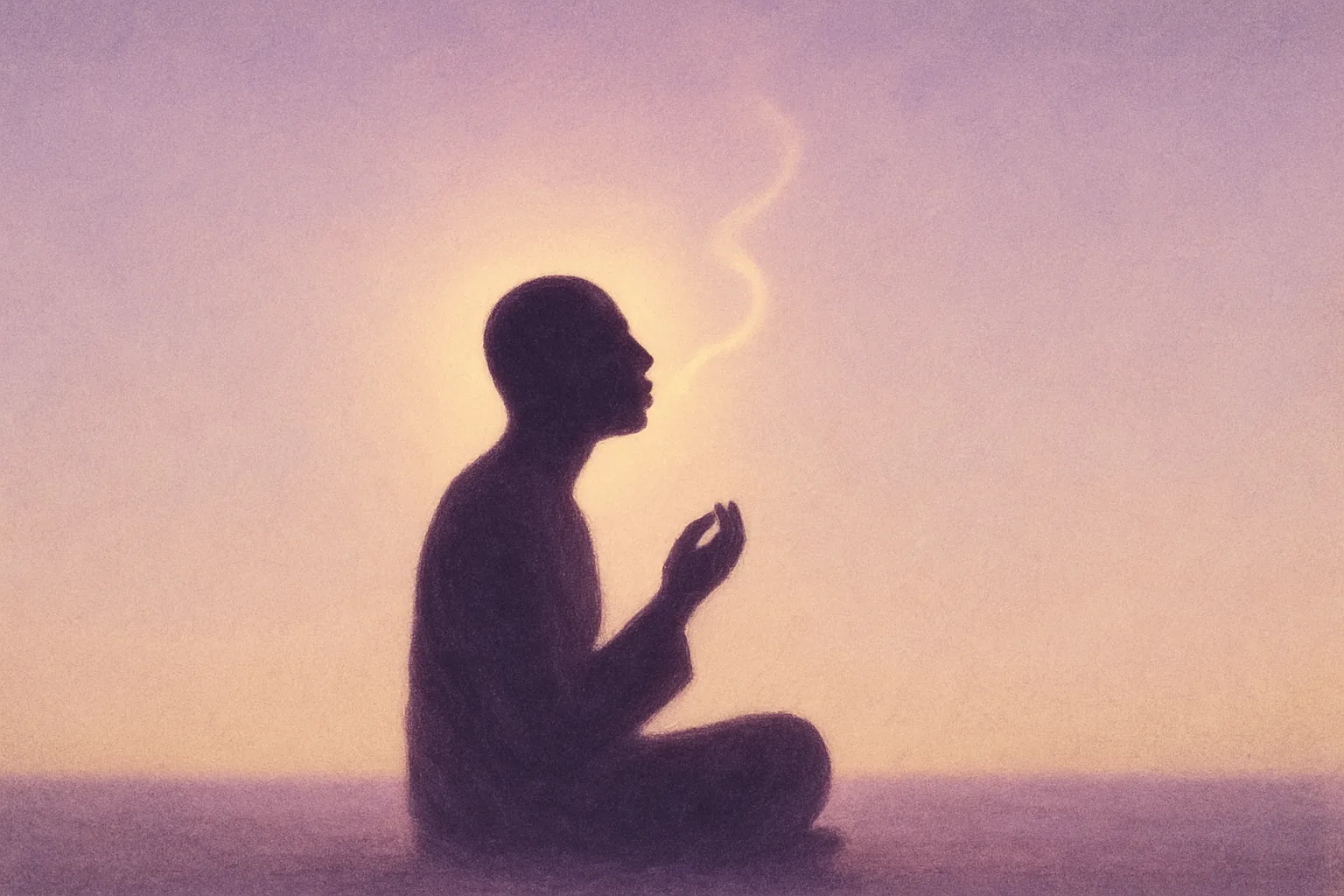
Devavani means the Divine Voice — a current that moves and speaks through the meditator, who becomes an empty vessel, a clear channel. This method is a Latihan of the tongue: effortless, unforced, and innocent. As the conscious mind relaxes and steps aside, sounds from a pre-verbal place begin to flow. Practiced last thing at night, it settles the mind so deeply that it is often followed by profound sleep.
The meditation unfolds in four stages of fifteen minutes each, with eyes closed throughout. It begins in quiet with gentle music, then blossoms into soft, unfamiliar syllables spoken as if in a tender conversation. The voice invites the body into subtle, natural movement, and finally everything dissolves into silent stillness. Devavani slips you beneath learned language into childlike trust, where the Divine Voice can speak through you.
Phase Instructions
First Stage: Quiet Sitting with Gentle Music
15 minutes. Sit quietly with your eyes closed, preferably with soft, gentle music playing. Let the body be at ease and the breath natural. Do nothing; simply rest and allow the mind to settle, preparing to become an empty vessel.
Second Stage: Allow Unfamiliar Sounds to Arise
15 minutes. With eyes closed, begin making simple nonsense sounds, for example, “la… la… la…”. Continue until unfamiliar, word-like sounds begin to arise on their own. Let the sounds come from the childlike, pre-verbal part of the brain, as if you are speaking a language you do not know. Keep a gentle, conversational intonation. Do not cry or shout, laugh or scream. Remain relaxed and allow the Divine Voice to speak through you.
Third Stage: Stand and Let the Body Move Softly
15 minutes. Stand up, keep your eyes closed, and continue speaking in the same unfamiliar, flowing language. Allow your body to move softly in harmony with the sounds. If the body is relaxed, subtle energies will create a Latihan outside your control—let movement happen rather than making it happen.
Fourth Stage: Lie Down in Silent Stillness
15 minutes. Lie down with eyes closed. Be silent and still. Let all sounds and movements fade. Rest in the spacious afterglow, allowing the practice to sink deeply within—especially supportive when done last thing at night.
Core Benefits
- Settles the mind deeply for profound sleep
- Relaxes the conscious mind
- Allows flow of pre-verbal sounds
- Engages the body in natural movement
- Facilitates a state of childlike trust
What Osho Said About This Technique
Deva means divine, shantam means silent -- divine silence. And let this be your basic key -- silence. Whenever you can find time, wherever, fall into silence. And there is no need to find a separate place for it. Walking on the road you can remember and fall into silence, and you will enjoy the walk more, because when you are silent you are more alive, more pulsating. When you are silent the mind is not making noise. You are more aware -- aware of the birds singing, aware of the wind blowing, aware of the sunrays falling on you, aware of people, and aware of the whole that surrounds you. Ordinarily we live in a kind of fog -- we are surrounded by our own noise. And that noise is so much that it doesn't allow anything else to enter.
As you go deeper in meditation you will hear this music. Zen people call it the sound of one hand clapping. In India we call it nad; nad means: there is no instrument. There is nobody playing but still the music is heard. It is uncreated music, unstruck music. And this is our very being, but we are lost in the noise of the head and we cannot hear the still small voice within. The whole work of meditation is to move from the noisy head to the musical heart. And once this starts happening you are on an incredible journey. For the first time you will feel ecstasy arising in you, for the first time a subtle spiritual drunkenness -- one becomes a drunkard. Deva means divine, mouni means the silent one -- divine silence, and that has to be the key for you.
Deva Toru. Deva means divine, toru means clarity -- divine clarity. Mind is confusion; no-mind is clarity. Thinking can never be clear; howsoever logical it is, it remains unclear. It can, at the most, pretend clarity. But there is a state of no-thought when the mind is utterly quiet -- no traffic of thoughts, no process of thoughts -- and one is not asleep, one is alert, awake, conscious, and there is no content in the mind. The mind is utterly empty and one is watching that emptiness. That is clarity, and only in that clarity is God known. That clarity is the goal of meditation, the goal of sannyas. Attain it! Without it there is no knowing; without it there is no seeing. Without it we are in darkness; there is no light. Mind is our darkness, mind is our hell, mind is our death.
Deva means divine, shravano means listening -- the art of divine listening. And that's what meditation is. If one can learn how to listen rightly, one has learned the deepest secret of meditation. People hear but they don't listen. Hearing is one thing -- listening, altogether different; they are worlds apart. Hearing is a physical phenomenon; you hear because you have ears. Listening is a spiritual phenomenon. You listen when you have attention, when your inner being joins with your ears. And once you have learned how to join your inner being with your ears, you can join it with any sense. It can be joined with the eyes or with the nose or with the sense of touch or taste, and slowly slowly you can join it with all your senses simultaneously. In that moment, god is available. But it is easier to start with the ears...
Deva means divine, anunada means vibration. You have to meditate much on vibrations and you have to learn how to vibrate in tune with the whole. When a person is too self-conscious he vibrates against the whole. When a person is no more self-conscious, simply conscious with no self in it, then he vibrates with the whole. The self gives you a different rhythm and you fall apart. Man is not really separated, only he starts vibrating in a different rhythm from the whole -- as if in an orchestra a musician falls out of tune. He is committing a sin because the whole harmony is being destroyed. That is the only sin there is: to vibrate in such a way that you are not part of the whole.
Common Questions
Devavani is a Latihan of the tongue meditation where the meditator becomes an empty vessel, allowing the Divine Voice to move and speak through them.
Each stage of Devavani meditation lasts for fifteen minutes.
The meditation begins in silence with gentle music, moves into soft, unfamiliar syllables, invites natural body movement, and ends in silent stillness.
Devavani is best practiced as the last thing at night as it leads into profound sleep.
No, the sounds should flow effortlessly and unforced as the conscious mind relaxes.