
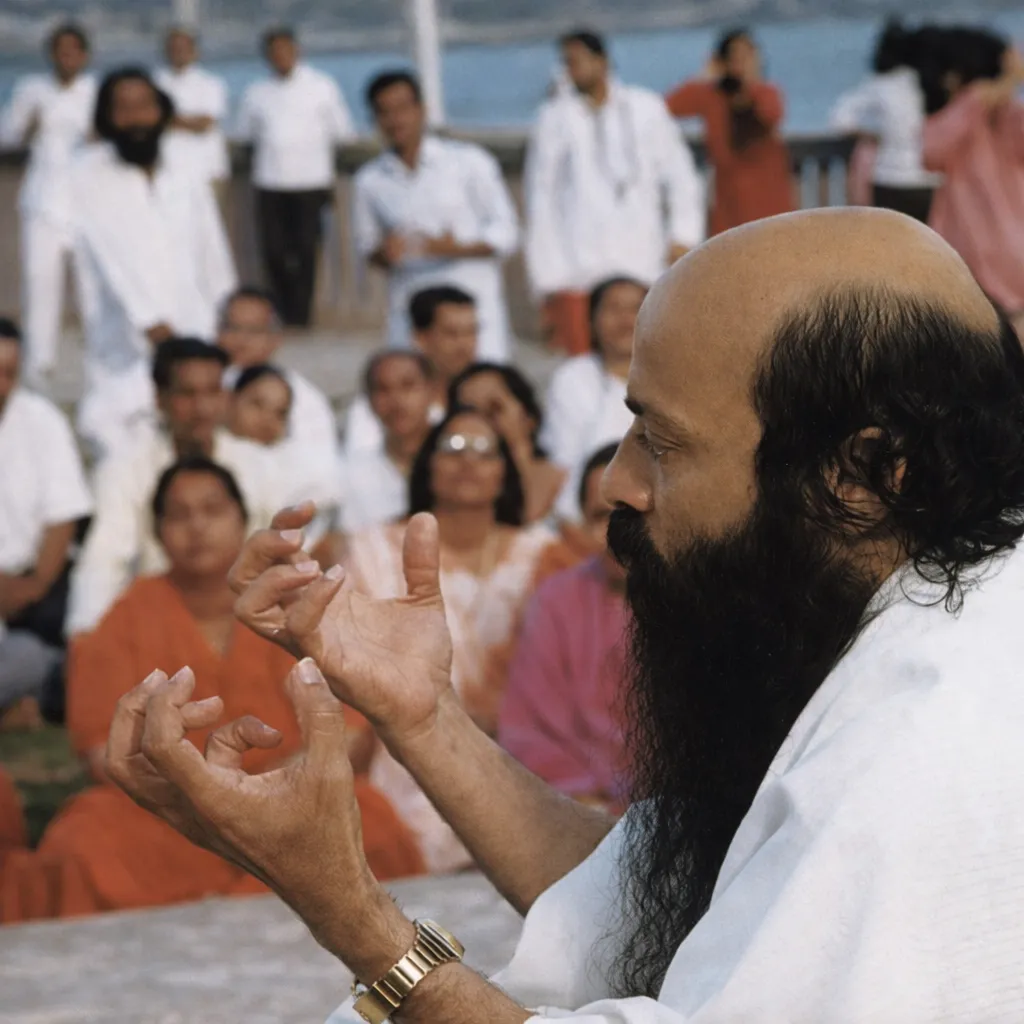
According to Osho, yes—once you see your misery and self-loathing as priest‑implanted ‘conscience,’ sannyas and meditation cure it. Sannyas is a decisive yes to dropping the imposed mind; meditation separates you from it. Recognize the mind as borrowed, disidentify, and you slip out of guilt into your unpolluted being—if his sannyas can’t do it, nothing will.
Realize the mean voice in your head isn’t you, then use sannyas and meditation to drop it and be your natural, happy self.
From the Discourses
Passages where Osho speaks to this question — each links to the complete discourse.
[NOTE: This is an unedited tape transcript of an unpublished darshan diary, which has been scanned and cleaned up. It is for reference purposes only.] Man lives in misery because of cowardliness. There is no other cause for it. It is fear of the unknown that keeps man clinging to his misery, because misery is known, well-known. We are born in it, we are brought up in it, we see it all around -- everybody is miserable, the whole crowd is miserable. It is the climate, the atmosphere. To be blissful means to transcend this climate, this atmosphere, to go beyond the limits of the crowd, to move into the unknown and the unacquainted and the uncharted. It is the fear of the unknown that keeps us clinging to all kinds of suffering. The suffering is not clinging to you, you cling to it. People prefer suffering more than nothing.
It cannot happen in a state of misery. A miserable person is constantly distorting truth. He himself is in such a distortion. He himself is in so many pieces that whatsoever goes through him becomes something other than what is was. Just by passing through the distorted person, it becomes distorted. He is not empty; a miserable person is full of his misery. That is something tremendously significant to remember: a miserable person is very full -- of garbage, rubbish, but very full. The blissful person is very empty. He is just space. And through this emptiness god can flow into the world. Become empty, become blissful -- and they go together very well. If you are blissful you will become empty, if you are empty you will become blissful. It is impossible for the empty person to be miserable.
Misery is rooted in our robot-like behavior; it arises out of our unconsciousness. You become angry because you are unconscious; if you are conscious, to be angry is so stupid -- it is impossible to get into it. One can get into it only unconsciously; hence even unconscious people later on repent. When they start getting a little bit alert to what they have done, how they have behaved, how ugly it was, then they start saying "I am sorry -- I did it in spite of myself!" But how can you do it in spite of yourself? Then who does it? But there is a certain significance in that expression; it shows that when you are unconscious you are not yourself. Then you are at the mercy of anything that is happening outside -- it can drive you into any direction. You become driftwood.
Sannyas means that we will have to destroy that circumference so that you can be brought back to your original centre. The Zen people call it the original face -- your face before anybody started painting it and putting masks on it to make it beautiful, to make it look beautiful -- just the original face as nature intended it to be. That already exists at the centre but the circumference has to disappear. And through the fire of meditation is the only way -- because the circumference means the mind and meditation means no-mind; hence I say the only way, because if mind has to be destroyed then you have to learn the ways of being a no-mind. And once you have discovered your centre you can a totally new circumference, but it will be accordance with your nature. Then life has beauty, harmony, grace.
Osho, the feeling for sannyas arises, and then the mind runs away. I can’t decide whether to take sannyas or not! Because it feels as if I’d be deceiving myself. It seems to me that I am not worthy of taking sannyas.
Three years passed. He thought and thought, listing hundreds of reasons pro and con: If I marry, these gains, these losses; if I don’t, these gains, these losses. In the end he found one extra gain in marrying—experience. And one loss in not marrying—no experience. The pan tilted. After three years he knocked on her door. Her father opened it. Kant said, “I have finally decided—one reason more on this side; I will marry.” The father laughed. “Too late. My daughter is married—and already has a child. You came far too late. Think again. And if someone else proposes, have your decision ready beforehand; don’t take so long.” He never married—no one else proposed. If you live by thinking, you’ll end up trivial. The vast requires a leap, not thinking. It requires courage—the gambler’s heart, not a shopkeeper’s book-keeping. Jamuna Singh, if you want to take it, take it. If…