
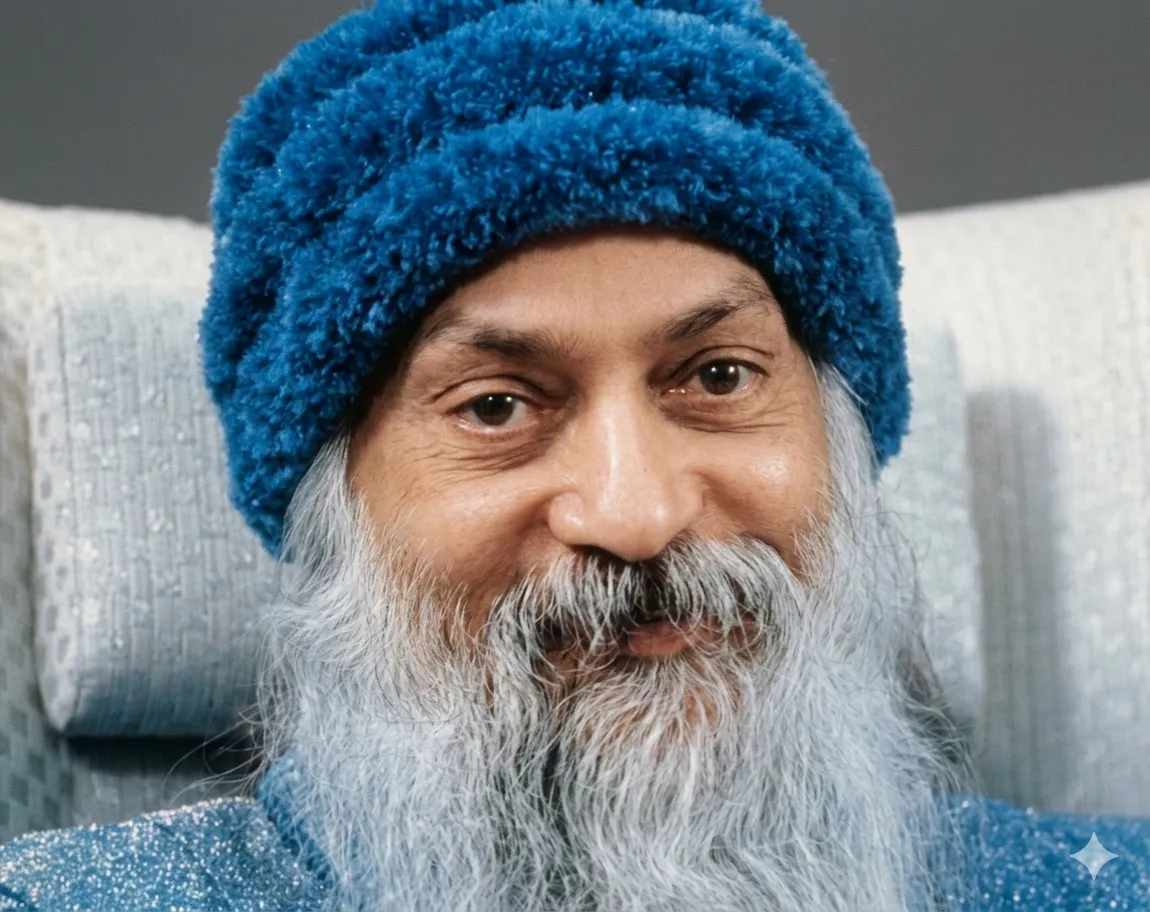
According to Osho, happiness cannot be achieved by wanting it; desire breeds misery. Drop aggression and ambition, stop 'snatching' at life, and rest in receptive, non-demanding awareness. Accept whatever arises—without rejection—allowing life to flow. In relaxed, prayerful gratitude and feminine receptivity, happiness appears on its own and gradually overflows to others.
Stop chasing happiness; relax, accept what comes, and let life happen—then happiness shows up by itself.
From the Discourses
Passages where Osho speaks to this question — each links to the complete discourse.
How is one to be happy?
If you want to be happy, you will become unhappy: the very wanting will create unhappiness. That's why people are unhappy. Everybody wants to be happy and everybody becomes unhappy. Can't you see this? Have you ever met a man who does not want to be happy? If you have met such a man you will find he is happy. If you meet a man who says 'I don't want to be happy, I don't care a bit' then you will suddenly see, here is a man who is utterly happy. People who want to be happy you will find miserable, in the same proportion. If they want too much to be happy they will be too much unhappy -- the proportion of unhappiness will be the same as is their desire for happiness. What goes wrong? People come to me and they ask: 'Every-body in the world wants to…
Osho, I want to be happy. Whatever I do, I do it in the hope of being happy. Now I have come to practice religion also in that same hope. You say: dissolve the ego. It seems to me that if I dissolve the ego, I myself will be dissolved; then I won’t be there—so how will I be happy? Wouldn’t a miserable existence be preferable to losing my very existence?
They entered the city; people began removing turbans and caps, bowing. But the farmer said nothing. He remained silent. The emperor asked, “What is the matter? Do you understand?” The farmer said, “I am in a fix. You don’t remove your turban—and I don’t remove mine. So who is the emperor—you or I? This is a serious tangle.” Ego is such a delusion. Ego mistakenly believes itself to be the soul. Ego is not the soul—but both ride the same horse, very close. As a man rides a horse, his shadow too rides the horse. Similarly, with the soul rides the ego’s shadow. If the soul does not remove its hat, how will the shadow remove hers? The shadow too has a hat; she too struts, enjoying the full fun. You have taken the shadow to be yourself. When the shadow disappears, you will not. And the shadow must vanish…
Osho, can one not desire nothing but happiness in life?
What I am saying is: man is unhappy, therefore he wants to find happiness. And since he keeps seeking happiness but never sees that happiness and sorrow are two sides of the same coin, however much happiness he seeks he will remain unhappy—and keep seeking happiness. What I am saying is that fundamentally he fails to see that what he seeks is not happiness; a basic mistake is occurring. The mistake is that he is rejecting sorrow and seeking happiness, whereas happiness is a part of sorrow. That is, I am seeking birth and do not want to die; I am seeking youth and do not want to grow old. This is a great difficulty. If I want youth, old age is part of it; it is simply youth on the decline. When the flood has come, it must recede; when morning has happened, evening will be. Now I seek…
And for you? Even if the world were made exactly as you want it, there would be no change in your unhappiness—you might even become more unhappy. When your demands are fulfilled, you discover that after all that effort and toil, nothing was gained; you become even more miserable. To become a siddha, the sutra says: “By your own experience, know your own Self to be indivisible and be a siddha, and abide most joyfully in the non-conceptual Self.” Remain in that. Stay there. Abide, be established there. Be absorbed in that. Do not go out from it. Keep a little remembrance of this. Rising and sitting, seek unconditional happiness. Walking, sleeping, waking, eating, drinking—whatever the circumstance—seek unconditional happiness. Be happy. It sounds strange when we tell someone, “Just be happy.” He will ask, “How can I be happy?” Because our notion is that happiness must come from outside.
Bliss demands only one thing and that is the decisive factor. Misery allows you the ego and takes everything else. Bliss does not allow you the ego and gives you everything else, the whole existence. You have to decide. Either you choose the ego... then the kingdom of God is not yours; then you live in an egoistic, illusory world, surrounded by an ocean of misery. The ego can exist only in hell. That context is a must for the ego to exist. Any moment bliss can be victorious over you if you surrender the ego, if you drop the idea of "I," the idea of being separate from existence. You will be overflooded with bliss and you will have inexhaustible energy for creating. My sannyasins have to be creative, because my experience, my observation, is that only by being creative do you come closer to the creator.