
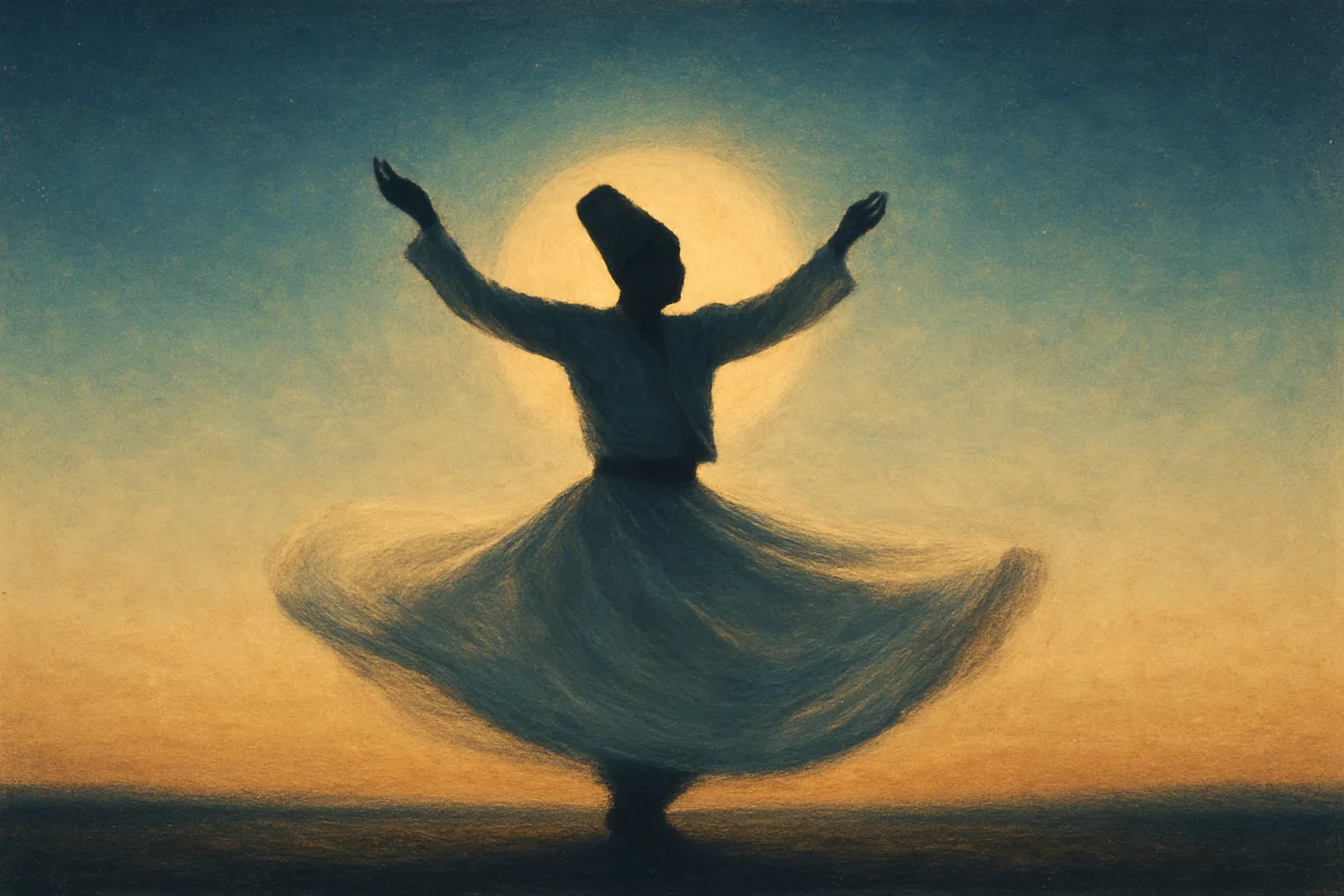
Sufi Whirling is one of the most ancient and potent methods of inner transformation. Osho presents it in its original, alive spirit: whirl with open eyes as a child would, until movement becomes a storm at the periphery and a silent witness awakens at the center. In this simple yet forceful dance, your inner being stands still while the whole body turns like a potter’s wheel, the world blurring into a flowing tapestry.
Practice on an empty stomach, barefoot and loosely clothed, and let the energy gather into a living whirlpool. There is no rigid duration for the spin—it can go on for hours—but whirling for at least one hour allows the current to take over. When the body falls by itself, the second stage begins: resting upon the earth, melting like a child at the mother’s breast, letting silence deepen and the energy settle.
Some may feel nauseous at first; this usually passes within two or three days. Remain gentle with yourself, let the body stay soft, and allow the earth to receive and absorb whatever arises. Afterward, keep quiet and unhurried so the fragrance of stillness can permeate your day.
Phase Instructions
First Stage: Whirling
Preparation: Do not eat or drink for at least three hours before starting. Be barefoot and wear loose clothing. Stand on the spot with your right arm lifted high, palm facing upward, and your left arm low, palm facing downward. Begin to whirl anti-clockwise on the spot (change to clockwise if anti-clockwise causes discomfort). Keep your eyes open yet unfocused so that images blur and flow. Remain silent throughout. For the first 15 minutes, rotate slowly. Over the next 30 minutes, gradually build up speed, letting the whirling take over until you feel like a vortex of energy—the body a storm of movement, the witness at the center silent and still. Continue whirling for at least one hour in total. When you are moving so fast that you cannot remain upright, let the fall happen by itself—do not decide the fall or try to arrange your landing. Keep the body soft; it will land softly and the earth will absorb the energy.
Second Stage: Resting on the Earth
As soon as you have fallen, roll onto your stomach so that your bare navel rests in contact with the earth. If lying face-down brings strong discomfort, lie on your back instead. Close your eyes. Feel the whole body blending into the earth like a small child pressed to the mother’s breast. Remain passive, silent, and unmoving for at least 15 minutes, simply receiving and allowing the energy to settle. After completing the meditation, stay as quiet and inactive as possible. Note: Some people may feel nauseous at first; this typically disappears within two or three days. If it persists, discontinue the practice.
Core Benefits
- Inner transformation
- Awakening of a silent witness
- Enhancement of stillness
- Deepening silence
- Settling of energy
What Osho Said About This Technique
The japanese master nan-in gave audience to a professor of philosophy. Serving tea, nan-in filled his visitor's cup, and kept pouring. The professor watched the overflow until he could restrain himself no longer: stop! The cup is overfull, no more will go in. Nan-in said: like this cup, you are full of your own opinions and speculations. How can I show you zen unless you first empty your cup?
In the night, just the opposite of the morning -- be completely unconscious; don't bother at all. The night has come, the sun has set, now everything is moving into unconsciousness. Move into unconsciousness. This whirling, Sufi whirling, is one of the most ancient techniques, one of the most forceful. It is so deep that even a single experience can make you totally different. You have to whirl with open eyes, just like small children go on twirling, as if your inner being has become a center and your whole body has become like a wheel, moving- a potter's wheel, moving. You are in the center, but the whole body is moving. Start slowly, clockwise. If somebody feels it is very difficult to move clockwise then anti-clockwise, but the rule is to move clockwise. If a few people are left-handed then they may feel it difficult; they can move anti-clockwise.…
By knowing oneself as the individual witnessing self of the intellect, and all its moods, and cultivating such feelings as "I am that," one should renounce any identification with all things except the self. After ceasing to follow others, one should create a distance with one's own body. Then one should stop following scriptures and give up one's identification with the self also.
WHEN A YOGI IS ROOTED IN THE SELF, HIS MIND IS DESTROYED BY FOLLOWING RIGHT METHOD, RIGHT LISTENING, AND HIS FIRST HAND EXPERIENCE, AND BY SEEING OTHERS AS HIS OWN SELF. HE THEN, CONTEMPLATES THE SELF, INSIDE THE HEART, WITHOUT GIVING AN EAR TO WHAT PEOPLE SAY, WITHDRAWING HIS ATTENTION FROM THE OBJECTS OF THE SENSES: SOUND, TOUCH, SIGHT, TASTE AND SMELL COLLECTIVELY; AND HE DOES NOT GIVE IN TO SLEEP OR FORGETFULNESS OF THE SELF. The word "witnessing" is one of the most significant words, particularly in Eastern spiritual alchemy. This word is a key word. So we must understand what witnessing means. We act, we do something, and the moment we do it we become the doer -- you walk, you become the walker. But there is one more possibility -- to remain a witnesser, to remain a witness. Walk, eat, or do whatsoever; don't be identified with…
Osho, in one camp I did five meditations. I don’t know at what moment what happened. After returning, for four months I continuously felt a strange kind of bliss within, and my body kept swaying like a pendulum. “Om Anand” began to arise from my lips of its own accord, and I felt an intoxication that I still feel. And during bhajans, kirtans, discourses, or even just seeing others meditate, my body starts to sway. Also, after emotional excitement or a little exertion, the body begins to sway. Kindly analyze this condition, guide me for future practice, and shed light on the possibilities.
Bhagwandas! Meditation pours a wine into the heart. An auspicious sign has happened. You began to sway, you began to feel intoxicated. Embrace it. It seems there is still a little hesitation in your mind about accepting it. You are a bit timid, a little afraid. You are doubtful—did what happened happen rightly or not? Am I perhaps going mad? When the first incident of meditation happens, it does feel as if one has gone mad. Who knows what they kept thinking, endlessly, in their hearts, their heads bowed a long while over my funeral bier. Among them lay hidden someone’s secret of love— whose tears, having risen to the eyelashes, had already dried. The boundary of the Beloved’s lane begins exactly there where your steps start to stagger. The Beloved’s domain begins where the feet begin to wobble. Your feet have wobbled. Good! With it, some restlessness will also…
आखिरी प्रश्न: ओशो, एक शिविर में मैंने पांच ध्यान किए। मुझे ज्ञात नहीं किस क्षण क्या घटित हुआ? वहां से लौटने पर मैं चार माह तक अपने भीतर एक अजीब से आनंद का अनुभव अनवरत करता रहा और मेरा शरीर पेंडुलम की भांति डोलता रहा। मुख से अनायास ही ‘ओम् आनंद’ का उच्चारण होता रहा और मैं एक मदहोशी का अनुभव करता रहा, जिसे अब भी अनुभव करता हूं। तथा भजन, कीर्तन या प्रवचन अथवा ध्यान के समय दूसरों को ध्यान करते देखने मात्र से मेरा शरीर डोलने लगता है। साथ ही आवेश या थोड़े परिश्रम के उपरांत भी शरीर डोलने लगता है। कृपया अनुग्रहपूर्वक उक्त स्थिति का विश्लेषण कर भावी साधना हेतु मार्ग दर्शन कर तथा संभावना पर प्रकाश डाल क
भगवानदास! ध्यान एक शराब घोल देता है हृदय में। शुभ लक्षण हुआ। तुम डोलने लगे, तुम मस्त होने लगे। इसे अंगीकार करो। लगता है, तुम्हारे मन में अभी थोड़ी इसे अंगीकार करने में झिझक है। तुम थोड़े डरे-डरे हो। तुम थोड़े भयभीत हो। तुम संदिग्ध हो--जो हुआ, ठीक हुआ कि नहीं हुआ? कहीं मैं विक्षिप्त तो नहीं हुआ जा रहा हूं?
What has been asked is: Where is the source, the fountainhead, of peace, of bliss, of amrit?
And remember, if such mastery comes over any part of the body, then gradually mastery begins to come over the whole body. The eye is the most precious, the most delicate, the most valuable part of the body. One who becomes the master of the eyes becomes the master of the whole body. Perhaps you have never thought that the most precious words in the world we have formed from the eye. Darshan—vision, philosophy—comes from seeing. Drashta, the seer, comes from seeing. One who has mastery over the eyes becomes the master of vision. For the eyes are the most restless part of the body. And if mastery over the eyes is attained, then no other part of the body can remain outside your mastery; they are far more inert. Therefore this forty-minute experiment with the eyes carries very deep meaning; its implications are far-reaching. Tomorrow, those friends who could…
यह जो पूछा है: शांति का, आनंद का, अमृत का स्थान कहां है उदगम का?
और ध्यान रहे, शरीर के किसी भी हिस्से पर अगर इतनी मालकियत आ जाए, तो धीरे-धीरे पूरे शरीर पर मालकियत आनी शुरू हो जाती है। आंख शरीर का सबसे ज्यादा कीमती, सबसे ज्यादा डेलिकेट, सबसे ज्यादा मूल्यवान हिस्सा है। जो आदमी आंख का मालिक हो जाता है, वह पूरे शरीर का मालिक हो जाता है। इसलिए शायद आपने कभी न सोचा होगा कि सारी दुनिया में, जितने कीमती शब्द हैं, वे हमने आंख से बनाए हैं। दर्शन, वह देखने से बनता है। द्रष्टा, सियर, वह देखने से बनता है। जिसकी आंख पर मालकियत हो गई वह दर्शन का मालिक हो जाता है। क्योंकि आंख शरीर का सबसे ज्यादा चंचल हिस्सा है। और अगर आंख की मालकियत हो गई तो शरीर के फिर कोई और हिस्से आपकी मालकियत के बाहर नहीं रह सकते। वे बहुत जड़ हैं।
SECOND STAGE Now we have to enter the second stage. Continue deep breathing, and let go of the body. Leave the body to do what it wishes to do. Let go of it. Let it take whatever asanas or postures it wants to take; let it form whatever mudras or gestures it likes. Leave it free to move and shake and whirl as it likes. If it wants to weep let it. Let go of the body completely. Continue deep breathing and let go of the body. Let the body fall down if it wants to fall down. And let it rise again if it wants to rise. And if it wants to dance allow it wholly. Let go of the body absolutely. Let it do whatever it wants to do. Leave it free. Don't impede it even in the least. Cooperate with the body. If it spins, let it.
Common Questions
Practice on an empty stomach, barefoot and loosely clothed.
There is no rigid duration for the spin, but whirling for at least one hour is recommended.
Remain gentle with yourself, and allow this feeling to pass, which usually happens within two or three days.
When the body falls by itself, rest upon the earth, letting silence deepen and energy settle.
After practice, keep quiet and unhurried so the stillness can permeate your day.