
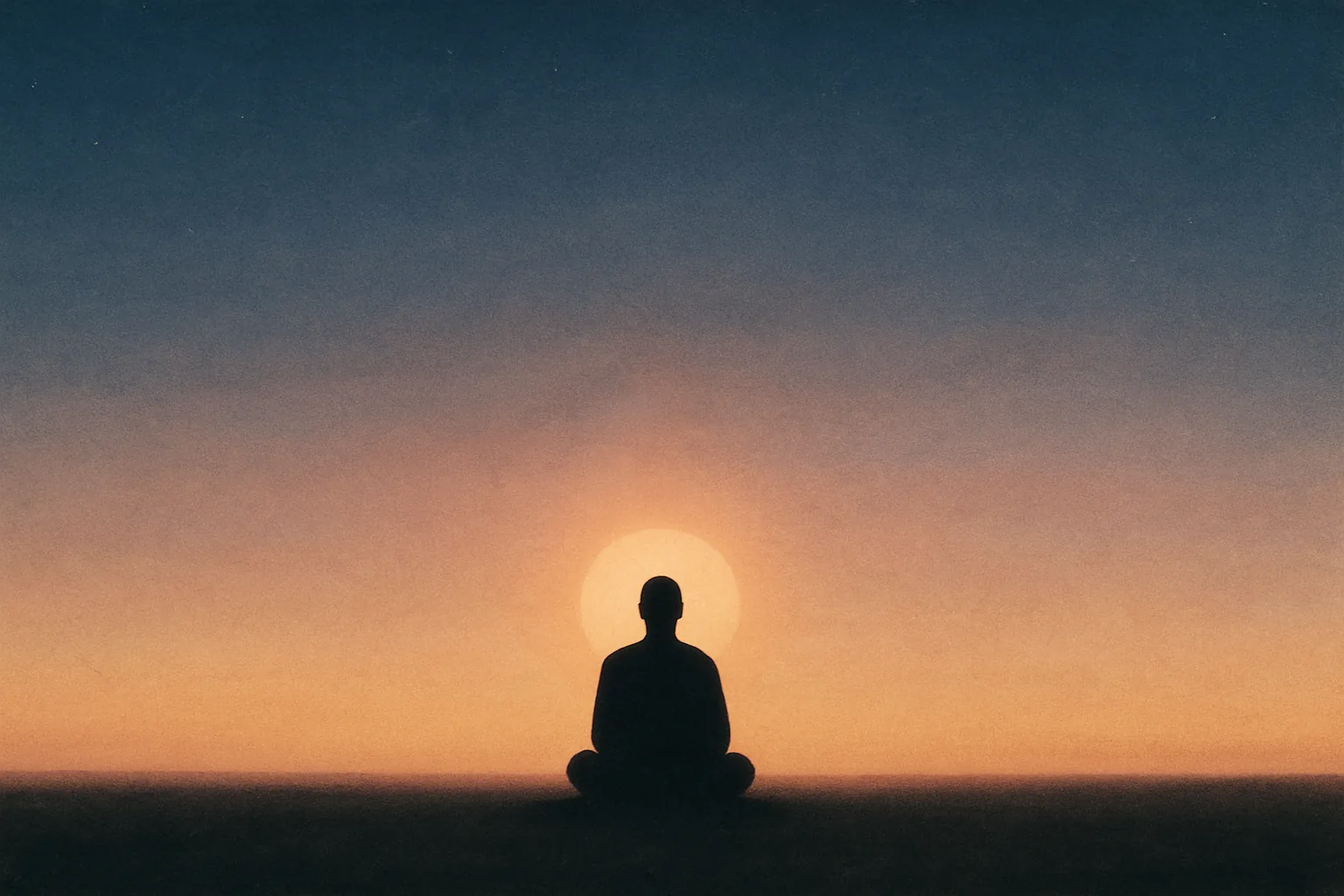
The Path of Witnessing is a silent, non-doing meditation distilled from Osho’s guidance on pure awareness. As you sit, a dense, heavy inner space may reveal itself. The essential insight of this method is to recognize the space without identifying with it—clearly sensing, "this is present in me, yet it is not me." No struggle, fixing, or judgment is invited. You cultivate a lucid, steady watchfulness and let the inner law unfold by itself.
In this approach—echoing Taoist non-action and the Zen spirit of effortless presence—awareness itself becomes luminous. You neither push the dark nor chase the light; you simply abide as the witness. When the gaze is clean and unforced, its inherent radiance naturally disperses the obscurity. The result is an unmanufactured quiet that deepens into trust, fearlessness, and a living taste of the inner temple.
Phase Instructions
First Stage: Arriving and the Intention of Non-Doing
Sit comfortably with the spine upright, shoulders relaxed, chin slightly tucked. Place hands easily on thighs or in the lap. Close the eyes or keep them half-open with a soft gaze. Let the breath find its own rhythm—do not regulate it. Set a clear inner resolve: for this session, nothing is to be fixed or improved. You will only watch. If the body needs a minor adjustment, make it slowly and return to stillness. Allow outer sounds to remain as they are, simply part of the field of noticing.
Second Stage: Watching the Dark Space from the Hilltop
Turn attention inward and become aware of any dark, heavy, or dense space within—maybe felt in the chest, belly, head, or as a vague inner atmosphere. Do not label it bad or try to remove it. Imagine you are seated on a silent hill, simply looking into a valley below where the density appears. You are the watcher on the height; the dark space is an object in your view. Let breath and sensations come and go. Thoughts may say, "this shouldn’t be here"—notice the thought as another passing cloud and return to bare seeing. Stay simple, quiet, and intact as the observer.
Third Stage: Purifying Awareness—Letting Light Emerge
Refine the quality of seeing by dropping every judgment, comparison, or goal. Any impulse to act on the inner space—soothe it, push it away, analyze it—is gently recognized and released. Allow awareness to become clear, steady, and clean of interference. Sense how pure noticing has a subtle brightness of its own—an unforced radiance. Do not try to brighten anything; feel how the simple presence of awareness begins to outshine the heaviness by itself. Rest here. If the dark grows or shifts, keep the same stance: open, effortless witnessing.
Fourth Stage: Actionless Abiding
Remain still and let the meditation deepen without intentional doing. If there is a feeling of being drawn inward—as if by a gentle magnetic pull—allow it completely. Do not manage the breath, posture, or mind; avoid all strategies. Whenever you notice trying, stop trying and return to knowing you are the seer, not the seen. Let the natural law operate: the more untampered the awareness, the more easily obscurity dissolves. Abide as the witness until a quiet, centered clarity becomes self-evident.
Fifth Stage: Integration and Return
In the last few minutes, feel the whole body, the room, and the contact points with the ground. Gently open the eyes if they were closed, keeping the same soft witnessing. Do not evaluate the session; resist the urge to measure progress or claim success. Carry a thread of this simple, non-interfering awareness into ordinary activity—walking, speaking, working—letting life move while you remain the clear, silent hill from which everything is seen.
Core Benefits
- Cultivates lucid, steady watchfulness
- Enhances pure awareness
- Develops a sense of inner trust and fearlessness
- Encourages effortless presence
- Facilitates a living taste of the inner temple
What Osho Said About This Technique
Drik swaroop awasthanam akshataha to be established in one's own witnessing nature is akshat -- the unpolished and unbroken rice used for the worship.
Breathe, be aware. And if you are trying to be aware of your breathing, you cannot think, because the mind cannot do two things simultaneously -- thinking and witnessing. The very phenomenon of witnessing is absolutely, diametrically opposite to thinking, so you cannot do both. Just as you cannot be both alive and dead, as you cannot be both asleep and awake, you cannot be both thinking and witnessing. Witness anything, and thinking will stop. Thinking comes in, and witnessing disappears. Witnessing is a passive awareness with no action inside. Awareness itself is not an action. One day Mulla Nasrudin was very much worried, in deep brooding. Anyone could look at his face and feel that he was lost somewhere in thoughts, very tense, in anguish. His wife became alarmed. She asked, "What are you doing, Nasrudin? What are you thinking? What is the problem? Why are you so worried?"…
The moment you witness something you become separate from it, you are the witness, the thing becomes an object -- the witnessed. If you are walking on the road, and you are also witnessing that you are walking -- not going along just like a robot, mechanical, everyday habit, the road is known, the legs know it, you can even walk with closed eyes. But walking with absolute alertness every step, every fall of a leaf, every ray of the sun, every bird flying in front of you, fully alert... slowly, slowly, you become aware that you are not the body that is walking, you are something inside which is witnessing. Once you have witnessed your body, you have got the knack of the method. Then you start witnessing your thoughts -- sitting silently, just watching the rush of thoughts, not interfering, not saying, "This is good. This is bad.
For years I am most of the time witnessing and I feel it like a disease. So is it that there are two kinds of witnessing and mine is wrong? Tell me.
And only then can the third step be taken, which will bring you close to what Gurdjieff calls self-remembering, or Krishnamurti calls awareness, or the Upanishads call witnessing. But first the two steps have to be fulfilled; then the third comes easy. Don't start doing the third immediately. First the object, then the consciousness, then the subject. Once the object is dropped and the emphasis on the consciousness is no longer a strain, the subject is there but there is no subjectivity in it. You are there but there is no "I" in it, just being. You are, but there is no feeling that "I am." That confinement of "I" has disappeared; only amness exists. That amness is divine. Drop the "I" and just be that amness. And if you have been working too long on witnessing, then for a few months, at least for three months, drop it completely,…
Osho said that there was no need to try to still the mind, to stop the thoughts. He said that just as the traffic goes by and one remains on the sidewalk, unaffected, just a watcher, so one should simply witness the thoughts as they went by. We are not our thoughts, and recognising that we are the witness is enough. The very acceptance of the thoughts makes one more relaxed. The relaxation helps to create a distance, to separate oneself. To evaluate a thought as good or bad means that you are attached to your thoughts -- so one should not put labels on them.] ... put yourself aside, sit under a tree, and just watch the traffic. Soon, one day, the traffic disappears and the road is empty. Suddenly there is an interval and in that interval is meditation. But that interval cannot be created or cultivated.
By knowing oneself as the individual witnessing self of the intellect, and all its moods, and cultivating such feelings as "I am that," one should renounce any identification with all things except the self. After ceasing to follow others, one should create a distance with one's own body. Then one should stop following scriptures and give up one's identification with the self also.
WHEN A YOGI IS ROOTED IN THE SELF, HIS MIND IS DESTROYED BY FOLLOWING RIGHT METHOD, RIGHT LISTENING, AND HIS FIRST HAND EXPERIENCE, AND BY SEEING OTHERS AS HIS OWN SELF. HE THEN, CONTEMPLATES THE SELF, INSIDE THE HEART, WITHOUT GIVING AN EAR TO WHAT PEOPLE SAY, WITHDRAWING HIS ATTENTION FROM THE OBJECTS OF THE SENSES: SOUND, TOUCH, SIGHT, TASTE AND SMELL COLLECTIVELY; AND HE DOES NOT GIVE IN TO SLEEP OR FORGETFULNESS OF THE SELF. The word "witnessing" is one of the most significant words, particularly in Eastern spiritual alchemy. This word is a key word. So we must understand what witnessing means. We act, we do something, and the moment we do it we become the doer -- you walk, you become the walker. But there is one more possibility -- to remain a witnesser, to remain a witness. Walk, eat, or do whatsoever; don't be identified with…
Common Questions
To recognize the inner space without identifying with it, sensing 'this is present in me, yet it is not me.'
With no struggle, fixing, or judgment; cultivate a lucid, steady watchfulness and let the inner law unfold by itself.
It echoes Taoist non-action and the Zen spirit of effortless presence.
Its inherent radiance naturally disperses the obscurity, leading to unmanufactured quiet.