
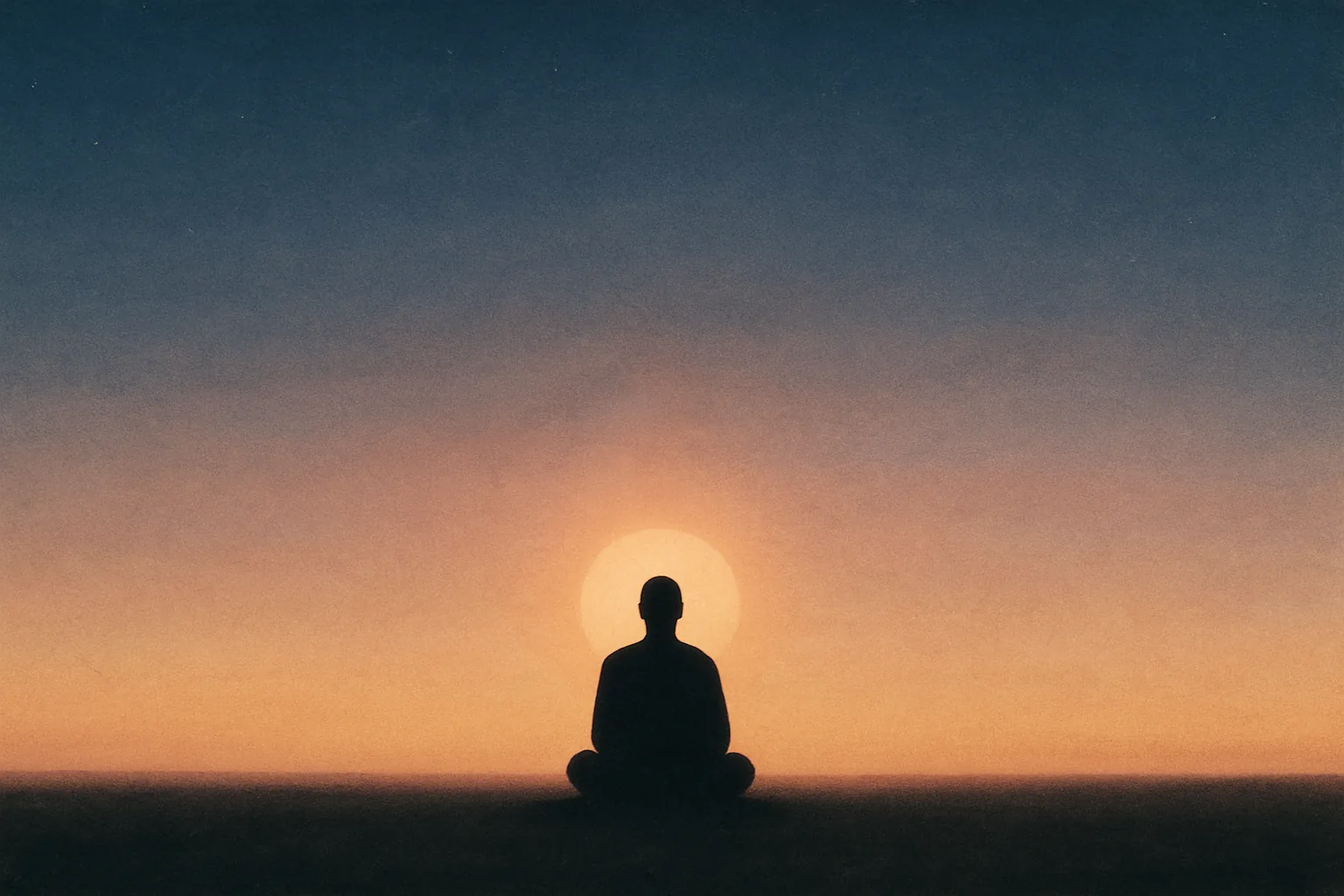
Satsang Darshan Meditation is rooted in the ancient Indian understanding that presence itself transforms. Rather than striving, explaining, or even "participating," this practice rests on synchronicity: when awareness is luminous, hearts open the way flowers open to the sun. In the classical language, satsang means “being with truth,” and darshan means “to behold.” Simply sitting in living silence becomes a university of meditation—no debate, no doctrine, only the fragrance of being.
This method invites you to become utterly receptive—open, humble, and nonresistant—so that the noise of questions fades without needing answers. Practiced in a commune setting or in quiet solitude, it asks nothing heroic: sit, soften your gaze or close the eyes, and allow the silent field to do the work. The more you stop trying, the more the heart recognizes an intimate music beyond words.
Phase Instructions
First Stage: Enter the Field of Silence (10 minutes)
Choose a quiet space. If you are with others, agree on shared silence; no speaking, no gestures. Sit comfortably with the spine at ease, hands resting on thighs or in the lap. Let the jaw and belly soften. Switch off devices. Make a simple inner resolve: for this entire hour, you will neither seek nor supply answers—only be present.
Second Stage: Satsang — Rest in Presence (25 minutes)
Close the eyes or keep them gently lowered. Breathe naturally and feel that breathing is happening by itself. Drop all inner commentary. Sense the space around you, as if a quiet, friendly atmosphere is holding you. Receive it. Do not try to meditate; let meditation happen. If thoughts or questions come, neither follow nor fight them; allow them to pass like birds crossing a bright sky. Soften the chest and the area between the eyebrows. Relax the shoulders. Feel a subtle showering of peace, as though silence is washing through you from all directions.
Third Stage: Darshan — Open, Nonverbal Seeing (15 minutes)
Gently open the eyes to a half-gaze. If you are in the presence of a teacher or a silent group, simply share the same space without seeking interaction. If alone, rest your gaze on empty space a few meters ahead—neutral, alive, not on a picture. Let the eyes be soft and unfixated, receiving rather than looking. Meet whatever is present—faces, air, light—as a wordless blessing. Feel warmth in the heart, quiet in the belly, spaciousness around the head. Allow questions to dissolve in this seeing; let understanding arrive as silence, not as conclusions.
Fourth Stage: Integration — Return Without Answers (10 minutes)
Close the eyes again. Sense the residue of stillness in body and breath. Notice if the mind is quieter, as though its questions have melted. Do not analyze the session. When ready, bring palms to the heart or make a small bow to the silence within and around you. Stand slowly. Keep outer silence for a few minutes after the meditation; avoid immediate discussion. Carry the fragrance of presence into simple actions—walking, drinking water, or meeting others—letting synchronicity, not effort, guide your steps.
Core Benefits
- Transforms presence through synchronicity.
- Opens the heart like flowers to the sun.
- Fosters a luminous awareness.
- Encourages receptivity and humility.
- Cultivates an intimate music beyond words.
What Osho Said About This Technique
We had sat for meditation. By meditation I mean a state of consciousness in which no distress, no question, no curiosity remains. We are continually asking something or other regarding the truth of life. It is hard to find a person who carries no curiosity about the truth of life. Neither do we have any knowledge of who we are, nor do we know what this world spread all around us is. We find ourselves in the midst of life without any answer, without any solution. Questions on every side—and in their midst man finds himself surrounded. Among these questions, some pertain to the very foundations of life. For example—why am I? Why does my being exist? What necessity is there for my existence? What inevitability? And then—who am I? And why this whole business of birth and death and life?
हम ध्यान के लिए बैठे थे। ध्यान से मेरा प्रयोजन है एक चित्त की ऐसी स्थिति जहां कोई संताप, जहां कोई प्रश्न, जहां कोई जिज्ञासा शेष न रह जाए। हम निरंतर जीवन-सत्य के संबंध में कुछ न कुछ पूछ रहे हैं। ऐसा मनुष्य खोजना कठिन है जो जीवन के सत्य के संबंध में किसी जिज्ञासा को न लिए हो। न तो हमें इस बात का कोई ज्ञान है कि हम कौन हैं, न हमें इस बात का कोई ज्ञान है कि हमारे चारों ओर जो जगत फैला है, वह क्या है। हम जीवन के बीच में अपने को पाते हैं बिना किसी उत्तर के, बिना किसी समाधान के। चारों तरफ प्रश्न हैं और उनके बीच में मनुष्य अपने को घिरा हुआ पाता है। इन प्रश्नों में कुछ तो अत्यंत जीवन की बुनियाद से संबंधित हैं। जैसे--मैं क्यों हूं? मेरी सत्ता क्यों है? मेरे होने की क्या आवश्यकता है? क्या अनिवार्यता है? और फिर मैं कौन हूं? और यह जन्म और मृत्यु और जीवन का यह सारा व्यापार क्यों है? यह जिज्ञासा, यह प्रश्न प्रत्येक व्यक्ति के मन में--चाहे वह किसी धर्म में पैदा हो, चाहे किसी देश में पैदा हो--उठता है।
Kailash has asked a question: Sannyas? A question mark attached—and then the buts and howevers.
Sannyas—then what place is there for “but” and “however”? “But” and “however” are a man’s tricks. Either yes or no—where do buts fit in? Either you feel something is right and you do it, or you don’t feel it is right and you don’t do it. But man is dishonest. He wants to persuade himself: “The thing does seem right to me; I am so intelligent—how could it not seem right? Only, the circumstances aren’t suitable yet for me to take sannyas.” So he tacks on a but. Understand: whenever someone adds a “but,” politics has entered. “But–however” is the language of politics. The language of religion is straight and clear—yes or no. People are afraid of the company of a saint; they are frightened. They find many excuses. But they don’t want to look at the real thing. The real thing is one fear: “If I go there, I…
So my sannyas can be reduced to a simple definition: non-identification with any role you are playing, whatsoever it is. One can be a doctor or a businessman, one can be an engineer or a painter -- whatsoever role you are playing, remember it is a play. Don't get serious about it. Success and failure are the same when it is a play. Whether you succeed or fail does not matter; what matters is that you remained alert all the time. Success comes, you watch it; failure comes, you watch it. Life is there, you watch it; death comes, you watch it. Your whole work is to remain a witness to all that happens around you, within and without. This is the foundation for my sannyas. And the second thing to remember is: this witnessing is possible only if you slowly move into meditation.
Yes, there will be a few people who will have to follow the door of truth, which is a desert path, but for a few people the desert is beautiful; it also has its own beauty. It depends on the person and his inner structure. Bet out of one hundred sannyasins ninety will find the door of beauty the closest to their heart. Satsang is a very specific word. It is almost impossible to translate it, but the flavour can be transmitted. Satsang means the miracle that transpires between the disciple and the master. Something does transpire; what it is exactly is indefinable. The disciple sits in silence with the master and the master is already absolutely silent; the master has nothing to say because the truth cannot be uttered, and the disciple has nothing to ask because whatsoever can be asked cannot be significant.
In the beginning you will find only darkness or absurd, irrelevant thoughts, dreams floating here and there. It will look like a chaos but go on watching, go on looking. We are not worried about what you are seeing. Our whole effort is to see. Remember, the emphasis is on seeing, not on the seen, so it does not matter what you see. Thoughts, desires, memories, dreams -- it doesn't matter what you are seeing. Everything is just an opportunity to make the inner eye function. So remember the emphasis otherwise people become tired; they think 'What is the point? We don't see any light, we don't see god, we don't see the soul we don't see this, we don't see that. Just ordinary thoughts are there so what is the point? They have missed the whole message.
Common Questions
No, just sit and allow the silent field to work.
It can be practiced in a commune setting or in quiet solitude.
You can soften your gaze or close your eyes.
No, it's about stopping trying and being receptive.
No, it focuses on the fragrance of being rather than debate or doctrine.