
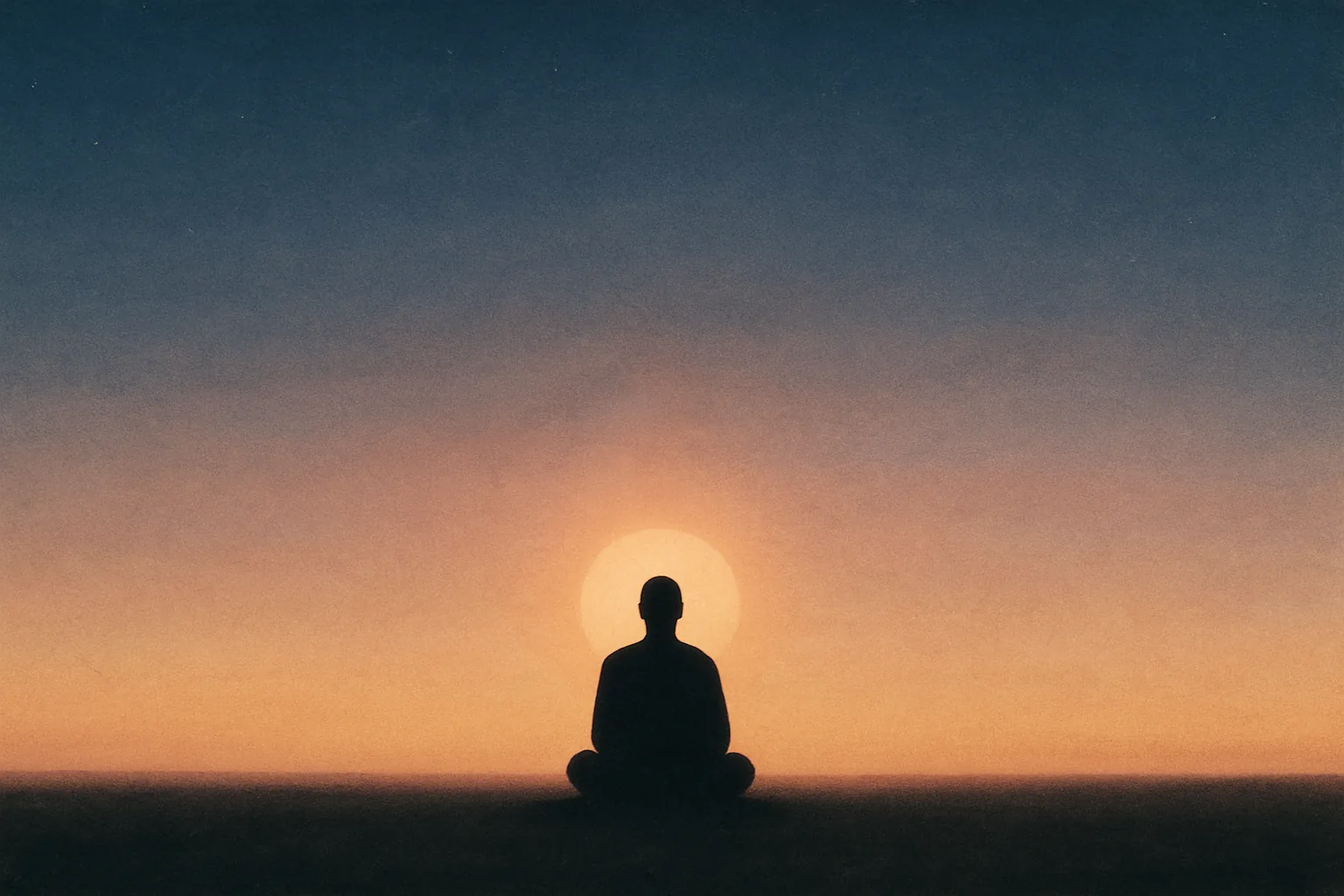
This meditation distills the essence spoken of in Osho’s reflections on Nietzsche: to gaze into emptiness, nothingness—into the abyss—until the abyss also gazes into you. Rather than fighting with the mind’s monsters, you relax the fighter, soften all effort, and look into the vast, silent space that is always here. In this looking, the habitual stance of doing gives way to effortless seeing; witnessing replaces struggle.
Rooted in Tantra’s embrace of totality, this practice uses a soft, unforced gaze into open space (a blank wall, a dark room, the night sky) to invite a felt sense of boundlessness. As the meditation deepens, the direction reverses: instead of you looking at space, you allow space to look through you. Subject and object begin to dissolve, leaving a luminous, choiceless awareness—simple, intimate, and free of the need to become anything.
Phase Instructions
First Stage: Arriving and Softening (5 minutes)
Choose a quiet place with minimal distractions. Dim the light so the field before you feels spacious—facing a blank wall, an open corner, or gentle darkness. Sit comfortably with the spine naturally upright, shoulders relaxed, hands resting on thighs or in the lap. Let the jaw unclench and the belly soften. Breathe through the nose and let the breath find its own rhythm. Set a simple intention: no fighting, no fixing, only seeing. Keep the eyes softly open or half-open with an unfocused, gentle gaze into the empty space ahead.
Second Stage: Gazing into the Abyss (15 minutes)
Let your gaze rest on emptiness itself—on the unfilled space rather than any object. Do not stare; allow natural blinking and keep the eyes tender, like looking into a great distance. Feel the breath as a quiet tide while your attention falls open into the vastness before you. When thoughts, feelings, or inner images arise, neither follow nor fight them. Notice the impulse to struggle and relax it on the exhale. If the body tightens, soften the belly and widen the peripheral vision. Let looking be effortless, as if space is inviting you forward. You are not seeking experiences; you are simply present to the sheer, edgeless openness.
Third Stage: Let the Abyss Gaze Back (15 minutes)
Without moving the eyes much, quietly reverse the sense of direction. Instead of you looking at space, feel that the vast space is looking into you. Allow yourself to be seen, breathed, and held by this boundlessness. Let the boundary of your skin feel porous; allow sounds, sensations, and breath to arise within the same open field. If fear or awe appears, acknowledge it and keep softening—down through the pelvis, through the feet, into the ground—while remaining available to being seen. Rest as transparent presence: the seer and the seen are not-two.
Fourth Stage: Dissolving and Resting (10 minutes)
Gently let the eyelids close while keeping the sense of vastness inside and all around. Do nothing at all—no technique now. Let breathing happen by itself. Notice any afterglow of spaciousness and allow it to pervade the whole body-mind. Thoughts can pass like birds through the sky; sensations can ripple without needing commentary. If attention narrows, softly expand it to include the whole field again. End by feeling the contact of your body with the seat and the ground. Carry the taste of openness into your next movements, without losing the simplicity of witnessing.
Core Benefits
- Relaxes the fighter within and softens all effort.
- Facilitates witnessing instead of struggling.
- Encourages the dissolution of subject and object.
- Invites a felt sense of boundlessness and vast, silent space.
- Cultivates a luminous, choiceless awareness free from the need to become anything.
What Osho Said About This Technique
What is the difference between gazing at an open clear sky, gazing at an enlightened master's photo, and gazing at the darkness?
The technique of gazing is not concerned really with the object; it is concerned with gazing itself. Because when you stare without blinking your eyes, you become focused, and the nature of the mind is to be constantly moving. If you are really gazing, not moving at all, the mind is bound to be in a difficulty. The nature of the mind is to move from one object to another, to move constantly. If you are gazing at darkness or at light or at something else, if you are really gazing, the movement of the mind stops. Because if the mind goes on moving, your gaze will not be there; you will go on missing the object. When the mind has moved somewhere else, you will forget, you will not be able to remember what you were looking at. The object will be there physically, but for you it will…
For example, it brings you the experience that not the body, so clearly, so solidly, so categorically, that even if the whole world denies it, it cannot make any difference: you know from your innermost core you are not the body. It brings you the experience that you are not the mind either. And the moment you know you are neither the body nor the mind, suddenly a door opens. You have never been born and you are never going to die because only that which is born can die. The body was born, the mind was born -- they will die -- but you were before your birth and you will be after your death. Once this reality is revealed to you all fears and all miseries disappear. You become part of eternity. Only one thing remains and that is pure consciousness. And pure consciousness is nothing but godliness.
In summer when you see the entire sky endlessly clear enter such clarity. Shakti,
SEE ALL SPACE AS IF ALREADY ABSORBED IN YOUR OWN HEAD IN THE BRILLIANCE. WAKING, SLEEPING, DREAMING, KNOW YOU AS LIGHT. ... First try your imagination with small things: just that the body has become bigger or has become smaller. You can go both the ways. You are five feet six: feel you have become four feet, three feet, two feet, one foot; you have become just a seed. This is just a training; just a training so that you can feel whatsoever you want to feel. Your inner mind is absolutely free to feel; nothing can hinder it from feeling anything. It is your feeling. You can grow and you can be small. Suddenly you become aware that it is you. And if you can work well through this, you can come out of your body very easily. If you can grow and become small through imagination, you are capable
Common Questions
A soft, unforced gaze into open space, such as a blank wall or the night sky.
Rather than fighting them, it relaxes the fighter and facilitates effortless seeing.
The habitual stance of doing gives way to effortless seeing, and witnessing replaces struggle.
It dissolves the separation between subject and object, leading to luminous, choiceless awareness.