
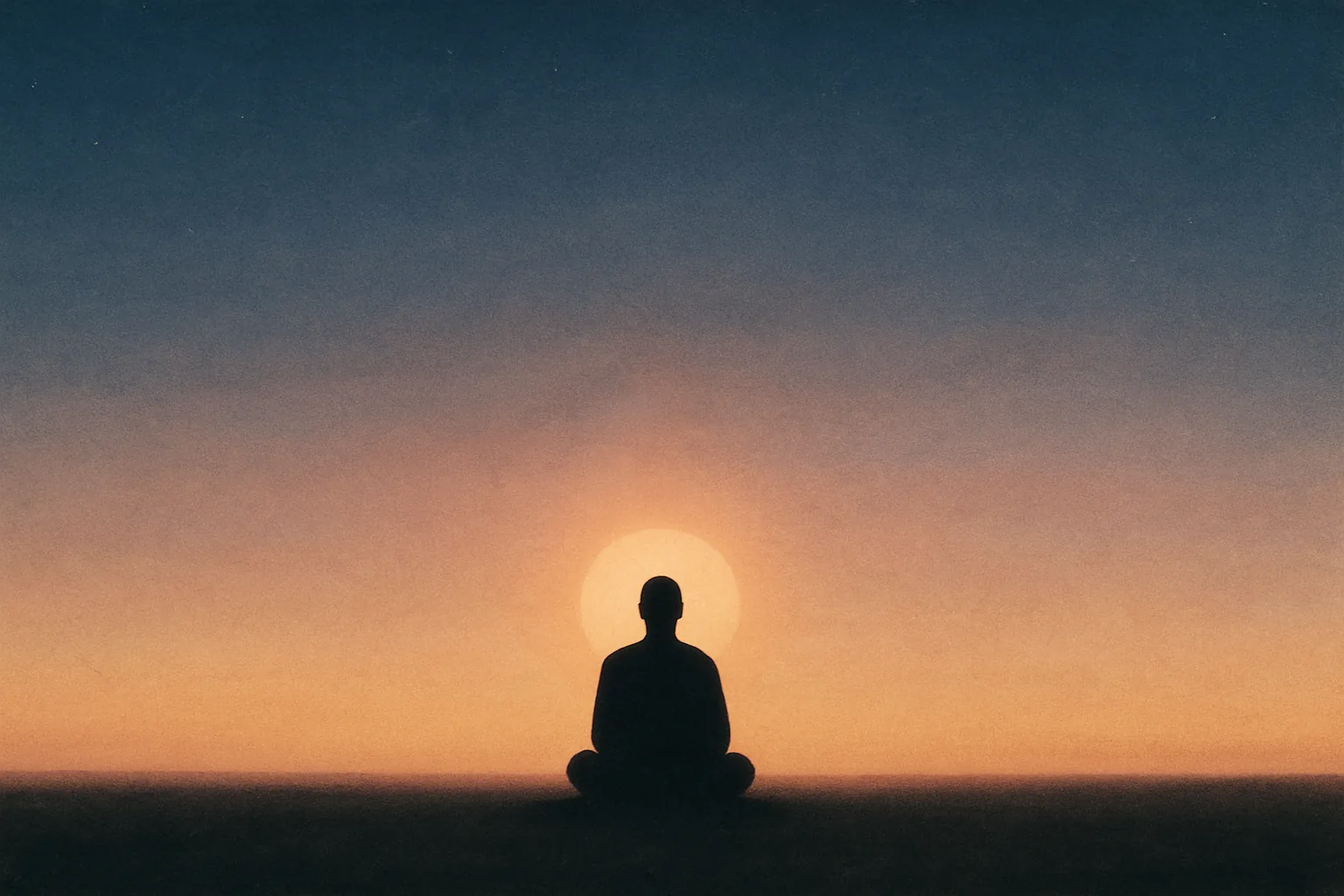
Bypassing the Mind is a direct, experiential passage from the noise of thought to the clarity of being. Rather than repairing the mind or arguing with it, this practice places the mind back in its rightful role as servant, not master, and lets awareness rest in that which is prior to thought. In the spirit of Osho’s guidance, it turns away from analysis toward silent witnessing, allowing the chattering mechanism to settle until the still, small current of your own being is unmistakably felt.
Rooted in the Tantric understanding that a human life unfolds in three layers—body, mind, and being—this meditation gently traverses each layer. You first befriend the body, then witness the mind as a passing play, and finally relax into no-mind: the open, wordless space where presence shines on its own. The result is not a belief or conclusion, but a taste of inner wholeness that therapy cannot confer and logic cannot reach.
Phase Instructions
First Stage: Ground the Body (10 minutes)
Sit comfortably with a straight yet unforced spine; eyes relaxed (closed or half-closed). Place both feet on the ground if on a chair, or sit cross-legged with your base steady. Take 5 slow breaths in through the nose and out through the mouth, then let the breath become natural. Scan the body from the soles of the feet to the crown: soften toes, calves, thighs, belly, chest, shoulders, jaw, eyes, and the small muscles of the face. Feel the simple fact of being embodied—weight, warmth, contact with the floor or cushion. Let the body be the anchor; do not try to control the mind yet.
Second Stage: Watch the Mind as a Mechanism (15 minutes)
Keep the body still and the breath natural. Turn attention to thoughts as they appear. Do not follow, fight, or finish any thought. See each one as a cloud crossing the sky or text scrolling on a screen. When you notice you are inside a thought, softly label it "thinking" and return to simple awareness. Include all mind-activity—images, memories, plans, inner talk—as equal weather passing through. Feel the silent space in which thoughts arise; you are the space, not the clouds.
Third Stage: Shift from Head to Heart (15 minutes)
Gently rest attention in the center of the chest (heart area), not anatomically but as a felt space of warmth and openness. Let the breath move itself. Sense the quiet aliveness behind everything—before words, before conclusions. If thoughts appear, notice the gap before and after each thought; favor the gap. Let this felt sense of "I am"—bare presence without story—be enough. No analysis, no evaluation; only intimacy with being.
Fourth Stage: Enter No-Mind (10 minutes)
Now drop even the method. Do not watch, do not label—simply be. The body is unmoving, the breath effortless. If a thought arises, let it pass without owner or commentary. Abide as clear, wordless awareness. Taste how everything appears within you and dissolves back into you. Nothing to do, nowhere to go—just the radiance of presence.
Fifth Stage: Reorient and Carry the Witness (10 minutes)
Deepen the breath slightly. Feel the room, sounds, and the support beneath you. Rub the palms, place them lightly over the eyes, then open the eyes into the warmth. Move the body gently. As you stand or walk, keep 10–20% of attention resting in the heart-space or in the sense of being. Let the mind resume its functions, but as a servant: clear, practical, and quiet. Through the day, return to the felt gap between thoughts whenever you remember.
Core Benefits
- Experiential passage from noise of thought to clarity of being
- Places mind back in its rightful role as servant
- Allowance for awareness to rest prior to thought
- Encourages silent witnessing
- Results in a taste of inner wholeness
What Osho Said About This Technique
For example, it brings you the experience that not the body, so clearly, so solidly, so categorically, that even if the whole world denies it, it cannot make any difference: you know from your innermost core you are not the body. It brings you the experience that you are not the mind either. And the moment you know you are neither the body nor the mind, suddenly a door opens. You have never been born and you are never going to die because only that which is born can die. The body was born, the mind was born -- they will die -- but you were before your birth and you will be after your death. Once this reality is revealed to you all fears and all miseries disappear. You become part of eternity. Only one thing remains and that is pure consciousness. And pure consciousness is nothing but godliness.
In 1969 followers of the Maharishi Mahesh Yogi invited Osho to talk to them. This was the first occasion on which Osho addressed a western audience, and the first time he talked publicly at length in English. The discourse has been published in OTI January 1 & 16, 1991; and February 1, 1991. Osho: Really, there can be no method as far as meditation is concerned. Meditation is not a method. Through technique, through method, you cannot go beyond mind. When you leave all methods, all techniques, you transcend mind. So meditation itself is not a method. Truth cannot be achieved through method. Method is our own invention. We, who are ignorant, have achieved knowledge through methods constructed, created, projected, in our ignorance. Through method you can achieve a sort of self-hypnosis, a sort of auto-hypnosis. Any method, whatsoever it's name, can only give you an illusory kind of peace.
Mind is a hoarder of bitterness. It collects sounds, hurts, insults. It goes on sulking over them for years. Psychologists are very aware of the fact that something said when you were only four years old may have hurt you so much that it is still there like a wound, still oozing pus. You don't allow it to be healed. You go on fingering the wound so you make it hurt again and again, again and again you create it, never giving it an opportunity to be healed by itself. If we look at our mind, it is nothing but wounds and wounds. Hence life becomes a hell; we collect only thorns. A man may have been loving to you for years, he may have been compassionate, kind and everything, and he says just one thing which hurts you, and years of love and friendship disappear.
We are not the body and we are not the mind either. Mind is also part of the body. The visible part is called body, the invisible part is called mind. It is a psychosomatic mechanism and we are the witness of it. We are in it but we are not it. This is the greatest experience. Once it has happened your life goes through a radical change. Then you are never the same again. It is a breakthrough. The whole effort here is to bring this breakthrough closer and closer. Every support, every technique and device is provided for this breakthrough so that you can see yourself as a witness of it all, as pure consciousness. To know oneself as pure consciousness is to be free of all bondage. It is to be free of birth and death, it is to be free of time.
Common Questions
The primary focus is on shifting from the noise of thoughts to clarity of being through silent witnessing.
The meditation places the mind back in its role as a servant, allowing awareness to rest in what is prior to thought.
This meditation traverses the layers of body, mind, and being.
The outcome is an experiential taste of inner wholeness that goes beyond therapy or logic.