
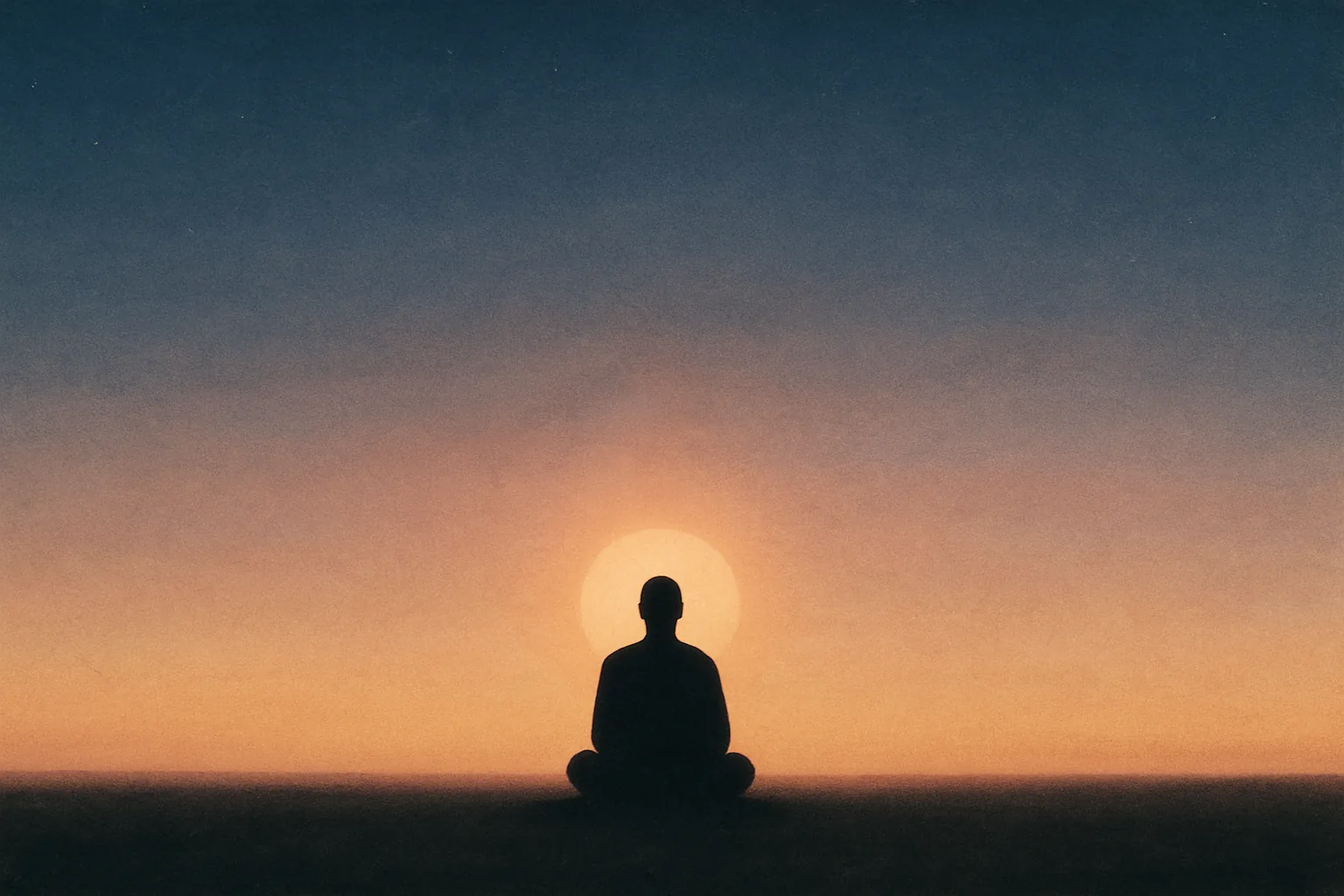
Chaotic Dynamic Meditation was introduced by Osho in April 1970 as a cathartic, energy-awakening method grounded in the ancient Tantric and Upanishadic insight that tension, brought to its peak, naturally collapses into effortless relaxation. Unlike purely quietist approaches, this method first amplifies breath and bodily energy, allowing latent forces to surge, express, and reorganize themselves. Through deep, vigorous breathing, unedited emotional release, a relentless inner inquiry of "Who am I?", and finally complete stillness, the practice invites a plunge from the summit of effort into the abyss of rest.
Refined through Osho’s early camps (including Nargol) and aligned with his dynamic, poetic style, the technique is both fiercely practical and profoundly transformative. It asks you to become a "breathing machine," to let the body cry, shake, whirl, dance, and assume spontaneous mudras without interference, all while remaining a clear witness. At its crescendo, self-inquiry saturates each breath, and in the last stage everything is dropped—no method, no question—only total rest and listening: the sea’s roar, wind through pines, a bird’s call. The meditation aims to awaken kundalini energy and convert accumulated tension into spacious awareness.
Phase Instructions
First Stage: Ten Minutes of Deep Breathing
Preparation: Stand or sit apart with ample space so no one touches or falls onto another; no talking or chit-chat. Choose a comfortable standing, sitting, or lying posture and close your eyes. Begin breathing as deeply as possible—inhale to your fullest, exhale to your fullest. Put total energy into both the in-breath and the out-breath, continuously and vigorously, like a bellows. Let every fiber of your body vibrate with breathing. Become a breathing machine—only breath going in and breath going out—for the full ten minutes. Simultaneously, remain a witness: keep inner watch on the breath entering and leaving. Bring all attention and energy to breathing alone.
Second Stage: Ten Minutes of Catharsis
Keep the deep, vigorous breathing going and completely let go of the body. Allow anything that arises to express itself: if tears come, let them flow; if hands or feet tremble, let them; if the body shakes, moves, whirls, rises to dance, or rolls on the ground, allow it. If postures and gestures appear spontaneously (asanas and mudras), let them form. Do not resist, hesitate, or think of others; do not interfere in any way. Keep witnessing while you breathe deeply. Give your whole energy to the breathing and to non-interference. In the last one to two minutes, intensify—bring it to a climax—so the energy ascends and expresses fully before the next stage.
Third Stage: Ten Minutes of Relentless Self-Inquiry
Continue the deep, fast breathing and allow the body’s movements to proceed on their own. Now saturate each breath with a single inner question: "Who am I? Who am I? Who am I?" Ask inwardly without interruption or gaps, letting the inquiry reverberate through your whole being. Pour in all your strength and energy—ask madly, totally, with no holding back—while remaining a witness to breath and bodily expression. Keep the breathing vigorous, keep the body free, and keep the question continuous for the full ten minutes. Exert to the maximum; then everything will drop in the next stage.
Fourth Stage: Ten Minutes of Total Rest
Now stop every effort. No deep breathing, no questioning. Simply lie down and remain utterly still, as if you are dead, as if you do not exist. Drop everything and rest. Do nothing at all—only wait in silence. Let sounds come and go: listen to the sea’s roar, the wind passing through pines, a bird calling. For these ten minutes be relaxed, effortless, and absent. At the end, open your eyes slowly; if they do not open easily, gently cover them with your palms and then open them.
Core Benefits
- Encourages cathartic release of emotions.
- Facilitates awakening of kundalini energy.
- Transforms accumulated tension into spacious awareness.
- Allows for profound inner inquiry and self-discovery.
- Promotes transition from intense effort to deep relaxation.
What Osho Said About This Technique
What is dynamic meditation?
The first thing to be understood about Dynamic Meditation is that it is a method of creating a situation through tension in which meditation can happen. If your total being is completely tense, the only possibility that remains is relaxation. Ordinarily one cannot go directly into relaxation, but if your whole being is at a peak of total tension then the second step comes automatically, spontaneously: silence is created. The first three stages of the technique are done in order to achieve this climax of tension throughout all the layers of your being. The first layer is the physical body. Beyond that is the prana sharir, the vital body: this is your second body, the etheric body. Beyond it is the third body, the astral body. Your vital body takes in breath as its food. If the normal intake of oxygen is changed, the vital body is bound to change.…
Question: in hatha yoga there is an exercise in which one tenses every muscle in the body and then releases the tension and becomes relaxed. Is this similar to what happens in dynamic meditation?
You are not aware of the spiritual because you have so much tension in the body, so much tension in the mind. But if you are not tense in the physical and mental realms, you will automatically know the bliss of the spiritual, the relaxation of the spiritual. It comes to you; it has been waiting for you. Your whole attention is so absorbed by the physical and the mental that there is no attention left to divert to the spiritual. Only if the body and the mind are not tense can you delve into the spiritual, can you know the bliss of it. The spiritual is never tense; it cannot be. There is no spiritual tension, only bodily tension, only mental tension. Bodily tension has been created by those who, in the name of religion, have been preaching anti-body attitudes. In the West, Christianity has been emphatically antagonistic toward…
Osho: No, no, not at their expense. Tell them about this method. They themselves will feel it. They will certainly feel the change, the transformation. Let them practise it--just as an experiment with their disturbed mind, their doubts. Let them experiment, just as an experiment. If 'something' happens, then the practice goes by itself. There is no need to convince them. And, the anarchy that is within must be exploded. It should not be stilled or cramped down. It must be expressed in total intensity. The calmness, the serenity, the Nirvana comes not by stilling the mind but by explosion. Then the stillness comes but it is not a cultivated composure. Express what you are, totally. Of course that means madness, because we are mad. So, if you express it, the madness will come out. Even you yourself will feel strange about it, unknown to yourself.
Question: dynamic meditation is very active, very strenuous.can one not go into meditation just by sitting silently?
You can go into meditation just by sitting, but then be just sitting; do not do anything else. If you can be just sitting, it becomes meditation. Be completely in the sitting; nonmovement should be your only movement. In fact, the word zen comes from the word zazen, which means, just sitting, doing nothing. If you can just sit, doing nothing with your body and nothing with your mind, it becomes meditation; but it is difficult. You can sit very easily when you are doing something else but the moment you are just sitting and doing nothing, it becomes a problem. Every fiber of the body begins to move inside; every vein, every muscle, begins to move. You will begin to feel a subtle trembling; you will be aware of many points in the body of which you have never been aware before. And the more you try to just…
The state in which the soul, with the help of the energies of the sun and other gods, and through the instrumentality of these fourteen: mind, intellect, mind stuff, ego, and the ten sense organs -- becomes sensitive to sound, touch and such other gross objects, is called the waking state. When the living being, on account of the unfulfilled desires of the waking state, becomes sensitive to sound, touch and such other gross objects -- even in the absence of the latter -- it is called the dreaming state of the self or soul.
This state of dreaming, the rishi says, means without the instrumentality of your senses. The senses are closed -- they are not aware of the world beyond you; now you are within your cells, within your body, but still you can create you own worlds. This creation of your own worlds in dreams becomes possible because your mind is a conditioning of everything you have known, you have felt; everything has been accumulated in it. It is an accumulation, not only of this life, but of all the lives one has lived; and not only of human lives, of animal lives also; and not only of animal lives, but of vegetable lives also. So in a dream you can become a tree; in a dream you can become a lion. Sometime you have been a tree: that memory is still there -- it can unfold. This unfolding of past memories,…
Common Questions
The core purpose is to awaken energy and transform tension into relaxation through breath, movement, and self-inquiry.
Deep, vigorous breathing is used to amplify bodily energy and support unedited emotional release.
In the final stage, drop all methods and questions to enter total rest and listen to the natural sounds around you.
While intense, beginners can practice it by following each stage's guidance carefully, allowing expression without judgment.
Self-inquiry saturates each breath, facilitating a deeper understanding of 'Who am I?' and enhancing the meditative experience.