
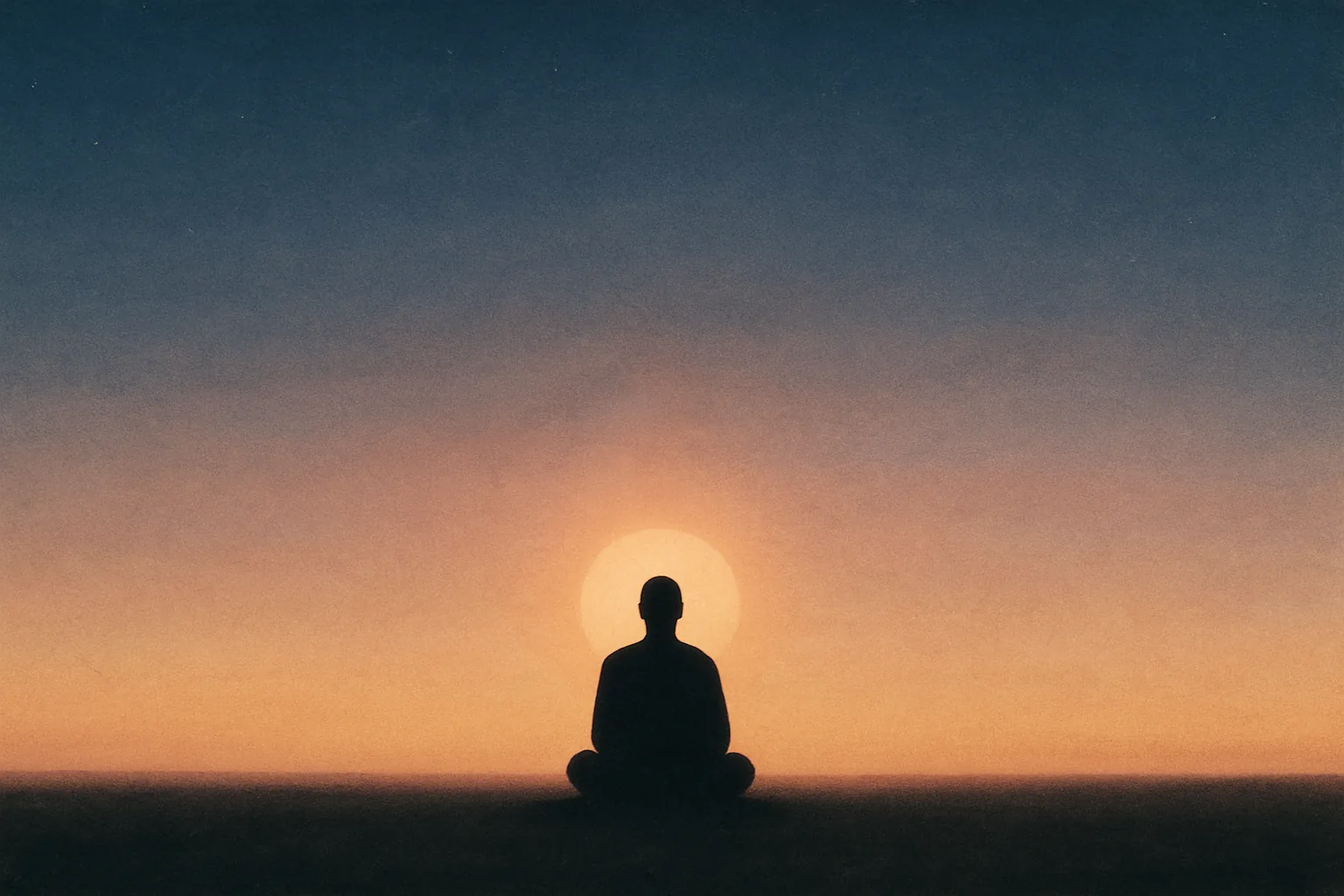
Start With Meditation distills Osho’s guidance through the Zen fragrance of Lin Chi: begin in innocence, learn conscious effort, then let effort dissolve into effortless awareness. Lin Chi’s final teaching—“Just listen”—is not a slogan but an instruction: allow the ordinary to be utterly sacred, the small and the great to carry the same weightless importance. From this equal-hearted listening, silence deepens, serenity ripens, and sensitivity becomes a natural way of being.
This practice invites you to drop borrowed ideas and meet life directly, to steady the flame of attention, and then relax into choiceless awareness where every sound, sensation, and breath is received without preference. What flowers in meditation—silence, blissfulness, sensitivity—is then consciously shared in daily life, so the inner fragrance beautifies the world. Begin simply. Let existence be a joyful dance. Share what grows. And discover the deathless ease of saying goodbye without sadness—only with the clarity of one who has truly listened.
Phase Instructions
First Stage: Begin Innocent
Sit comfortably with an alert, relaxed spine. Soften your gaze or close your eyes. Take a few natural breaths and feel the body settle. On each out-breath, let go of borrowed ideas and secondhand conclusions—imagine placing all opinions, roles, and shoulds outside the room. Sense a childlike freshness arriving. Keep the body unforced, the face soft, and the heart available to simple joy.
Second Stage: Learn Effort
Bring deliberate attention to the breath. Feel the whole arc of one inhalation and one exhalation. When the mind wanders, return without complaint. Let attention be clear but kind, like a steady flame in a windless room. You are learning effort: intentional, uncomplicated, consistent. Stay with the living rhythm of breath, moment to moment, until attention grows bright and stable.
Third Stage: Just Listen (Effortlessness)
Now release the focus on breath and open into choiceless awareness. Simply listen. Let sounds arrive from near and far—the hum of a fan, a birdcall, footsteps, even the faintest rustle—each received as equally important. Allow sensations, feelings, and thoughts to appear and pass without ranking them as trivial or profound. Do not chase meaning; do not resist anything. Rest as the listening itself. Let effort quietly melt into effortless presence.
Fourth Stage: Equal-Hearted Living
Gently open your eyes. Bring the same unprejudiced listening into small movements. Stand, walk a few slow steps, or sip water. Treat every action—rising, walking, touching a doorknob—as carrying the same sacred weight. Let inner silence move outward as simplicity and grace. Feel life as a joyful dance where nothing is excluded.
Fifth Stage: Share and Seal
Name one quality that arose—silence, serenity, blissfulness, or sensitivity. Choose one immediate, concrete way to share it today: a patient conversation, a kind message, a beautiful gesture. Offer it without display; what is shared grows. To close, whisper a gentle “goodbye” to the session, sensing the ease of letting go without sadness. Carry the fragrance into the day; leave the world a little happier, more beautiful, more fragrant than you found it.
Core Benefits
- Deepens silence
- Ripens serenity
- Enhances sensitivity
- Encourages effortless awareness
- Beautifies the world through inner transformation
What Osho Said About This Technique
Just a small flower, a grass flower and it opens doors to mysteries - it awakens great wonders in you. Small things of life start turning into something extraordinary and sacred, once you have the mirror of innocence to reflect them. Meditation can be reduced to a single word: innocence, a state of not-knowing. Don't be a Hindu, don't be a Christian, don't be a Mohammedan, don't be a communist, a fascist, a socialist; just be innocent, childlike, someone who knows nothing. In that not-knowing real knowing becomes possible. In that not-knowing wisdom happens. Wisdom is not information, it is transformation. You become new, you are born anew. It is a resurrection. The old dies, and each moment the old goes on dying and each moment the new goes on being born, life becomes such an alive phenomenon that each moment the dead simply is dropped, and the new asserts.
Osho, what is the first experience of samadhi like?
You will know only when it happens. It cannot be said; at most a few hints can be given. It is as if, in the dark, a lamp is suddenly lit. Or as if a dying patient, right at the edge of death, suddenly finds a medicine that works; life’s wave, life’s thrill spreads again—so it is. As if a corpse becomes alive—such is the first experience of samadhi. It is the taste of nectar. The experience of the ultimate music. But it will be only when it happens; and only then will you understand. You will not understand by my saying it. It is as with love. How can anyone explain it? To someone who has never loved, never known love, no matter how many explanations you offer—he will hear it all and still ask, “I haven’t understood; please explain a little more.” It is like explaining light to…
तीसरा प्रश्न: ओशो, समाधि का पहला अनुभव कैसा होता है?
होगा तो ही जानोगे। कहा जा सके, ऐसा नहीं है। कुछ-कुछ इशारे किये जा सकते हैं। जैसे अंधेरे में अचानक दीया जल जाये, ऐसा होता है। या जैसे बीमार मरता हो और अचानक कोई दवा लग जाये...मरते-मरते कोई दवा लग जाये; और जीवन की लहर, जीवन की पुलक फिर फैल जाये--ऐसा होता है। जैसे कोई मुर्दा जिंदा हो जाये--ऐसा होता है समाधि का पहला अनुभव। अमृत का अनुभव है। परम संगीत का अनुभव है। पर होगा तो ही होगा। और होगा तो ही तुम समझ पाओगे; मेरे कहने से समझ में न आ सकेगा। प्रेम में जैसा होता है। अब कोई किसी को कैसे समझाये? …
Osho, for many years I have been making continuous efforts—nothing happened. I did this, I did that—nothing happened. But yesterday, when I simply sat holding awareness, I was astonished: What was that? What happened was beyond my imagination.
It will be; it is bound to be beyond imagination. You don’t even know—what will happen is utterly unknown and unknowable. You cannot make any expectation of it; you have no idea what it will be. What will happen in meditation cannot be said in advance, nor can it be imagined. What happens is unprecedented. It has never been known before. It is totally unknown, utterly unknowable. It will happen only when this entire known mind of yours becomes utterly quiet. And it will become quiet. Awareness stills the mind. When the mind becomes still, meditation descends. Meditation is not something you do; it descends. It surrounds you. Meditation is a state outside the mind-field. Meditation is the very nature of the soul. As soon as the mind-field is quiet, meditation begins to spread. So, very quietly, very effortlessly, without any tension, in silence; everyone sit with a little space…
ओशो, बहुत वर्षों के बाद निरंतर उपाय किए हैं, कुछ नहीं हुआ। यह किया है, वह किया है, कुछ नहीं हुआ। लेकिन कल जब मैं सिर्फ बोध को साध कर बैठा, तो हैरान हो गया कि यह क्या हुआ? यह मेरी कल्पना के बाहर था जो हुआ।
… उसका आपको कोई पता ही नहीं कि क्या होगा। ध्यान में क्या होगा, इसका कुछ नहीं कह सकते आप। न कोई कल्पना कर सकते हैं। जो होगा वह अपूर्व है। वह कभी न जाना हुआ है। वह बिलकुल अननोन है, वह बिलकुल अज्ञात है। वह होगा तभी जब आपका यह सारा ज्ञात मन एकदम शांत हो जाए। और यह शांत हो जाएगा। बोध से मन शांत होता है। शांत होने से ध्यान का अवतरण होता है। ध्यान कोई आप नहीं करते, ध्यान उतरता है। ध्यान आपको घेर लेता है। ध्यान आपके चित्त के बाहर की स्थिति है। ध्यान आत्मा का स्वभाव है। जैसे ही चित्त शांत होता है ध्यान फैलने लगता है।
So those who think that meditation will happen just by sitting for ten minutes, fifteen minutes in the morning, fifteen minutes in the evening... and you will know what transcendental meditation is - are simply fools. All that you can learn from those fifteen minutes is a certain technique of falling asleep. Nothing is wrong with falling asleep. If you enjoy it, it is perfectly good, but don't mistake it for meditation. All kinds of chanting, all kinds of mantras are nothing but lullabies; they create a deep, auto-hypnotic state. Repeating a certain word constantly - you fall into a certain state of trance which is not meditation. Meditation means awareness. Meditation is not a trance. It is not auto-hypnosis; it is just the opposite of it. It means silence, but fully alert. It means a state of no-mind. There is no chanting, no chanter.
When wolves were discovered in the village near master shoju's temple, shoju entered the graveyard nightly for one week and sat in zazen. This put a stop to the wolves' prowling.
OVERJOYED, THE VILLAGERS ASKED HIM TO DESCRIBE THE SECRET RITES HE HAD PERFORMED. 'I DIDN'T HAVE TO RESORT TO SUCH THINGS,' HE SAID, 'NOR COULD I HAVE DONE SO. WHILE I WAS IN ZAZEN A NUMBER OF WOLVES GATHERED ROUND ME, LICKING THE TIP OF MY NOSE, AND SNIFFING MY WINDPIPE, BUT BECAUSE I REMAINED IN THE RIGHT STATE OF MIND, I WASN'T BITTEN. AS I KEEP PREACHING TO YOU, THE PROPER STATE OF MIND WILL MAKE IT POSSIBLE FOR YOU TO BE FREE IN LIFE AND DEATH, INVULNERABLE TO FIRE AND WATER. EVEN WOLVES ARE POWERLESS AGAINST IT. I SIMPLY PRACTICE WHAT I PREACH. ... You cannot see both together. They are contradictory. They cannot be seen together. When you see the figure, the background disappears; when you see the background, the figure disappears. Mind has a limited capacity to know -- it cannot know the contradictory. That s why
Common Questions
The practice invites open-hearted listening, allowing silence to naturally deepen as one becomes more present to the ordinary moments of life.
Choiceless awareness refers to a state where each sound, sensation, and breath is received without preference, allowing the practitioner to experience life more fully and directly.
The insights and qualities such as silence and sensitivity that flower during meditation can be consciously shared by embodying these attributes in everyday interactions and activities.
This refers to the clarity and peace that arises from non-attachment, allowing one to let go without sorrow due to the understanding and acceptance of life's transient nature.
This meditation views them with equal importance, guiding practitioners to recognize the sacredness in everyday life and interactions.