
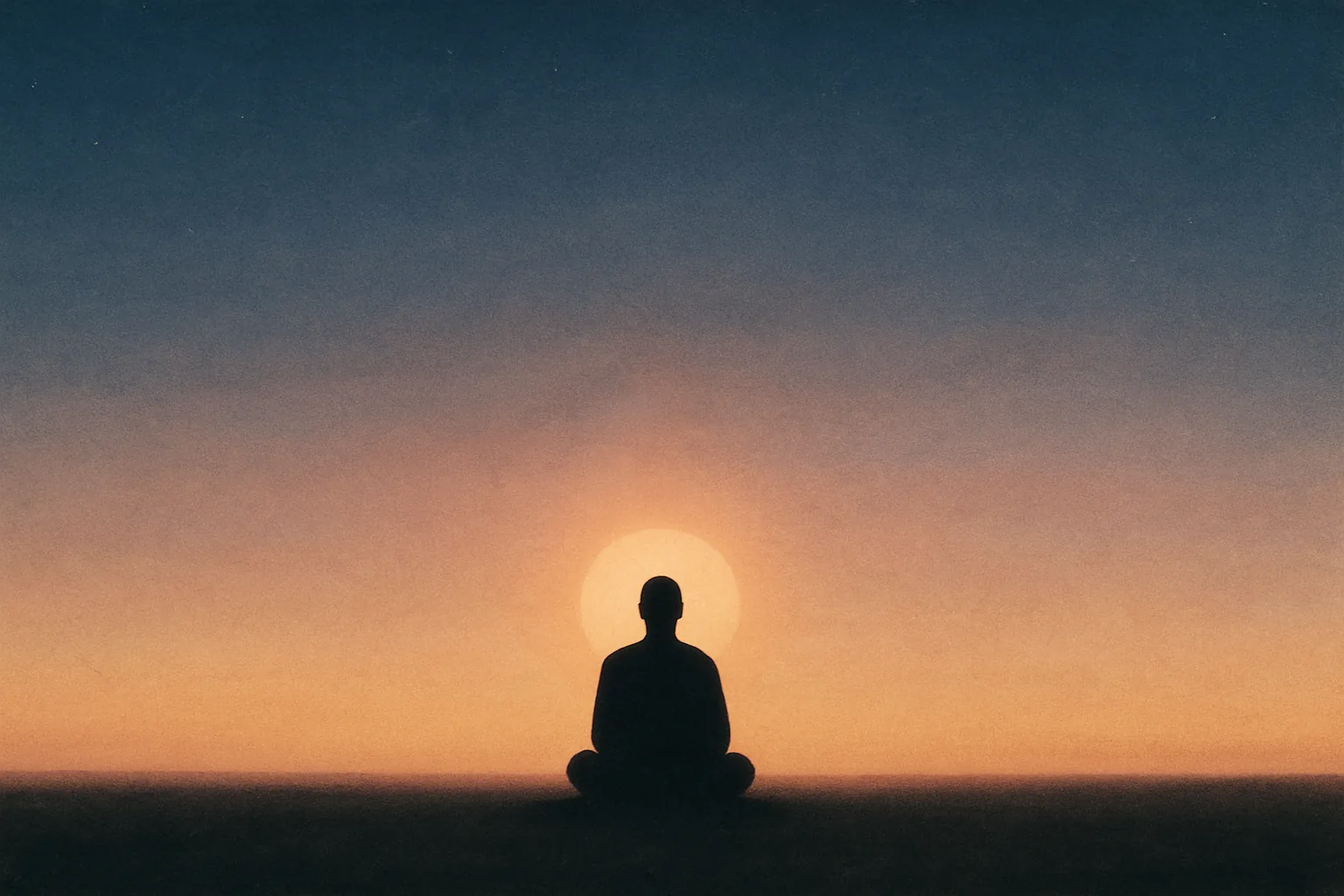
Meditation is Relaxation invites you to drop striving and allow the body–mind to unwind by itself. In the spirit of Osho’s methods, there is no goal to achieve and nothing to fight—only a simple, total let-go. As effort melts, breath finds its own rhythm and awareness naturally brightens, turning ordinary rest into a living, luminous silence.
This Tantra-oriented approach treats the body as a doorway. You soften into sensation, trust gravity, and watch—without interfering—as tensions release on their own. Rather than concentrating or suppressing, you relax so deeply that witnessing awakens by itself. The result is a spacious ease that can be carried into daily life: relaxed, alert, and utterly present.
Phase Instructions
First Stage: Arrive and Soften
Choose a quiet space. Sit comfortably or lie on your back with the spine neutral and the jaw unclenched. Let the eyes remain gently closed. Take a few natural breaths and give yourself permission to do nothing. Sense the contact points with the floor or seat; allow your weight to be fully supported. With each exhale, silently suggest to the body, “Let go.” No forcing—only a friendly invitation.
Second Stage: Let the Body Relax Itself
Without moving toward perfection, travel slowly through the body with awareness: feet, calves, thighs, pelvis, belly, chest, hands, arms, neck, face, scalp. Wherever you notice holding, simply notice it and allow it to soften. Imagine warm gravity flowing through each area and doing the work for you. If a tension remains, accept it; the acceptance is the relaxation. Keep effort to the minimum necessary to remain present.
Third Stage: Breath and Witnessing
Turn attention to the natural breath at the nostrils or belly. Do not regulate it; let it come and go on its own. Watch the whole movement—inhale, a tiny pause, exhale, a tiny pause—like waves arriving and receding. If thoughts, emotions, or sensations appear, include them in your field without pushing or pulling. Be the host, not the manager. The key is non-interference: relaxed body, spontaneous breath, clear awareness.
Fourth Stage: Rest in Effortless Silence
As the system settles, allow even the subtle suggestions to fall away. No method now—just resting, alert and easy. Let sounds, breath, and body sensations arise and pass by themselves while you remain spacious and undisturbed. If you notice new effort creeping in, smile inwardly and soften again. Taste the simple fact of being: nothing to do, nowhere to go.
Fifth Stage: Transition and Carry the Flavor
Before ending, take a few deeper breaths and sense the whole body from head to toe. Gently open the eyes, keeping the same softness. Move slowly—fingers, toes, a stretch. Stand or sit for a moment and notice how relaxation and alertness coexist. As you return to activity, keep a thread of this ease in ordinary movements—walking, speaking, working—so meditation becomes a relaxed undercurrent throughout the day.
Core Benefits
- Effortless relaxation and unwinding of the body–mind.
- Rhythmic breathing with increased awareness.
- Natural release of tensions without interference.
- Awakening of witnessing through deep relaxation.
- Carrying a spacious, easeful presence into daily life.
What Osho Said About This Technique
Meditation is always passive; the very essence of it is passive. It cannot be active because the very nature of it is non-doing. If you are doing something, your very doing disturbs the whole thing; your very doing, your very "activeness," creates the disturbance. Non-doing is meditation, but when I say non-doing is meditation I do not mean that you need not do anything. Even to achieve this non-doing, one has to do much. But this doing is not meditation. It is only a stepping stone, only a jumping board. All "doing" is just a jumping board, not meditation. You are just on the door, on the steps.... The door is non-doing, but to reach the non-doing state of mind one has to do much. But one should not confuse this doing with meditation. Life energy works in contradictions. Life exists as a dialectic: it is not a simple movement.
Question: in hatha yoga there is an exercise in which one tenses every muscle in the body and then releases the tension and becomes relaxed. Is this similar to what happens in dynamic meditation?
You are not aware of the spiritual because you have so much tension in the body, so much tension in the mind. But if you are not tense in the physical and mental realms, you will automatically know the bliss of the spiritual, the relaxation of the spiritual. It comes to you; it has been waiting for you. Your whole attention is so absorbed by the physical and the mental that there is no attention left to divert to the spiritual. Only if the body and the mind are not tense can you delve into the spiritual, can you know the bliss of it. The spiritual is never tense; it cannot be. There is no spiritual tension, only bodily tension, only mental tension. Bodily tension has been created by those who, in the name of religion, have been preaching anti-body attitudes. In the West, Christianity has been emphatically antagonistic toward…
That's the golden secret, the innermost secret of sannyas. We don't know how to turn the mind off, it always remains on. From birth to death it continues to work. Of course, if you work so much with the mind it becomes mediocre, it becomes stupid. It never has any moment for rest, it cannot rejuvenate. The body can sleep in the night, but the mind still goes on working. In the day it thinks , in the night it dreams. It is the same process; the work continues. Meditation means learning the art of turning the mind off. It is almost like a switch. You can turn the light on and you can turn the light off. Once you know how, it is simple; if you don't know how, it is very difficult.
Beloved Osho, relaxation has always been one of the most valuable states of being for me. "watchfulness" seems to be possible only then, or at least so much easier. Beloved master, would you like to comment on how "relaxation" is connected to "awareness"?
But beginning from awareness is far easier, and particularly for those who can understand the process of awareness, which is very simple. The whole day you are using it about things -- cars, in the traffic -- even in the Poona traffic you survive! It is absolutely mad. Just a few days ago I read about Athens. Athens is even worse than Poona. The government made a special seven day competition for the taxi drivers and they had put golden trophies for those who were the best at following traffic rules, the second and the third. But in the whole of Athens they could not find a single person. The police were getting worried; the days were almost finished, and the last day they wanted to find anyhow three -- they may not be perfect, but those prizes had to be distributed. One man they found was following the traffic…
Common Questions
Allow yourself to simply let go without trying to achieve any specific outcome.
Gently return your focus to the sensations in your body without judgment.
Let your breath find its own natural rhythm without conscious effort.
Embrace the spacious ease and alert presence cultivated during meditation throughout your daily routine.