
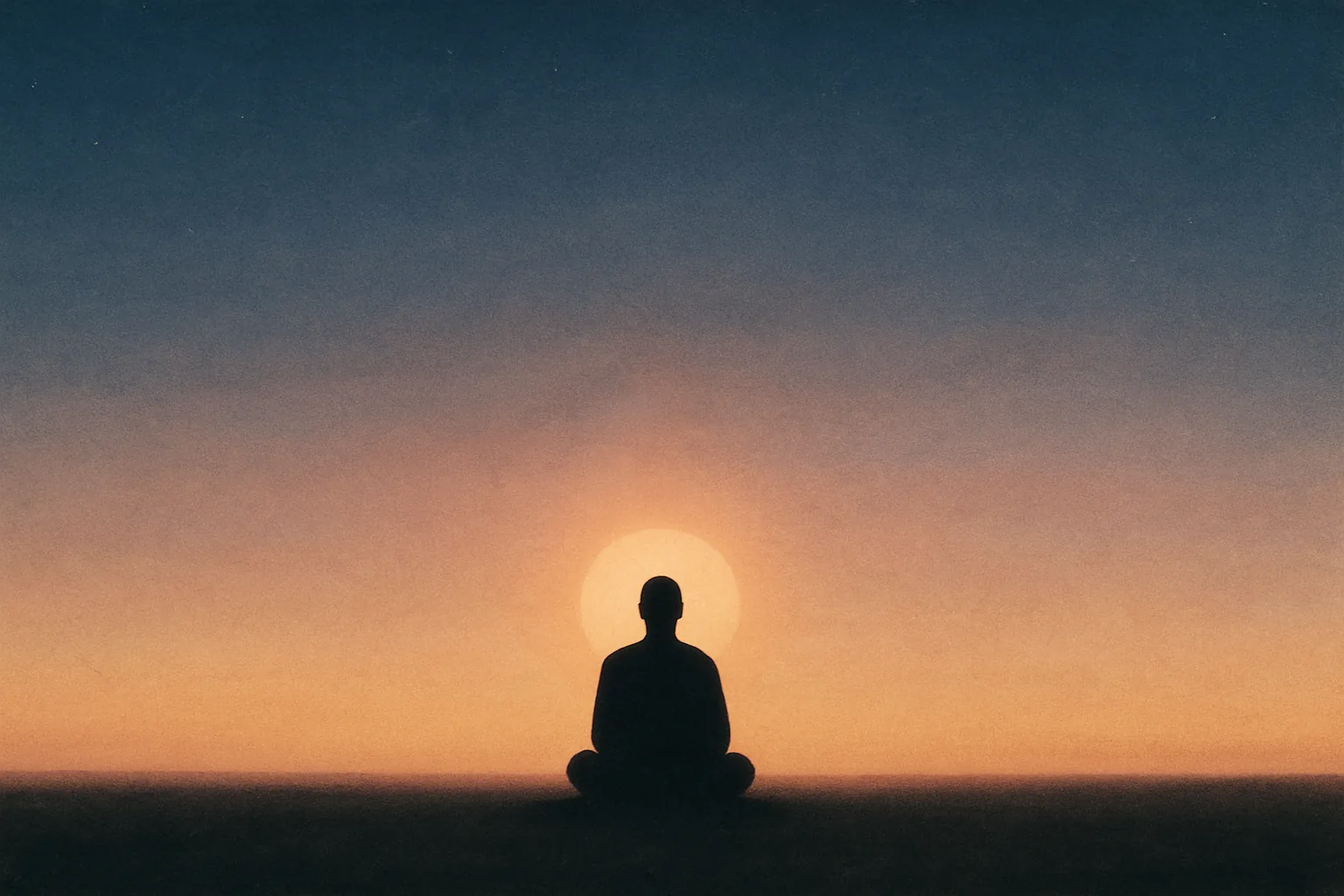
Meditation Has No Goal is a Tantric invitation to rest in pure being, free from the mind’s projects of improvement and arrival. In the spirit of Osho’s guidance, it dissolves the achievement-impulse that keeps the seeker chasing a future state, and opens a door to immediacy—this breath, this body, this silence. Nothing is cultivated, fixed, or forced; effort softens into effortless awareness, and the doer relaxes into witnessing.
Rooted in Tantra’s principle of non-doing, this practice begins by arriving without aim, then moves from gentle breath-awareness into choiceless awareness, and concludes with eyes-open integration. The method is simple yet exacting: notice the subtlest movement of ambition and let it pass; allow the breath to breathe itself; receive sensations, feelings, and sounds without preference; and rest as the spaciousness in which everything appears. Its purpose is not to get somewhere, but to recognize that nowhere is missing—presence is already here.
Phase Instructions
First Stage: Arriving Without Aim (15 minutes)
Prepare a quiet space. Sit comfortably on a cushion or chair with the spine naturally upright—alert yet unforced. Close the eyes or keep a soft downward gaze. Let the hands rest where they fall with ease. Before beginning, acknowledge inwardly: “There is nothing to attain.” Allow the breath to settle without controlling it. Feel the contact points—sit bones, feet, hands—temperature of the air on the skin, the weight of the body. If the posture wants micro-adjustments, allow them without fuss. Whenever thoughts of progress, timing, or result appear, notice them kindly and let them pass. If helpful, on a few initial exhales, whisper inwardly: “No hurry, no goal.” Do not try to be calm; simply be present as you are.
Second Stage: Gentle Breath-Witnessing (15 minutes)
Let awareness rest lightly with the natural breath—no counting, no shaping. Feel the belly and chest rise and fall. Include subtle sensations in the face, jaw, shoulders, hands. Allow thoughts, images, and feelings to come and go like clouds in a wide sky; do nothing to push them away or follow them. From time to time, scan for hidden effort—soften the brow, unfurl the jaw, release the belly, drop the shoulders. If restlessness or pressure builds, allow a spontaneous sigh, a small posture adjustment, or a brief stretch, then return to simple witnessing. The breath breathes itself; you remain as the one who notices.
Third Stage: Choiceless Awareness (15 minutes)
Let the breath move to the background and open awareness in all directions. Receive sounds, sensations, moods, and thoughts equally—no preference, no avoidance. There is nothing to fix or improve; everything that appears is permitted to be as it is. If the impulse to achieve a state, to become silent, or to make progress arises, include that impulse in awareness and let it dissolve on its own. Sense the space around and within the body; feel the gaps between thoughts. Rest as the clear, spacious knowing in which experiences arise and pass. Stay simple: no naming, no analysis—just effortless presence.
Fourth Stage: Eyes-Open Integration (15 minutes)
Without breaking the thread of awareness, slowly open the eyes. Keep the gaze soft and panoramic. Let sights, shapes, and movements be received just as sounds and sensations were—without grasping. If it feels natural, stand and take a few gentle steps, allowing ordinary movement to be infused with the same goal-free presence. No debrief, no verdict—avoid evaluating the session. Conclude by carrying this flavor of purposeless awareness into whatever comes next: walking, speaking, resting. Nothing to maintain, nothing to hold—simply remain naturally aware.
Core Benefits
- Encourages resting in pure being without goals
- Dissolves the need for achievement and future chasing
- Facilitates effortless awareness and witnessing
- Promotes non-doing and choiceless awareness
- Helps in integrating presence into everyday life
What Osho Said About This Technique
Osho, what is the goal of meditation?
Even Ananda, Buddha's closest disciple, asked one day when they were walking through a forest. It was autumn and leaves were falling from the trees and the whole forest was full of dry leaves and the wind was blowing those dry leaves about and there was a great sound of dry leaves moving here and there. They were passing through the forest and Ananda asked Buddha, "Bhagwan, one question persists. I have been repressing it, but I cannot repress it anymore. And today we are alone; the other followers have been left behind so nobody will know that I have asked you. I don't want to ask it before others. My question is: Are you telling us all that you have discovered or are you still hiding something? -- because what you are telling us does not clarify your bliss, your peace. It seems you are hiding something. " And…
In 1969 followers of the Maharishi Mahesh Yogi invited Osho to talk to them. This was the first occasion on which Osho addressed a western audience, and the first time he talked publicly at length in English. The discourse has been published in OTI January 1 & 16, 1991; and February 1, 1991. Osho: Really, there can be no method as far as meditation is concerned. Meditation is not a method. Through technique, through method, you cannot go beyond mind. When you leave all methods, all techniques, you transcend mind. So meditation itself is not a method. Truth cannot be achieved through method. Method is our own invention. We, who are ignorant, have achieved knowledge through methods constructed, created, projected, in our ignorance. Through method you can achieve a sort of self-hypnosis, a sort of auto-hypnosis. Any method, whatsoever it's name, can only give you an illusory kind of peace.
So first: now, when we sit for meditation—our entire language is the language of doing. We even say, We will do meditation. It is wrong to say, for there is no possibility of doing in meditation. But our entire language—human language—is the language of doing; we have no language for non-doing. In Japan, about a hundred and fifty years ago, there was a great monastery, a vast ashram. Some five hundred bhikshus practiced there. The emperor became eager to see it and went. The ashram spread far and wide in the forest; cottages were scattered. The head monk began to show them: In this cottage our monks cook; in this cottage they study; in this cottage they sing—here they do this, there they do that; here they bathe. In the middle stood a large building—the monk said nothing about it.
तो पहली बात, अभी जब हम ध्यान के लिए बैठेंगे, हमारी सारी भाषा करने की भाषा है। ध्यान करने बैठेंगे, ऐसा कहेंगे, गलत है कहना, क्योंकि ध्यान में करने जैसी कोई संभावना नहीं है। लेकिन हमारी सारी भाषा, मनुष्य की सारी भाषा करने की भाषा है, न-करने की हमारे पास कोई भाषा नहीं है। जापान में कोई डेढ़ सौ वर्ष पहले एक बहुत बड़ी मोनेस्ट्री थी, एक बड़ा आश्रम था। वहां कोई पांच सौ भिक्षु साधना करते थे। सम्राट उत्सुक हो गया उस आश्रम को देखने और गया। दूर-दूर जंगल में फैला हुआ वह आश्रम था, दूर-दूर फैली हुई कुटियां थीं। एक-एक कुटी को दिखाने लगा भिक्षु, जो प्रधान था और बताने लगा, इस कुटी में हमारे भिक्षु भोजन बनाते हैं, इस कुटी में हमारे भिक्षु अध्ययन करते हैं, इस कुटी में गीत गाते हैं; यहां यह करते हैं, वहां वह करते हैं; वहां स्नान करते हैं।
Meditation means a state of absolute silence where not even a single thought is creating any noise, any flutter; where no desire is creating any ripple; where there is no memory, no desire, no past, no future, no thought process at all; where you are simply relaxed, totally at rest, utterly silent -- that state is meditation. And this is the goal, because once you are absolutely silent you become aware of the immense beauty of existence, you become aware that you are part of the whole. You also become aware that you have never been separate, that the separation was only an idea, a dream -- you have always been one with the whole. Existence is an organic unity, it is a cosmos. And because you thought yourself separate you created so many unnecessary anxieties, problems, worries. They were all by-products of the basic error that "I am separate".
Therefore, o sariputra, it is because of his non-attainmentness that a bodhisattva, through having relied on the perfection of wisdom, dwells without thought-coverings. In the absence of thought-coverings he has not been made to tremble, he has overcome what can upset, and in the end he attains to nirvana. All those who appear as buddhas in the three periods of time fully awake to the utmost, right and perfect enlightenment because they have relied on the perfection of wisdom.
Buddha is powerful, powerful in his peace, in his silence. He is as powerful as a roseflower, he's not powerful like an atom bomb. He's as powerful as the smile of a child... very fragile, very vulnerable; but he's not as powerful as a sword. He is powerful, as a small earthen lamp, the small flame burning bright in the dark night. It is a totally different dimension of power. This power is what we call divine power. It is out of non-friction. Concentration is a friction: you fight with your own mind. You try to focus the mind in a certain way, towards a certain idea, towards a certain object. You force it, you bring it back again and again. It tries to escape, it runs away, it goes astray, it starts thinking of a thousand and one things, and you bring it again and you force it. You…
Common Questions
The main focus is to rest in pure being, letting go of goals and ambitions.
It involves breath-awareness, choiceless awareness, and noticing ambition without following it.
No, effort softens into effortless awareness; there is no forced effort.
Simply notice any movements of ambition or thought and let them pass without engagement.
It concludes with eyes-open integration, blending awareness into daily life.