
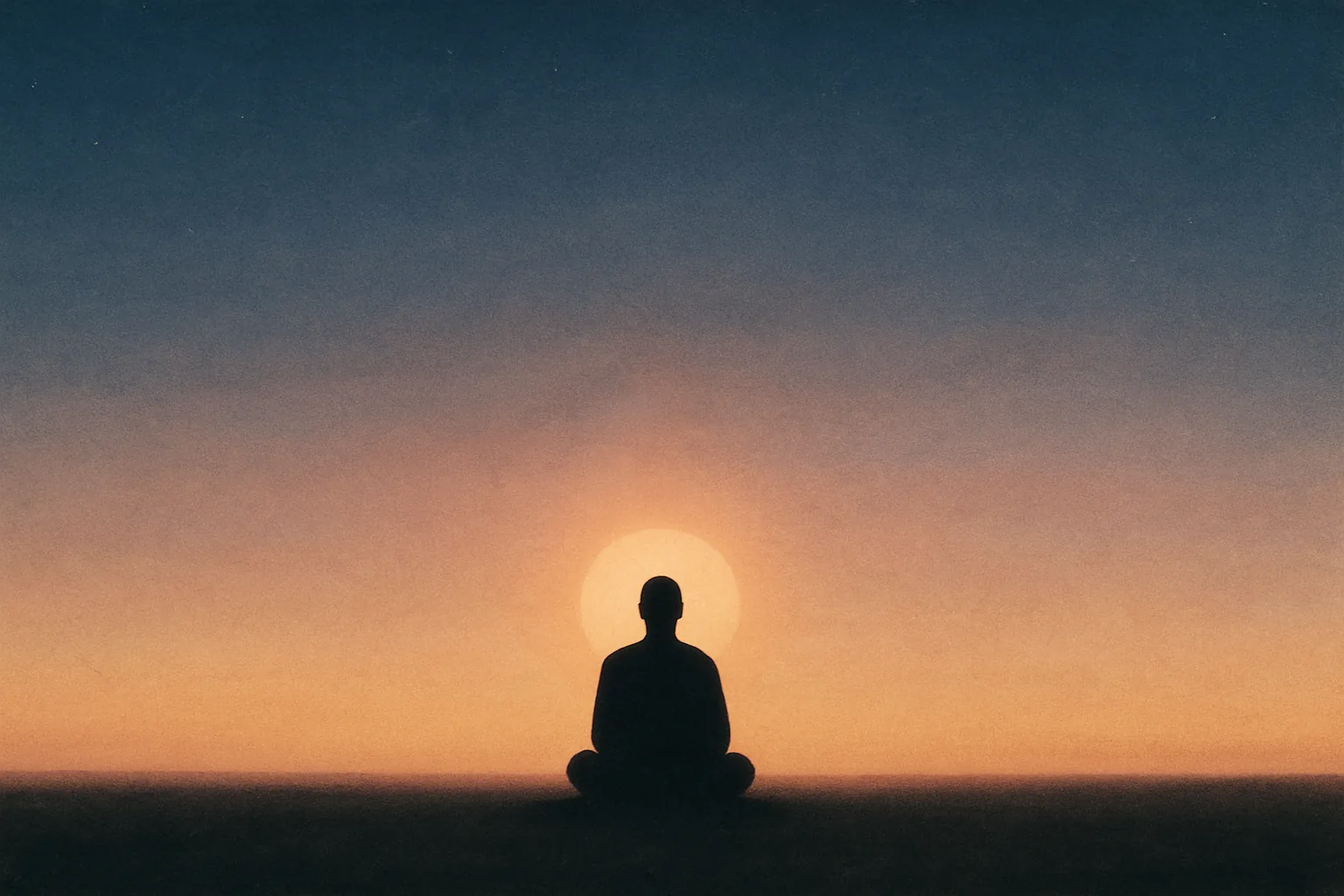
This practice distills Osho’s insight that love and meditation are two doors opening into the same inner shrine. Whether your energy naturally flows outward in communion (love) or inward in solitude (meditation), both currents spring from a single source. You do not need to force both at once; you begin with one, enter fully, and allow the meeting to happen in the center—where egolessness, silence, and timelessness naturally appear.
Honoring the many-paths-one-destiny spirit exemplified by Ramakrishna Paramhansa, this meditation offers a clear doorway for extrovert and introvert alike. The tone is Osho’s: playful yet precise, poetic yet practical. Love feels like a jugalbandi—two instruments attuned in living rhythm. Meditation is the solo flute—pure, simple, immediate. Follow the door that is truest for you today; the destination is the same luminous middle where love tastes like meditation and meditation overflows as love.
Phase Instructions
First Stage: Choose Your Door (Commitment and Setup, 5 minutes)
Create a quiet, comfortable space. If you are entering through love, you may sit with a partner facing you; if you are alone, place a flower, candle, or the open sky before you as your beloved. If you are entering through meditation, sit comfortably with an upright, relaxed spine. Close your eyes for a few breaths and sense your natural orientation today—outward (love) or inward (meditation). Choose one door for this session and commit not to switch mid-stage. Imagine a temple with two doors. See yourself walking with confidence through the door you have chosen. The other door also leads to the same inner shrine; trust that you will meet there.
Second Stage: Enter Through Your Chosen Door (Immersion, 20 minutes)
Option A — Meditation Door (for inward-flowing energy): Sit still, eyes closed. Let the breath settle into a natural rhythm. Feel the simple joy of being with yourself—no goal to achieve. Rest attention lightly on the breath and the sensations of the body from belly to heart to brow. Thoughts may pass like clouds; watch them without following. Allow the mind to grow transparent. If you drift, gently return to the breath and the felt sense of aloneness as bliss. Hear the inner music as if a flute were playing solo—unadorned, intimate, sufficient. Soften the face and shoulders; let the sense of “me” loosen with each exhalation. Option B — Love Door (for outward-flowing energy): With a partner, sit face-to-face, eyes open, and synchronize breathing for a few minutes. Place one hand on your own heart and one (with consent) on the other’s heart; if alone, keep both hands on your heart or gently hold the flower/candle. With each exhale, offer warmth, goodwill, and presence; with each inhale, receive. Let your gaze be soft, free of words and demands. Hum a gentle tone if it arises, as though two instruments were finding a shared rhythm. Touch, if present, remains conscious and unhurried. If practicing alone, offer loving attention to the chosen focus (person in mind, nature, or the whole existence), whispering a silent thank-you with the out-breath. Keep awareness anchored in the body so connection stays real, not imagined. Allow the boundaries between “I” and “Thou” to soften.
Third Stage: The Inner Shrine — Meeting Point of Polarities (Rest in Being, 20 minutes)
Now let doing dissolve. If you practiced the love door, keep a light physical link (hands touching or a soft gaze), then gradually close the eyes together or lower the gaze; if alone, close the eyes while holding the felt sense of connection. If you practiced the meditation door, continue with eyes closed and an open, choiceless awareness. Bring attention to the heart center; breathe softly into the chest and belly. Sense inwardness and relatedness at once—as if both doors have opened behind you and you are already in the center. Allow the ego-center to grow quiet; let time thin out. There is nothing to produce, nothing to maintain. Simply be. Rest as a spacious presence in which love and meditation are not two. If thoughts arise, let them pass through the same open space. Taste the still communion: alone and together, empty and overflowing.
Fourth Stage: Integration and Return (Gratitude and Grounding, 15 minutes)
Gently deepen the breath. If with a partner, open your eyes and acknowledge each other with a soft bow or embrace—no words yet. If alone, bow to the space or to your chosen symbol of the beloved. Place both hands on the belly to ground. Sit or lie quietly for a few minutes, allowing the flavor of the inner shrine to permeate the body. If you wish, note a single sentence in a journal: what shifted, what softened, what remains. Reenter activity slowly, carrying the sense that whichever door you take in life—love or meditation—you now know the way to the same luminous center.
Core Benefits
- Harmonizes love and meditation as complementary pathways
- Facilitates a journey toward egolessness
- Cultivates inner silence and timelessness
- Is adaptable for both extroverts and introverts
- Promotes unity by exploring diverse spiritual paths
What Osho Said About This Technique
Osho, you have titled this series of talks “Sahaj Yoga.” Do “sahaj” and “yoga” not seem mutually opposed?
Anand Maitreya! They don’t just seem opposed, they are opposed. But no ultimate truth of life can manifest without contradiction. Life is made of opposites—darkness and light, day and night, woman and man, negative electricity and positive electricity, birth and death. The very structure of life is woven of opposites. Hence the opposites are not only opposed; they are complementary to each other. If you have labored hard all day, you will be able to sleep deeply. Labor and rest are opposites, yet only the one who has worked can rest deeply—and the one who has not worked cannot. So the opposites are not only opposed, they complete each other. And only the one who has rested deeply at night can rise in the morning and engage in work again. One who has not rested through the night will not be able to work in the morning. Look closely at…
पहला प्रश्न: ओशो, आपने इस प्रवचनमाला का शीर्षक दिया है--सहज-योग। क्या सहज और योग परस्पर-विरोधी नहीं लगते?
आनंद मैत्रेय! विरोधी लगते ही नहीं, विरोधी हैं। लेकिन जीवन का कोई भी परम सत्य बिना विरोधाभास के प्रगट हो ही नहीं सकता। जीवन बना है विरोधों से--अंधेरा और प्रकाश, दिन और रात, स्त्री और पुरुष, ऋण विद्युत-धन विद्युत, जन्म-मृत्यु। जीवन की संरचना विरोधों से है। इसलिए विरोधी विरोधी ही नहीं हैं, एक-दूसरे के परिपूरक भी हैं। दिन भर श्रम किया खूब तो गहरी नींद सो सकोगे। श्रम और विश्राम विरोधी हैं, पर जिसने श्रम किया है वही गहरा विश्राम कर सकेगा। और जिसने श्रम नहीं किया वह गहरा विश्राम भी न कर सकेगा। तो विरोधी विरोधी ही नहीं हैं, एक-दूसरे के परिपूरक भी हैं। और जिसने रात्रि गहरा विश्राम किया है वही सुबह जागकर फिर श्रम में संलग्न हो सकेगा। जो रात-भर विश्राम नहीं कर सका वह सुबह श्रम में भी न लग सकेगा।
Beloved master, when I hear you speak on love and meditation, or sex and death, saying they are two sides of the same energy, something in me knows it is true. But, although drawn by both aspects, I feel myself hung up on the idea that I can only approach one side at a time. Is there actually a way to be at the meeting point of these polarities where they can be felt as one?
Prem Asang, the beginning has to be always from one side, from one aspect; in the beginning you cannot manage to enter from both the doors. If a temple has two doors you cannot enter simultaneously from both the doors. How will you manage it? But there is no need either to enter from both doors simultaneously; one door is enough. By entering by one door you have reached the inner shrine. The people who have entered from the other door, they have also reached to the same inner shrine. The meeting happens in the innermost experience. Whether you enter from love or from meditation it does not matter -- you reach to the same point. The same point of egolessness is arrived at through love or through meditation. The same point of mind disappearing is arrived at by love and by meditation, and the same point of going beyond…
Ordinarily psychologists don't think that meditation can do anything because they are not aware of the roots -- and meditation's whole function is to cut the roots. Once the roots are cut the tree withers away by itself. Love makes man an ocean, an infinity. It gives a kind of unboundedness. It helps you to know that you are not defined by any limits, that you are not confined by the body or the mind, that you are not confined at all, that you are as vast as the sky; in fact, even the sky is not the limit. There is no limit to you. This is the beauty of love, it makes you aware of vastness. That is the first experience of godliness. And if the first experience happens, then other things follow in their own time. The first experience triggers a process.
Meditation is an end and a beginning -- the end of the old and the birth of the new. You cannot even comprehend it because the old cannot comprehend the new, the old can only comprehend something which is old. It has limitations, it can move only within the boundary of the known, and the new is not within its boundary, the new is unknown. Hence only very courageous people can take the jump. Courage is needed because you have to die to the old, and the old is familiar. You are dropping that which is familiar for something which is absolutely unfamiliar. This is what courage is: dropping the known for the unknown. There are two steps to courage: the first is dropping the known for the unknown, and the second is dropping the knowable for the unknowable. By dropping the known for the unknown, meditation happens.
Meditation fulfils something, love fulfils something else. It is like telling a person 'Either you can eat or you can drink. If you eat, then you cannot be allowed to drink anything; if you want to drink anything then you cannot eat. Choose one -- whatsoever you want.' Now, you will drive that man crazy! He needs both. You tell somebody 'Either you can remain awake or you can go to sleep -- choose.' These are opposite activities, and you cannot choose opposite things because that will create troubles for you, so either be awake or be asleep.' Now, nobody can choose one. You will need a certain rhythm between waking and sleeping; you will have to move from one to the other. Waking you will create the necessity for sleep, sleep will create the necessity for waking.
Common Questions
Choose the path that resonates with you today, as both pathways lead to the same inner shrine.
It's not necessary to force both at once; delve deeply into one and allow the integration to happen naturally.
Anyone open to exploring their inner world, regardless of their personality type, can practice this meditation.
By embracing a spirit exemplified by Ramakrishna Paramhansa, it respects many spiritual paths as leading to a shared destiny.