
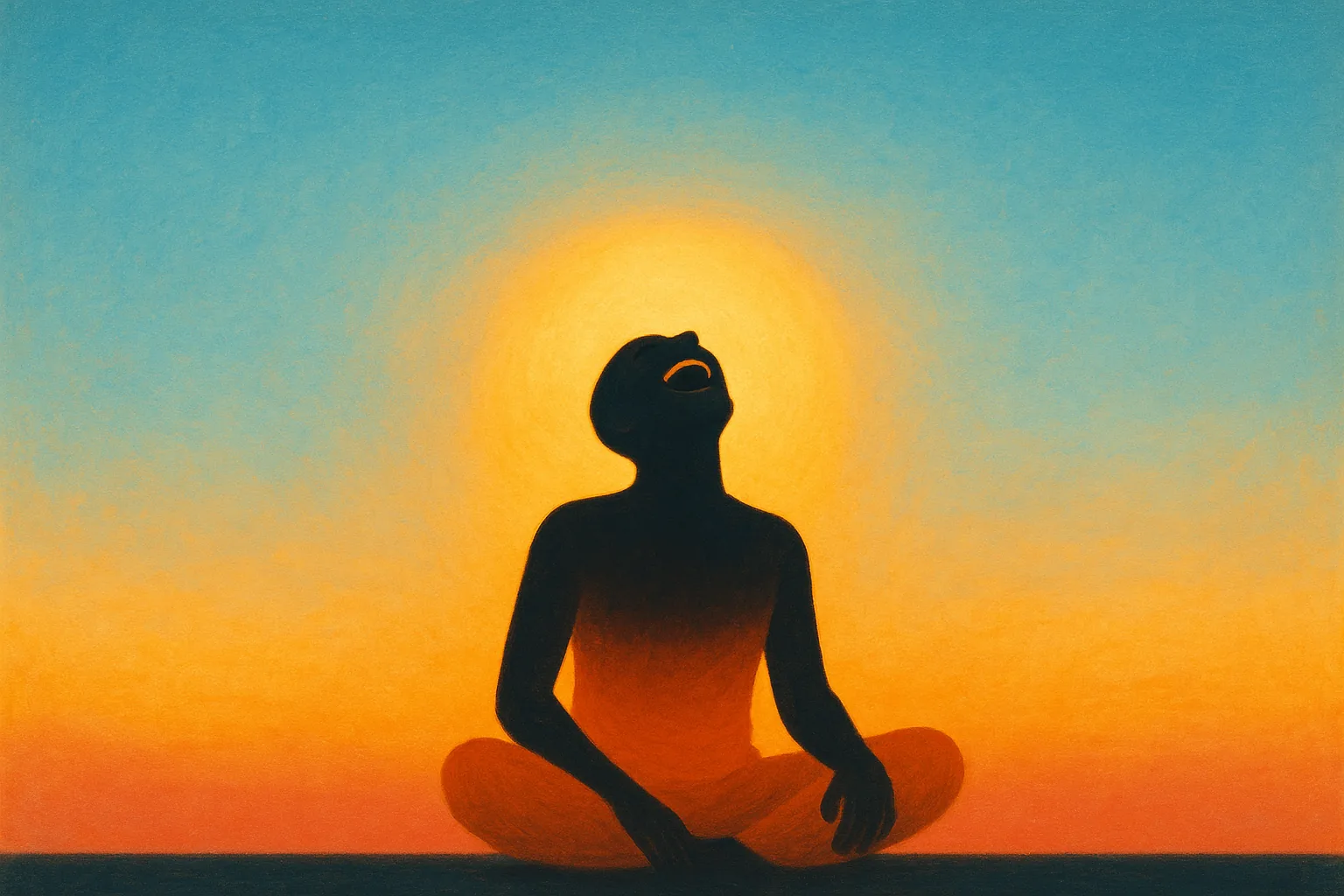
Laughing Meditation is a simple, playful morning practice Osho gave to open the day with lightness and a fresh current of life. Upon waking, before the world enters through your eyes, you first stretch like a cat and then let five minutes of laughter rise and ripple through the whole body. At first the laughter may be deliberate, even a little theatrical; soon the sound of your own attempt unlocks genuine laughter. Practised daily, this easy rhythm of stretch-and-laugh becomes spontaneous over a few days and changes the flavour of the entire day.
For those who feel blocked—unable to laugh totally or sensing the laughter is false—Osho points to a traditional yogic purification to clear the passage of expression. This lukewarm salted-water cleanse (a classic shatkarmic method) is done early in the morning before food: you drink quickly, then bend and gargle so the water flows back out, a gentle "vomiting of the water" that dissolves obstructions. After about ten days, you feel a striking inner cleanliness; laughter, tears, and even speech arise more naturally from the deep center.
Phase Instructions
First Stage: Catlike Stretching (3–4 minutes)
Immediately upon waking, keep your eyes closed. Still in bed, stretch like a cat—slowly, luxuriously. Reach and lengthen through every fiber of your body: arms, legs, spine, fingers, toes, face. Let the stretch move in waves and angles, finding every corner of tension. Continue for three to four minutes, staying inward with eyes closed.
Second Stage: Laughter with Closed Eyes (5 minutes)
With eyes still closed, begin to laugh for five minutes. If it feels artificial at first, allow a playful, intentional laugh and keep it going—the very sound of your effort will unlock real laughter. Let the belly shake, the chest open, the breath flow freely. Lose yourself in the laughter; allow it to bubble up on its own. Do not force a particular tone or volume—let it be total, rising and falling naturally. If spontaneity does not come immediately, continue daily; within a few days the laughter will become effortless and will set a joyful tone for your whole day.
Optional Purification: Saltwater Cleanse for Free Laughter (10 days)
If you find it hard to laugh totally or it feels false, add this yogic purification in the early morning before eating. Prepare lukewarm water with salt and drink quickly—almost a bucketful, as much as you comfortably can if you drink fast. Then bend forward and gargle so the water flows back out; allow a gentle vomiting of the water to happen and fully empty. This cleans the passage and dissolves blocks so expression can move freely. Practise this for ten days; you will feel a deep cleanness, and laughter, tears, and even your speaking will emerge from a deeper center.
Core Benefits
- Opens the day with lightness and a fresh current of life
- Becomes spontaneous over a few days
- Changes the flavour of the entire day
- Unlocks genuine laughter
- Clears the passage of expression through yogic purification
What Osho Said About This Technique
If you meditate, that very experience becomes your proof. So for three months simply forget all your training, analytic acumen, skill -- forget all about it. For three months just be here, a very primitive man. The primitive man is very pure -- he lives from the heart, and from the heart the being is very close. From the head the being is very tar away. From the head the moon is closer and the being is very far away. That's why the head people have reached to the moon, but have not yet been able to reach the being. They will never reach. They will reach Mars, they will reach farther and farther away, but they will never come home. From the head everything is close except the being. The being is very close to feeling. So for these three months, feeling has to be your style.
Beloved Osho, when I heard you say laughter is a small release from our misery, my mind would not compute. It felt as though hysteria was filling the room as we all laughed, and I am still asking myself, "what happened?"
You can see what happened! It can look like hysteria. For example, when you understand something and laughter happens as a relief from misery, a great energy is released. Every understanding releases accumulated energies in you. For example, you are not laughing the whole day -- only once in a while. You are not being loving the whole day -- only once in a while. What happens to the energy in the big gaps? It accumulates, and if you come to an understanding of a certain phenomenon there is a great release, and the release is so strong that it will feel hysterical. But it is not hysterical; it is really getting relief from energy which could have become hysterical any moment. You can find people in madhouses laughing for hours, laughing so much that tears come to their eyes. They are mad because they could not manage to release…
Osho, I’ve developed a strange addiction: sitting with you every morning and laughing!
Ranjan, When religion is alive, laughter is prayer; when religion is dead, it becomes the enemy of laughter. Laughter is the heartbeat of life. A religion that does not know how to laugh died long ago—the heartbeat has stopped, the breath no longer moves, a corpse is lying there. And the worship of the corpse goes on. Religion fails to transform the earth because again and again it forgets the language of laughter; it forgets song; it forgets dance. This is no addiction. This is your morning prayer, your worship. Laugh—laugh to your heart’s content! As I see it, if one learns to laugh totally, so that no circumstance in life can rob one of one’s laughter, so that the smile remains—in joy and in sorrow, in success and in failure—then there is nothing left to attain. All is attained! Such a state is samadhi, moksha—liberation. And one who knows…
पहला प्रश्न: ओशो, अजीब लत लगी है रोज सुबह आपके साथ बैठ कर हंसने की!
यह कोई लत नहीं है। यह तो तुम्हारी रोज की सुबह की प्रार्थना है, उपासना है। हंसो, जी भर कर हंसो! मेरे देखे, अगर कोई समग्ररूपेण हंसना सीख ले, कि जीवन की कोई भी परिस्थिति उससे उसकी हंसी न छीन पाए, उसकी मुस्कुराहट बनी ही रहे--सुख में, दुख में; सफलता में, असफलता में--तो कुछ और पाने को नहीं बचता। सब पा लिया! वैसी दशा ही समाधि है, मोक्ष है।
Aum, may my speech be rooted in my mind, and my mind rooted in my speech. O self-illumined brahman, be manifest unto me. Speech and mind form the basis of my knowledge, so please do not undo my pursuit of knowledge. Day and night I spend in this pursuit. I shall speak the law; I shall speak the truth. May brahman protect me; may he protect the speaker, protect the speaker. Aum, shanti, shanti, shanti.
But there are problems; theologicians have created them. The first problem they have created, and because of which this remembering becomes impossible -- to remember that you are already divine becomes impossible -- is a very deep condemnatory attitude. You go on condemning yourself: you are the sinner. They have created guilt in you. So how can a sinner be, right this very moment, the divine? He will have to get rid of the sin; he will have to suffer for his sins, and time will be needed. He will have to pass through purifications, and only when he has become holy, a saint, will he have a glimpse of the divine. Particularly in the West, Christianity has given everybody a deep guilt complex. Everybody is guilty -- not only about your own sins that you have committed, but also about the sin that Adam committed in the very beginning.…
In the tang dynasty there was a stout fellow who was called the happy chinaman, or the laughing buddha.
THIS HOTEI HAD NO DESIRE TO CALL HIMSELF A ZEN MASTER, OR TO GATHER DISCIPLES AROUND HIM. INSTEAD HE WALKED THE STREETS WITH A SACK ON HIS BACK FULL OF CANDY, FRUIT AND DOUGHNUTS -- WHICH HE GAVE OUT TO THE CHILDREN WHO GATHERED AND PLAYED AROUND HIM. WHENEVER HE MET A ZEN DEVOTEE HE WOULD EXTEND HIS HAND AND SAY: "GIVE ME ONE PENNY. AND IF ANYONE ASKED HIM TO RETURN TO THE TEMPLE TO TEACH OTHERS, AGAIN HE WOULD REPLY: "GIVE ME ONE PENNY. ONCE WHEN HE WAS AT HIS PLAY-WORK ANOTHER ZEN MASTER HAPPENED TO ALONG AND INQUIRED: "WHAT IS THE SIGNIFICANCE OF ZEN? HOTEI IMMEDIATELY PLOPPED HIS SACK DOWN ON THE GROUND IN SILENT ANSWER. "THEN," ASKED THE OTHER, "WHAT IS THE ACTUALIZATION OF ZEN? AT ONCE THE HAPPY CHINAMAN SWUNG THE SACK OVER HIS SHOULDER AND CONTINUED ON HIS WAY. ... You have turned life into
Common Questions
Initially, your laughter might be deliberate and theatrical, but soon it becomes genuine as you continue the practice.
You should practice five minutes of laughter in the morning after stretching.
Osho recommends a lukewarm salted-water cleanse to clear the passage of expression, helping laughter arise more naturally.
Drink quickly, then bend and gargle so the water flows back out, performing a gentle 'vomiting of the water.'
After about ten days of practice and cleansing, you may feel a striking inner cleanliness, facilitating natural laughter and expression.