
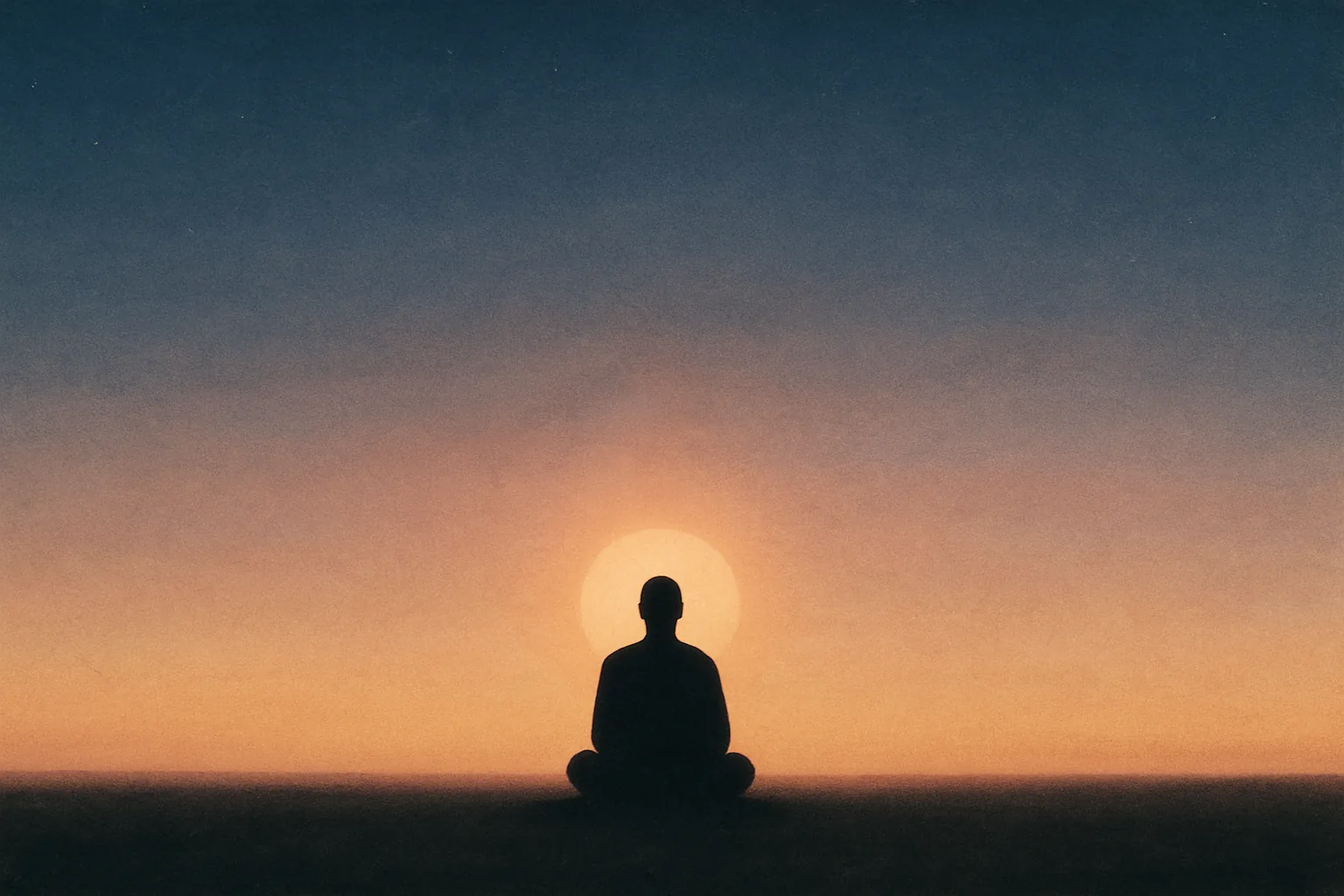
This practice distills Osho’s insight from the discourse “Be Happy! and Meditation Will Follow”: happiness is a conscious choice, and when chosen wholeheartedly, meditation arises on its own—like a shadow following the one who walks in sunlight. In the Tantra spirit of embracing life directly, you do not force the mind into silence; you turn toward your innate capacity for joy and alignment. As that joy flowers, awareness deepens naturally, effortlessly. The words “meditation” and “medicine” share a root; meditation becomes medicinal only when we have strayed from our natural ease. Choose happiness, and the remedy is no longer needed—presence returns by itself.
This is not a technique of chanting or borrowed belief. It is a courageous, intimate shift from secondhand shoulds to your own living truth. You align with existence—trees, birds, stars—whose very nature is bliss, and you remember that your deepest responsibility is to your own being. From this alignment, work becomes worship, breath carries grace, and the whole world is felt as a temple. The method is simple: choose happiness now, let go of imposed voices, attune to the joy already humming in existence, and then stop doing—allow meditation to follow.
Phase Instructions
First Stage: Declare the Choice of Happiness
Sit upright, relaxed yet alert. Let the face soften. Place a gentle, authentic smile on your lips—not forced, simply available. On a slow exhale, whisper inside: “I choose happiness now.” Feel the weight of freedom and responsibility in this choice. Sense how choosing happiness is not denial but a return to your own authority. Rest a few breaths in this felt decision.
Second Stage: Drop the Borrowed Voices
Notice the inner chorus of shoulds—parents, teachers, society, religion—telling you who to be. With each exhale, say inwardly: “Not mine.” Let your shoulders drop; soften your jaw and belly. If disobedience is needed to be true, honor it inwardly with respect for all, but fidelity to your own being. Feel the relief of turning from approval-seeking to truth-sensing.
Third Stage: Tune to Existence’s Natural Bliss
Open your senses. Listen as if hearing distant birds; feel the breath like wind through trees; imagine the wide sky arching above you. If indoors, visualize stepping beneath the stars—vast, silent, shimmering. Let the body breathe a little more freely, perhaps swaying subtly. Recognize: trees, birds, stars are naturally happy; you, with consciousness, can be happy by choice. Receive this atmosphere.
Fourth Stage: Embody the Yes
Let a warm, quiet joy fill the chest. On each inhale, feel a cellular “yes” spreading through ribs, heart, and face. On each exhale, release frowns, tightness, and the habit of waiting. Allow small spontaneous movements—stretching, opening the arms, placing a hand on the heart—anything that deepens ease without effort. No mantra, no repetition; simply a living yes to this moment.
Fifth Stage: Fit With Your Life—Inner Alignment Inquiry
Ask inwardly, without rushing: “What do I really want to do? What fits me now?” Let images or feelings surface. See one small, honest step you can take today that harmonizes you with your true direction. Feel the rightness of that step in your body. Seal it with a simple inner vow: “My deepest responsibility is to my own being.” Rest in the warmth that follows clarity.
Sixth Stage: Do Nothing—Let Meditation Follow
Now stop all doing. Sit comfortably, eyes soft or closed. Do not control breath or thoughts. Allow sensations, sounds, and thoughts to appear and fade by themselves. Abide as a quietly happy presence. Notice how, without effort, attention gathers and deepens. Feel meditation arriving on its own—like a shadow accompanying your chosen joy.
Seventh Stage: Carry It Into the Day—Work as Worship
Gently open your eyes. See the room as a temple, the day as your altar. As you stand, walk, cook, type, or speak, let happiness tint each act with grace. No special religious activity is required; your ordinary doing becomes prayerful when done from joy. Avoid mechanical name-repetition; instead, look with happy eyes and recognize the sacred everywhere.
Core Benefits
- Happiness becomes a conscious choice, aligning with joy.
- Meditation arises naturally without forcing the mind.
- Deepened awareness occurs effortlessly.
- Work is transformed into worship as presence returns.
- Life itself becomes a temple, felt through grace and joy.
What Osho Said About This Technique
Osho, I want to be happy. Whatever I do, I do it in the hope of being happy. Now I have come to practice religion also in that same hope. You say: dissolve the ego. It seems to me that if I dissolve the ego, I myself will be dissolved; then I won’t be there—so how will I be happy? Wouldn’t a miserable existence be preferable to losing my very existence?
They entered the city; people began removing turbans and caps, bowing. But the farmer said nothing. He remained silent. The emperor asked, “What is the matter? Do you understand?” The farmer said, “I am in a fix. You don’t remove your turban—and I don’t remove mine. So who is the emperor—you or I? This is a serious tangle.” Ego is such a delusion. Ego mistakenly believes itself to be the soul. Ego is not the soul—but both ride the same horse, very close. As a man rides a horse, his shadow too rides the horse. Similarly, with the soul rides the ego’s shadow. If the soul does not remove its hat, how will the shadow remove hers? The shadow too has a hat; she too struts, enjoying the full fun. You have taken the shadow to be yourself. When the shadow disappears, you will not. And the shadow must vanish…
पहला प्रश्न: ओशो, मैं सुखी होना चाहता हूं। मैं जो भी करता हूं, सो सुखी होने की आशा में ही करता हूं। अब मैं धर्म साधने आया हूं, सो भी उसी आशा में। आप कहते हैं: अहंकार को मिटाओ। इससे मुझे ऐसा प्रतीत होता है कि अहंकार को मिटाने से मैं स्वयं ही मिट जाऊंगा; फिर मैं रहूंगा ही नहीं, तो सुखी कैसे होऊंगा? अस्तित्व खोने की अपेक्षा दुखमय अस्तित्व ही क्यों न ठीक होगा?
राजधानी आ गई, शहर में प्रवेश भी हो गया और लोग पगड़ियां और टोपियां उतार-उतार कर नमस्कार भी करने लगे; लेकिन किसान कुछ बोला नहीं। चुप्पी साधे रहा। सम्राट ने पूछा कि बात क्या है? समझ में आया कि नहीं? उसने कहा: मैं बड़ी मुश्किल में पड़ गया हूं, आप भी पगड़ी नहीं उतारते, मैं भी पगड़ी नहीं उतारता, पता नहीं सम्राट कौन है? आप हैं कि मैं हूं? यह तो बड़ी झंझट हो गई। अहंकार ऐसी ही भ्रांति है। अहंकार को भ्रांति है आत्मा होने की। अहंकार आत्मा नहीं है। मगर एक ही घोड़े पर दोनों सवार हैं। बहुत करीब-करीब एक ही घोड़े पर सवार हैं। जैसे आदमी घोड़े पर सवार हो, तो उसकी छाया भी तो घोड़े पर सवार होती है। बस, ऐसे ही आत्मा के साथ अहंकार की छाया भी घोड़े पर सवार है। न आत्मा अपनी टोपी उतारती, तो छाया की कैसे उतरेगी? …
Osho, what is the first experience of samadhi like?
You will know only when it happens. It cannot be said; at most a few hints can be given. It is as if, in the dark, a lamp is suddenly lit. Or as if a dying patient, right at the edge of death, suddenly finds a medicine that works; life’s wave, life’s thrill spreads again—so it is. As if a corpse becomes alive—such is the first experience of samadhi. It is the taste of nectar. The experience of the ultimate music. But it will be only when it happens; and only then will you understand. You will not understand by my saying it. It is as with love. How can anyone explain it? To someone who has never loved, never known love, no matter how many explanations you offer—he will hear it all and still ask, “I haven’t understood; please explain a little more.” It is like explaining light to…
तीसरा प्रश्न: ओशो, समाधि का पहला अनुभव कैसा होता है?
होगा तो ही जानोगे। कहा जा सके, ऐसा नहीं है। कुछ-कुछ इशारे किये जा सकते हैं। जैसे अंधेरे में अचानक दीया जल जाये, ऐसा होता है। या जैसे बीमार मरता हो और अचानक कोई दवा लग जाये...मरते-मरते कोई दवा लग जाये; और जीवन की लहर, जीवन की पुलक फिर फैल जाये--ऐसा होता है। जैसे कोई मुर्दा जिंदा हो जाये--ऐसा होता है समाधि का पहला अनुभव। अमृत का अनुभव है। परम संगीत का अनुभव है। पर होगा तो ही होगा। और होगा तो ही तुम समझ पाओगे; मेरे कहने से समझ में न आ सकेगा। प्रेम में जैसा होता है। अब कोई किसी को कैसे समझाये? …
The root of this division is mind. If there is no mind, there is no division. Therefore, concentrate your mind on the universal consciousness which is your interiority.
KNOWING THAT YOU ARE THE PERPETUALLY BLISSFUL SOUL, ALWAYS REJOICE IN THIS BLISS WITHIN AND WITHOUT YOUR VERY SOUL. THE FRUIT OF DETACHMENT IS KNOWLEDGE, THE FRUIT OF KNOWLEDGE IS RELAXEDNESS, AND THE PEACE THAT DESCENDS FROM EXPERIENCING THE SELF-BLISS IS THE VERY FRUIT OF RELAXEDNESS. IF EACH ONE OF THE AFORESAID DOES NOT HAPPEN IN SUCCESSION, KNOW THAT THE PREVIOUS ONE HAS GONE FRUITLESS. ABSTENTION FROM THE SENSE-OBJECTS IS IN ITSELF THE SUPREME CONTENTMENT AND INCOMPARABLE BLISS. ... THE ROOT OF THIS DIVISION IS MIND. IF THERE IS NO MIND, THERE IS NO DIVISION. THEREFORE, CONCENTRATE YOUR MIND ON THE UNIVERSAL CONSCIOUSNESS. ... And then came the monk who gave a hit on the head. The flow of thinking had stopped, the dozing had set in, the monk gave a hit on your head -- for a moment the dozing was broken. In that single moment a glimpse of meditation happens.
In 1969 followers of the Maharishi Mahesh Yogi invited Osho to talk to them. This was the first occasion on which Osho addressed a western audience, and the first time he talked publicly at length in English. The discourse has been published in OTI January 1 & 16, 1991; and February 1, 1991. Osho: Really, there can be no method as far as meditation is concerned. Meditation is not a method. Through technique, through method, you cannot go beyond mind. When you leave all methods, all techniques, you transcend mind. So meditation itself is not a method. Truth cannot be achieved through method. Method is our own invention. We, who are ignorant, have achieved knowledge through methods constructed, created, projected, in our ignorance. Through method you can achieve a sort of self-hypnosis, a sort of auto-hypnosis. Any method, whatsoever it's name, can only give you an illusory kind of peace.
When one is blissful, loving, when one is full of laughter, joy, when one is not serious about life but playful like a small child -- innocent, wondering about each and everything, looking at everything with awe, when the heart is singing hallelujah -- then God can come any moment. There is no need for you to go anywhere, just learn how to be receptive, open, loving, singing, cheerful -- and that's enough. There is no need to become a Christian or a Hindu or a Mohammedan, there is no need to go to any church, to any temple or mosque. If your heart is overflowing with cheerfulness and love there is no need to even believe in God, he is bound to come. Jesus says "Knock and the doors shall be opened," and I say, don't bother! Just sing and he will knock on your door.
Common Questions
Simply choose happiness now and let go of imposed voices, attuning to the joy already humming in existence.
No, it is not based on chanting or borrowed belief; it is about aligning with one’s own living truth.
Happiness is seen as a natural state that, when chosen, allows meditation to arise naturally as a consequence.
Begin by acknowledging and letting go of secondhand beliefs and pressures, focusing on innate joy present in existence.
Yes, when happiness is embraced, everyday actions like work and breath transform into experiences of grace and worship.