
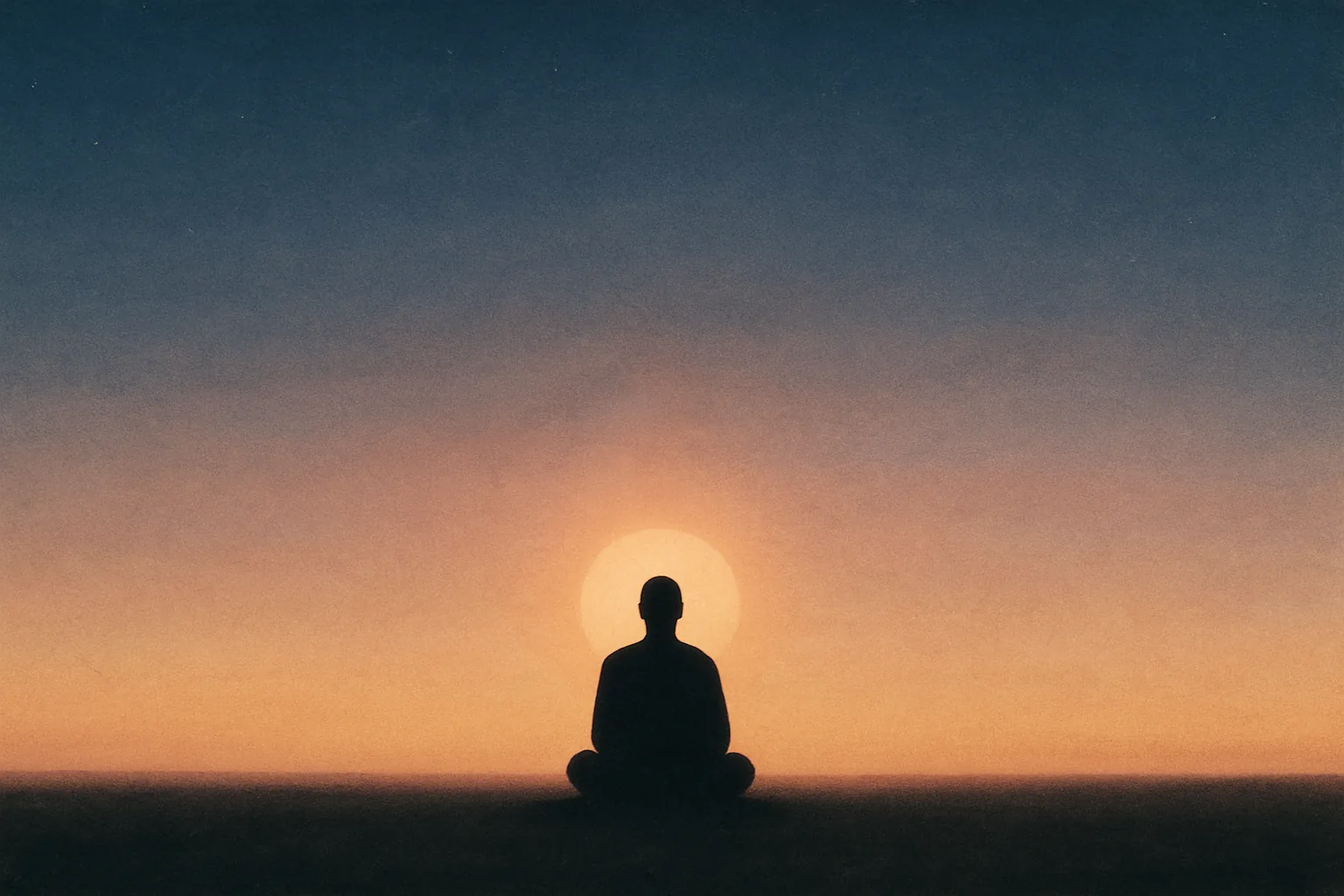
Drawn from a sutra of the Vigyan Bhairav Tantra—“Stop the doors of the senses when feeling the creeping of an ant. Then.”—this method turns any immediate sensation into a doorway to the center. Osho’s commentary preserves the directness of the original: do not wait for perfect conditions or rare signs; the ordinary itch, a throb of pain, the coolness of bedsheets—anything will do. In the instant a sensation claims you, withdraw the senses, become utterly still, stone-like, and the world recedes. Then—the thing happens: you are thrown back to yourself.
This practice is subtle yet simple in form. It trains pratyahara (sense-withdrawal) through a brief suspension of breath and a radical somatic image: “I am a stone.” No movement, no window to the outside. As identification with the body’s signals loosens, the sensation grows distant, even disappears, and a quiet, centerless clarity appears. The method can be done anywhere, is outwardly unobtrusive, and serves both as an intensive meditation and a spontaneous in-the-moment shift from reactivity to presence.
Phase Instructions
Preparation: Private, simple setting
Choose a posture you can keep still—sitting upright or lying down. You need only a few minutes and enough privacy not to be disturbed. This method is externally unobtrusive; you can also practice it wherever a sensation finds you (at home, in bed, on a chair).
Select the trigger: Anything will do
Let a live sensation present itself: an itch, a throb, a pressure point, the creeping of an ant, the sting of a thorn, a headache, the coolness or roughness of sheets. Do not search for a special sensation; take the first that is naturally there. Resist the impulse to fix, scratch, or adjust—use the urge itself as energy for the method.
Close the doors of the senses
As the sensation becomes distinct, immediately withdraw the senses. Gently close the eyes and feel as if you are blind; let the ears turn inward as if you cannot hear; let smell, taste, and skin-contact fade as if switched off. To seal the withdrawal, after a natural exhale, suspend the breath for a brief, comfortable moment—just enough that the senses dim together. Do not strain. If breath returns, let it, then gently pause again if needed.
Become stonelike: Absolute immobility
Now be a stone, a statue—dense, heavy, unmoveable. No adjusting, no fidgeting, no micro-movements. Allow the image to saturate the body: stone eyelids, stone limbs, stone torso. Feel as if you have no window to the outside. Remain closed to the world and thus also closed to the body’s claims.
Let the sensation recede; stay with the center
Do not fight the sensation and do not follow it. From within the stone-stillness, simply notice: the sensation grows distant, as if happening to someone far away; it may thin out and disappear. Allow this distancing to complete itself. When it does, rest in the silent center that remains—alert, unmoving, effortless. If the breath needs to flow, let it resume softly without breaking the inner stillness.
Release and integration
When the round feels complete, gently let go of the stone image. Breathe naturally. Reopen the senses slowly—first hearing, then sight. Move a little. Notice how the body and the world reappear while the center remains. Repeat with any new sensation that arises, on the spot, throughout the day.
Everyday use and notes
Use this anywhere: when an ant creeps, when pain spikes, when sheets feel cold—anything will do. The key is immediacy: as soon as the sensation is vivid, withdraw, become stonelike, and let the world fall away. Keep breath suspensions gentle and brief; never strain. With practice, the shift to the center becomes instantaneous, and once you can look from your center, you cannot be the same again.
Core Benefits
- Enhances ability to turn any sensation into a doorway to self-awareness.
- Trains sense-withdrawal through a suspension of breath.
- Promotes a centerless clarity and loosening of body signal identification.
- Facilitates spontaneous shift from reactivity to presence.
- Can be practiced anywhere in an unobtrusive manner.
What Osho Said About This Technique
When wolves were discovered in the village near master shoju's temple, shoju entered the graveyard nightly for one week and sat in zazen. This put a stop to the wolves' prowling.
OVERJOYED, THE VILLAGERS ASKED HIM TO DESCRIBE THE SECRET RITES HE HAD PERFORMED. 'I DIDN'T HAVE TO RESORT TO SUCH THINGS,' HE SAID, 'NOR COULD I HAVE DONE SO. WHILE I WAS IN ZAZEN A NUMBER OF WOLVES GATHERED ROUND ME, LICKING THE TIP OF MY NOSE, AND SNIFFING MY WINDPIPE, BUT BECAUSE I REMAINED IN THE RIGHT STATE OF MIND, I WASN'T BITTEN. AS I KEEP PREACHING TO YOU, THE PROPER STATE OF MIND WILL MAKE IT POSSIBLE FOR YOU TO BE FREE IN LIFE AND DEATH, INVULNERABLE TO FIRE AND WATER. EVEN WOLVES ARE POWERLESS AGAINST IT. I SIMPLY PRACTICE WHAT I PREACH. ... You cannot see both together. They are contradictory. They cannot be seen together. When you see the figure, the background disappears; when you see the background, the figure disappears. Mind has a limited capacity to know -- it cannot know the contradictory. That s why
This not-feeling of the leg or the body is not a good state. You should feel. The more inner awareness, the more you will feel. Do not worry—quietly change the leg. Non-resistant—no opposition—quietly change. If the neck tires, moves forward or back—let it go. Let the body do what it will—without any opposition. Keep only this in mind: I will not oppose anything. I will sit silently. I will let happen what is happening. I will not hold onto anything—"let this happen"—I will allow what is happening to happen. If breezes come—fine; if not—fine. If someone shouts—fine; if not—fine. I accept everything—total acceptability. I oppose nothing. Sit in this mood for ten minutes. So, it will be good if you sit a little apart from one another—because you may be in this mood, but your neighbor may not be. A little distance, so no one touches anyone.
यह जो पैर का पता न चलना है, या शरीर का पता न चलना है, यह कोई अच्छी स्थिति नहीं है। आपको पता चलना चाहिए। भीतर होश है, कांशसनेस जितनी ज्यादा होगी, पता चलेगा। उसकी कोई फिकर न करें, चुपचाप पैर को बदल लीजिए। नॉन-रेसिस्ट, कोई विरोध नहीं, चुपचाप पैर बदल लीजिए। गर्दन थक गई हो, आगे-पीछे जाती हो, जाने दीजिए। ऐसे जाने दीजिए जैसे आपका कोई विरोध नहीं है, जो हो रहा है शरीर को करने दीजिए। आप इतना ही भर खयाल रखिए कि मैं किसी चीज का विरोध नहीं करूंगा, चुपचाप बैठा रहूंगा। होने दूंगा जो हो रहा है, मैं किसी चीज पर पकड़ नहीं रखूंगा कि ऐसा हो, वह जो हो रहा है होने दूंगा। हवाएं आएंगी तो ठीक, नहीं आएंगी तो ठीक। कोई चिल्लाएगा तो ठीक, नहीं चिल्लाएगा तो ठीक। मैं सब कुछ स्वीकार करता हूं, टोटल एक्सेप्टिबिलिटी, और मैं किसी चीज का विरोध नहीं करता हूं। बस इस भाव में एक दस मिनट हम यहां बैठेंगे।
Common Questions
Begin by waiting for any immediate sensation like an itch or a pain, then withdraw your senses and become still and stone-like.
Yes, this method can be done anywhere and remains outwardly unobtrusive.
No, there are no special conditions required—ordinary sensations can be used as triggers.
Upon correct practice, the sensation grows distant, and a quiet, centerless clarity appears.