
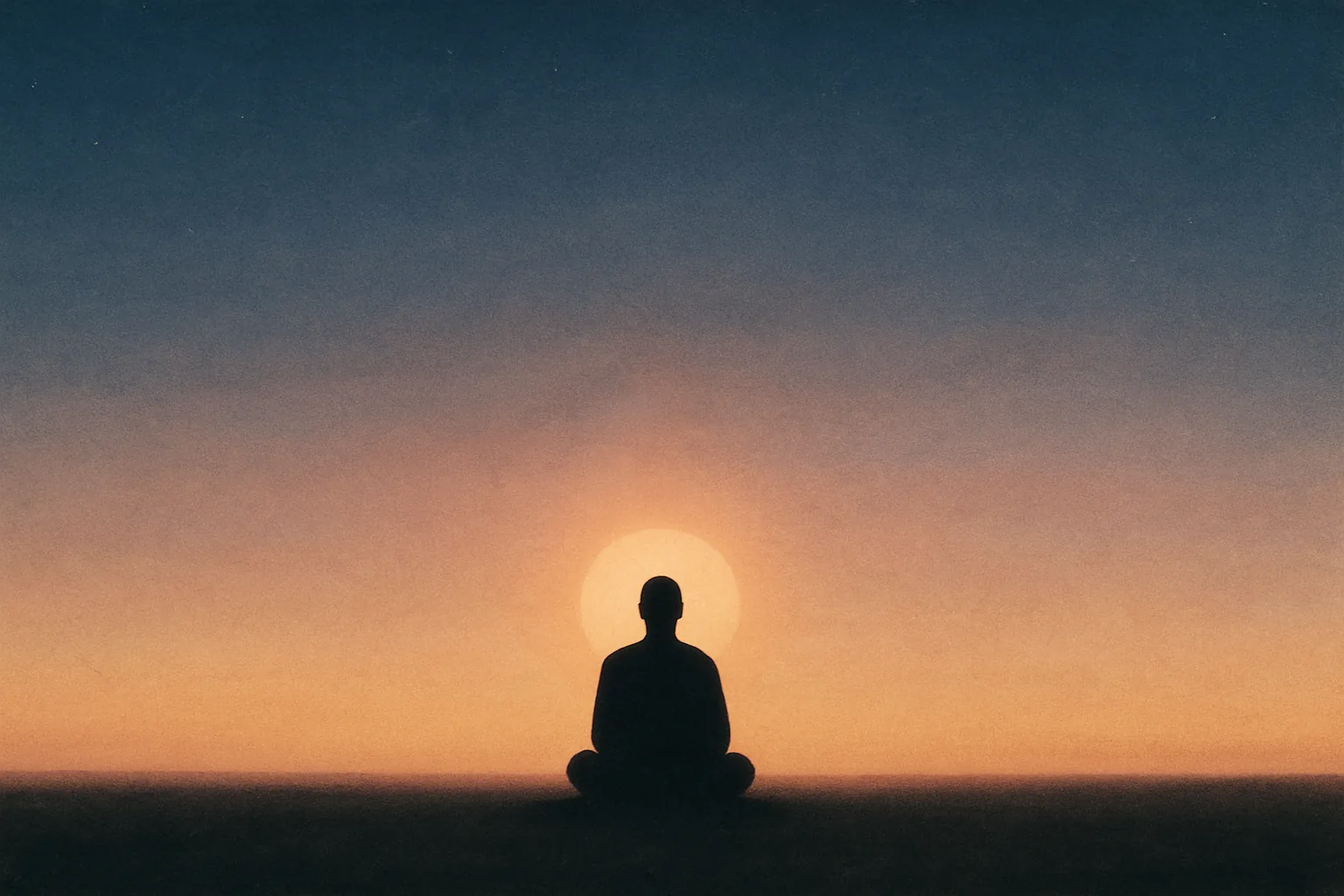
Fragrance of a Conscious Life distills Osho’s radical redefinition of meditation: not a ritual performed at a fixed hour, but a living quality of presence that permeates every breath, movement, and interaction. Celebrated each year on Dhyan Diwas—Osho’s birthday—this approach honors his vision and vast offering of methods while affirming a deeper truth: meditation is the very heartbeat of inner transformation, a way of being rather than a technique to perform.
This practice invites you to let awareness silently perfume the entire day. Instead of a single posture or set time, you weave consciousness through ordinary acts—walking, speaking, eating, working, resting—so the divide between “practice” and “life” dissolves. Respecting individual uniqueness, you choose simple anchors that fit your nature and return to them again and again, gently, without rigidity. In doing so, you discover meditation as a natural state: present, fluid, and alive.
Phase Instructions
First Stage: Light the Intention on Waking
As you open your eyes, feel your first few breaths and the weight of your body on the bed. Silently affirm: “Today, awareness will fragrance everything I do.” Choose one or two personal anchors to revisit all day—e.g., the natural breath, sensations in your hands or feet, the heart area, or ambient sounds. Keep it simple. No ritual, no compulsion—just a clear, tender intention to remember.
Second Stage: Micro-Pauses at Every Transition
Each time you cross a threshold or switch activities—standing up, sitting down, opening a door, starting a call, sending a message—stop for 3 conscious breaths. Relax your jaw and shoulders, feel the ground beneath you, sense the whole body at once. Let haste drain out on the exhale. Then move on, a shade more present than before.
Third Stage: Moving as Meditation
While walking or doing any task (cleaning, commuting, working), let awareness ride the body’s rhythm. Feel the contact of your feet with the earth, weight shifting, the play of balance. For a minute, slow down by about 10% to cut through autopilot, keeping the breath natural and the gaze soft. Let movements be efficient yet unhurried, precise yet relaxed.
Fourth Stage: Speaking and Listening in Presence
Before speaking, touch your anchor—one felt breath, a quick sense of the heart or belly—and allow your words to arise from clarity rather than habit. While listening, rest attention in the space of hearing and in the chest simultaneously. Notice urges to interrupt; let them pass. Savor the silences between words. Let communication become a shared field of awareness.
Fifth Stage: Eating and Everyday Acts Without Ritualism
Turn daily acts into gateways. At meals, take the first bite with full attention—sight, aroma, texture, taste—then put the utensil down for a breath before the next mouthful. When washing hands, feel water on skin; when brewing tea, attend to sound, steam, warmth. No forced solemnity and no mechanical prayer—just intimate, unornamented presence.
Sixth Stage: Meeting Emotions with Spaciousness
When emotion surges, pause. Name it softly—“anger,” “sadness,” “fear”—and feel where it lands in the body. Breathe into that region without fixing or suppressing. Allow sensations to move and change. Refrain from acting out in the heat; let awareness be the container in which the wave rises, crests, and subsides.
Seventh Stage: Gentle Reminders Throughout the Day
Use cues to remember: a chime on your phone every hour, a tiny dot on your watch, a sticky note by the door. Each cue = one mindful breath and a whole-body check-in. If you forget for hours, notice that too—without judgment. The instant you remember, you are back.
Eighth Stage: Evening Integration
Before sleep, sit quietly for 10–20 minutes. Review the day in reverse, from now to morning, touching moments where presence was vivid and where it was lost. No blame—simply seeing. Let gratitude arise for even one clear breath. Feel the residue of effort dissolve; rest as simple awareness.
Ninth Stage: Falling Asleep Consciously
Lying down, sense the whole body as one field. Let attention settle lightly on the exhale or the heart. If thoughts appear, do not chase or resist; return to the chosen anchor with kindness. Allow sleep to arrive by itself, as awareness softly accompanies you across the threshold.
Tenth Stage: Personalize and Evolve
Adjust anchors, reminders, and emphasis to suit your nature and changing circumstances. On Dhyan Diwas—or any day you choose—devote the full day to this seamless awareness. Over time, let the practice shed even the sense of ‘practice,’ until presence is the ordinary fragrance of your life.
Core Benefits
- Transforms meditation into a living quality of presence.
- Weaves consciousness through everyday activities.
- Dissolves the divide between practice and life.
- Discovers meditation as a natural state.
- Encourages a personalized, gentler approach to meditation.
What Osho Said About This Technique
(God is less a personality and more a presence, a perfume, Osho reminds us.) The flower has a form, a personality. The fragrance is formless, it has no personality. It is there, it exists, but it exists not in a fixed form, it exists in a formless way. And that's what god is, a godliness. And the experience of this fragrance comes through meditation. There is no other way, there never has been, there never will be. The really religious person has only one thing to do, and that is to become meditative. And by using the very word 'meditation' there is a possibility of moving in a wrong direction -- because English has no exact word for 'dhyana'; meditation only comes close to it. English has three words: concentration, contemplation, meditation. Concentration is of the mind.
Osho, what is the first experience of samadhi like?
You will know only when it happens. It cannot be said; at most a few hints can be given. It is as if, in the dark, a lamp is suddenly lit. Or as if a dying patient, right at the edge of death, suddenly finds a medicine that works; life’s wave, life’s thrill spreads again—so it is. As if a corpse becomes alive—such is the first experience of samadhi. It is the taste of nectar. The experience of the ultimate music. But it will be only when it happens; and only then will you understand. You will not understand by my saying it. It is as with love. How can anyone explain it? To someone who has never loved, never known love, no matter how many explanations you offer—he will hear it all and still ask, “I haven’t understood; please explain a little more.” It is like explaining light to…
तीसरा प्रश्न: ओशो, समाधि का पहला अनुभव कैसा होता है?
होगा तो ही जानोगे। कहा जा सके, ऐसा नहीं है। कुछ-कुछ इशारे किये जा सकते हैं। जैसे अंधेरे में अचानक दीया जल जाये, ऐसा होता है। या जैसे बीमार मरता हो और अचानक कोई दवा लग जाये...मरते-मरते कोई दवा लग जाये; और जीवन की लहर, जीवन की पुलक फिर फैल जाये--ऐसा होता है। जैसे कोई मुर्दा जिंदा हो जाये--ऐसा होता है समाधि का पहला अनुभव। अमृत का अनुभव है। परम संगीत का अनुभव है। पर होगा तो ही होगा। और होगा तो ही तुम समझ पाओगे; मेरे कहने से समझ में न आ सकेगा। प्रेम में जैसा होता है। अब कोई किसी को कैसे समझाये? …
As waves come with water and flames with fire, so the universal waves with us.
WHEREVER YOUR MIND IS WANDERING, INTERNALLY OR EXTERNALLY, AT THIS VERY PLACE, THIS. WHEN VIVIDLY AWARE THROUGH SOME PARTICULAR SENSE, KEEP IN THE AWARENESS. ... So how does everything become synthetic? Ears hear, eyes see, hands touch, the nose smells, and suddenly somewhere inside you know that this is the same man that you are hearing and seeing and touching and smelling. This knower is different from the senses. Every sense reports to this knower, and in this knower, in the center, everything falls, fits and becomes one. This is miraculous. I am one, outside you. ... I am one! ... My body and body's presence, my body odor, my speaking, are one. Your senses will divide me. Your ears will report if I say something, your nose will report if there is some odor, your eyes will report if I can be seen and am visible. They will divide me into parts.
I am not saying to do anything. Meditation is not a doing at all, it is pure awareness. But a miracle happens, the greatest miracle in life. If you go on watching, tremendous and incredible things start happening. Your body becomes graceful, your body is no more restless, tense; your body starts becoming light, unburdened; you can see great weights, mountainous weights, falling from your body. Your body starts becoming pure of all kinds of toxins and poisons. You will see your mind is no more as active as before; its activity starts becoming less and less and gaps arise, gaps in which there are no thoughts. Those gaps are the most beautiful experiences because through those gaps you start seeing things as they are without any interference of the mind. Slowly slowly your moods start disappearing. You are no more very joyous and no more very sad.
Osho, you say that if there is awareness, then how are the two to be brought into harmony?
That is precisely the practice of active meditation: awareness. Awareness is the very means of going into emptiness in relation to all actions, to the movements of the mind as well. For example, if you lie there for half an hour—what will you do? In that half hour, whatever thoughts are moving in your mind, you are to be simply aware of them. Simply a witness—what else will you do? Just become a witness. Keep silently watching; let them move. But obstacles arise in our seeing. We become absorbed. We fail to remain a witness. We don’t even notice when we have become one with those very thoughts. That sense of awareness fades; a kind of stupor, a moorchha, comes in. A thought comes, a memory arises, and we stop being the watcher. We become part of that thought and of its flow. That is moorchha. And the opposite is…
प्रश्न: ओशो, आप जो बोलते हो कि जागरूकपना अगर है तो उन दोनों का समन्वय कैसे स्थित करेंगे?
वह सक्रिय ध्यान का ही प्रयोग है जागरूकता। समस्त क्रियाओं के प्रति, चित्त की क्रियाओं के प्रति शून्य में जाने का भी माध्यम जागरूकता ही है। जैसे आधा घंटा आप पड़े रहेंगे तो क्या करेंगे? उस आधे घंटे में आपके चित्त में जो भी विचार चल रहे हैं, उनके प्रति केवल जागरूक होना है। केवल साक्षी होना है, और क्या करिएगा? साक्षी भर हो जाना है। देखते रहना है चुपचाप, वे चलें। लेकिन हमारे देखने में बाधा आती है। हम तल्लीन हो जाते हैं। साक्षी नहीं रह पाते। हम कब उन्हीं विचारों में एक हो गए इसका पता नहीं रहता। यह बोध मिट जाता है, मूर्च्छा आ जाती है।
Common Questions
This meditation is not confined to a specific time or ritual; it integrates presence into every aspect of daily life.
Select simple practices that resonate with your nature and gently return to them throughout the day.
Yes, it encourages weaving awareness into ordinary acts, making it adaptable to any schedule.
No, the focus is on spreading awareness into each moment rather than meditating at a fixed time.
Success is marked by the fluidity and presence you experience in everyday life, rather than rigid adherence to technique.