
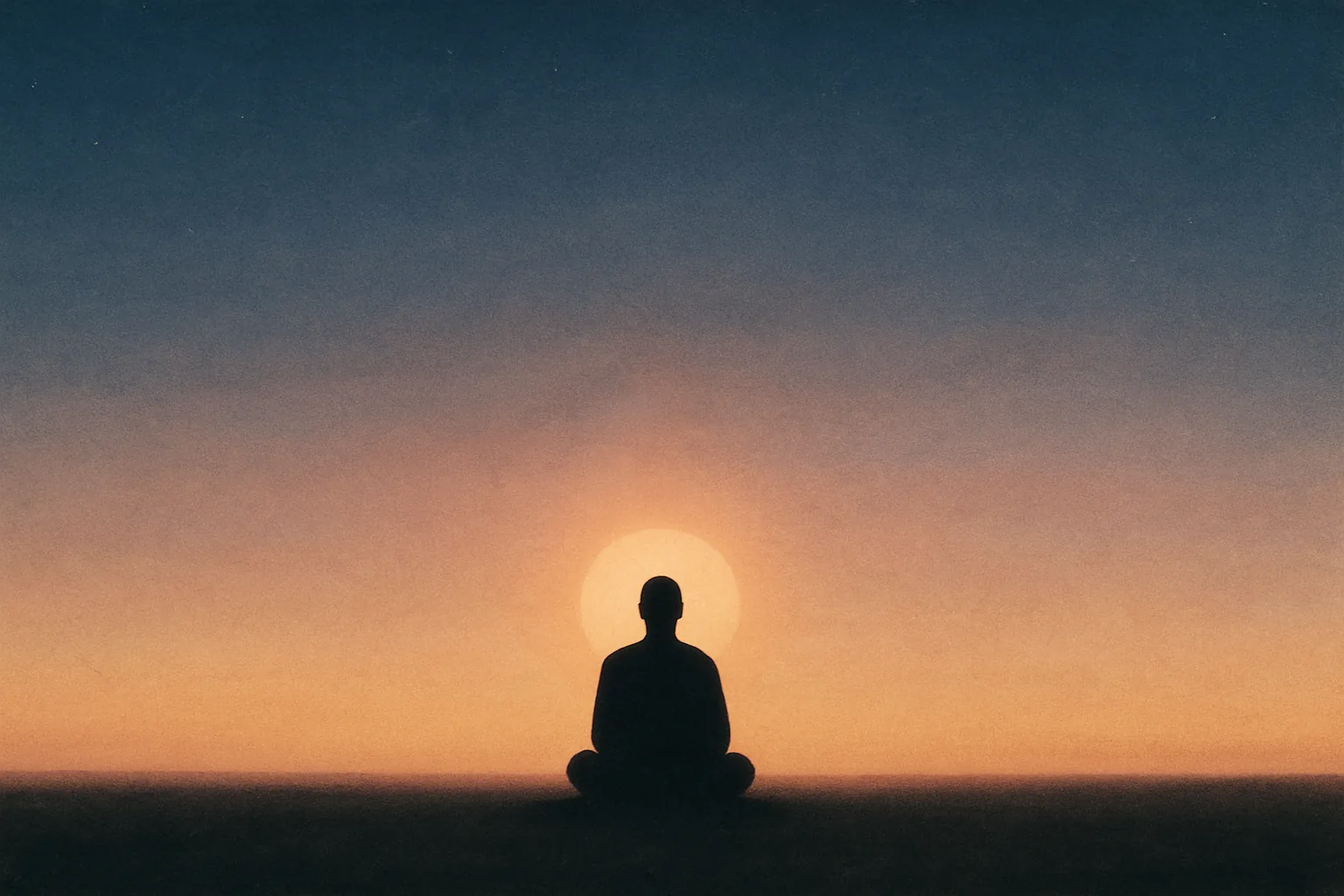
This intimate technique from the Vigyan Bhairav Tantra, echoed in Osho’s language, turns your attention to the two silent turning points of every breath. The in-breath moves down, the out-breath rises up—between these arcs there is a natural, effortless pause when breathing stops by itself. In that infinitesimal stillness, the teaching says, beneficence is revealed: a spacious, benevolent silence in which the small self loosens its grip.
Practice is disarmingly simple: remain natural, do not hold or control, and become vividly aware of the gap just after inhalation and just after exhalation. For a fraction of a moment, there is no breathing—only a universal pause. Rest your awareness there. As you attune to these moments, the mind settles, and the felt sense of “I” softens in the open quiet that contains both movement and stillness.
Phase Instructions
Arrival and Posture
Sit comfortably with an upright, relaxed spine. Close your eyes or keep them half-open and soft. Let the jaw, shoulders, and belly relax. Allow the breath to find its own rhythm—do not regulate, count, or hold. Simply feel the natural descent of the in-breath (down) and the ascent of the out-breath (up). Set the clear intention to observe, not interfere.
First Turning Point: After In-Breath (Down) — The Beneficence
Track the in-breath all the way to its natural completion, as if following a wave to the shore. Just after the breath comes in and before it turns to go out, notice the tiny, spontaneous stop. For a single instant—sometimes only a sliver of a moment—there is no breathing. Rest your awareness precisely in this pause. Do not prolong or force it; let it be exactly as it is. Sense the quiet, benevolent stillness that opens here.
Second Turning Point: After Out-Breath (Up) — The Universal Pause
Now follow the out-breath to its natural end. When the breath has gone all the way out and just before it turns to come in again, there is another unbidden stop. Recognize this gap and abide in it, alert and effortless. Again, do not hold the breath; simply remain aware of the breathless moment as it appears and dissolves on its own.
Continuous Cycle: Weaving Both Gaps
Let awareness ride the whole cycle of breathing. Feel the descent of inhalation, the pause after in-breath, the ascent of exhalation, the pause after out-breath. Touch each turning point lightly with clear attention. If a pause feels too brief to notice, keep attending to the very end of each breath—the gap will reveal itself. If thoughts arise, gently return to sensing the exact moment of stopping at each turn.
Integration and Closing
For the final minutes, release any deliberate tracking and rest in the overall sense of stillness that includes breath and gap alike. Let the taste of the beneficent pause pervade the whole body-mind. When ready, open your eyes softly. Carry the memory of the universal pause into ordinary activity, returning to it in any quiet moment of the day.
Core Benefits
- Reveals beneficence in moments of stillness
- Provides a spacious, benevolent silence
- Loosens the grip of the small self
- Allows the mind to settle
- Softens the felt sense of 'I' in open quiet
What Osho Said About This Technique
Osho! You were just here, you were just here. The fragrance of your breath is in these breezes. The whisper of your lovely footsteps is in the air. The earth and sky that beheld you… you were just here, you were just here. When I saw you, my breath simply stopped, my Master! These eyes would not lower. The moment I came to my senses, where did you hide? You were just here, you were just here.
Meera! If you want to know the divine, to attain it, you must sustain a very paradoxical kind of awareness. Paradoxical because from one side it is awareness, and from the other it is a kind of unawareness too—an ecstasy, a divine drunkenness that is not stupor but awakening; in which within, a lamp of meditation is lit, a flame of alertness burns. Love knows this art of paradox. Love is the key that opens the lock on that door. Love knows how to sway and yet remain centered within. Love knows how to close the eyes and still come to vision. Love knows how to move not even an inch, and yet complete a journey of a thousand miles. Reason will not grasp it. For thought it is inaccessible. But for love it is natural and easy. What is needed is an awareness colored by ecstasy; and an ecstasy…
पहला प्रश्न: ओशो! तुम अभी थे यहां, तुम अभी थे यहां। तुम्हारी सांसों की गंध इन हवाओं में है। प्यारे कदमों की आहट फिजाओं में है। तुम्हें देखा किए ये जमीं-आसमां तुम अभी थे यहां, तुम अभी थे यहां। तुम्हें देखा तो सांसें रुकी ही रहीं मेरे मालिक! ये आंखें झुकीं ही नहीं, होश आते ही तुम छुप गए हो कहां! तुम अभी थे यहां, तुम अभी थे यहां।
मीरा! परमात्मा को जानना हो, पाना हो, तो एक बहुत विरोधाभासी होश को सम्हालना होता है। विरोधाभासी इसलिए कि एक तरफ से वह होश है और दूसरी तरफ से बेहोशी भी। एक ऐसी अलमस्ती, एक ऐसी मदमस्ती, जो मूर्च्छा नहीं है, जो जागरण है। जिसमें भीतर एक ध्यान का दीया जल रहा है। जिसमें होश की ज्योति है। प्रेम विरोधाभास की इस कला को जानता है। प्रेम ही कुंजी है उसके द्वार पर लगे ताले को खोल लेने की। प्रेम जानता है कैसे डगमगाओ और फिर भी कैसे भीतर संभले रहो। प्रेम जानता है कि कैसे आंख बंद करो और फिर भी दर्शन को उपलब्ध हो जाओ। प्रेम जानता है कि इंच भर न चलो और हजारों मील की यात्रा पूरी हो जाए।
Osho, in this verse the fourth and final yajna is called the Yoga Yajna. In the Gita Press translation it is called the Ashtanga Yoga Yajna. Please clarify this as well.
Now a lovely thing: Om has A, U, and M. If you emphasize M, vibration immediately occurs at the navel. Islam has the word Allah. Sufi fakirs use the word Allah as with Om. “Allah”—the H lands just where M lands. “Allahu”—the Hu lands exactly at the navel where Om lands. Allah and Om are entirely different words, but the intent is one, and the result is one; the meaning too is one. The Sufi begins with Allah—Allah, then Lah, then Lahu, and finally only Hu remains. And Hu’s blow lands on the navel; and at the navel the sleeping master begins to awaken. By a thousand methods yoga awakens the sleeping master. And as soon as that master awakens, integration arises in the personality—yoga happens. Fragments gather together. The marketplace disappears; soldiers in formation stand. Then the personality obeys command. In the market’s crowd no one obeys; there is…
प्रश्न: ओशो, इस श्लोक का चौथा और आखिरी यज्ञ योग यज्ञ कहा गया है। गीता प्रेस के अनुवाद में इसे अष्टांग योग यज्ञ कहा गया है। कृपया इसे भी स्पष्ट करें।
अब यह बड़े मजे की बात है। ओम में अ, उ और म हैं। म आप जोर से कहें, तो नाभि पर फौरन कंपन होगा। इस्लाम के पास शब्द है, अल्लाह। सूफी फकीर ओम की तरह अल्लाह शब्द का प्रयोग करते हैं। अल्लाह, तो ह की चोट वहीं पड़ती है, जहां म की पड़ती है। अल्लाहू, तो हू की चोट ठीक वहीं पड़ती है नाभि पर, जहां ओम की पड़ती है। अब अल्लाह और ओम बिलकुल अलग-अलग शब्द हैं। लेकिन प्रयोजन एक है, और परिणाम एक है। अर्थ भी एक है। सूफी फकीर अल्लाह से शुरू करता है। अल्लाह, फिर लाह, फिर लाहू। और फिर हू ही रह जाता है। और हू की चोट नाभि पर पड़ती है। और नाभि पर सोया हुआ मालिक जगना शुरू होता है। हजार विधियों से योग सोए हुए मालिक को जगाता है। और उस सोए हुए मालिक के जगते ही व्यक्तित्व में इंटीग्रेशन, योग पैदा हो जाता है। खंड इकट्ठे हो जाते हैं। बाजार समाप्त हो जाता है। पंक्तिबद्ध सैनिक खड़े हो जाते हैं। फिर व्यक्तित्व आज्ञा मानता है। बाजार की भीड़ में कोई आज्ञा नहीं मानता। मानने का कोई सवाल भी नहीं है। …
As you go in, come out, you will become aware of two points. As you go in, there is a small, fragment of a moment when the breath stops before it starts moving outward. And the same happens outside: before it has moved outward, for a split second the breathing stops, before it again moves in. These two points are very significant, because as you become more and more aware, these points will become more and more clear, longer. One breath goes in and then there is a pause, breathing stops. And in that pause there is so much beauty, so much bliss. And the same happens outside; again the breathing stops. And these gaps go on becoming bigger and bigger, bigger and bigger.
And when the breathing is perfectly natural, goes on its own, comes on its own, and you are just a watcher, a moment comes when you suddenly feel that it is not you who is breathing. You are not doing anything, so how can you say 'I am breathing'? You simply feel as if you are breathed . That's what one sufi mystic, Mansoor, has said -- 'I suddenly saw that God is breathing me!' And after that he declared 'I am God' -- 'Ana-el-Haqq!' That became the crime, and he was murdered by mohammedans. But his experience was perfectly true... right, because when the doer disappears, you are not breathing -- you are breathed. 'That' is breathing you, or 'it' is breathing you. You are breathed through. You become just a vast space in which God breathes in and breathes out. And a total change happens.
Common Questions
The main focus is to become vividly aware of the natural pauses in breathing after inhalation and exhalation without controlling the breath.
The practice is disarmingly simple, as it involves remaining natural and becoming aware of the gap between breaths.
Rest your awareness in the universal pause after inhalation and exhalation, where no breathing occurs.