
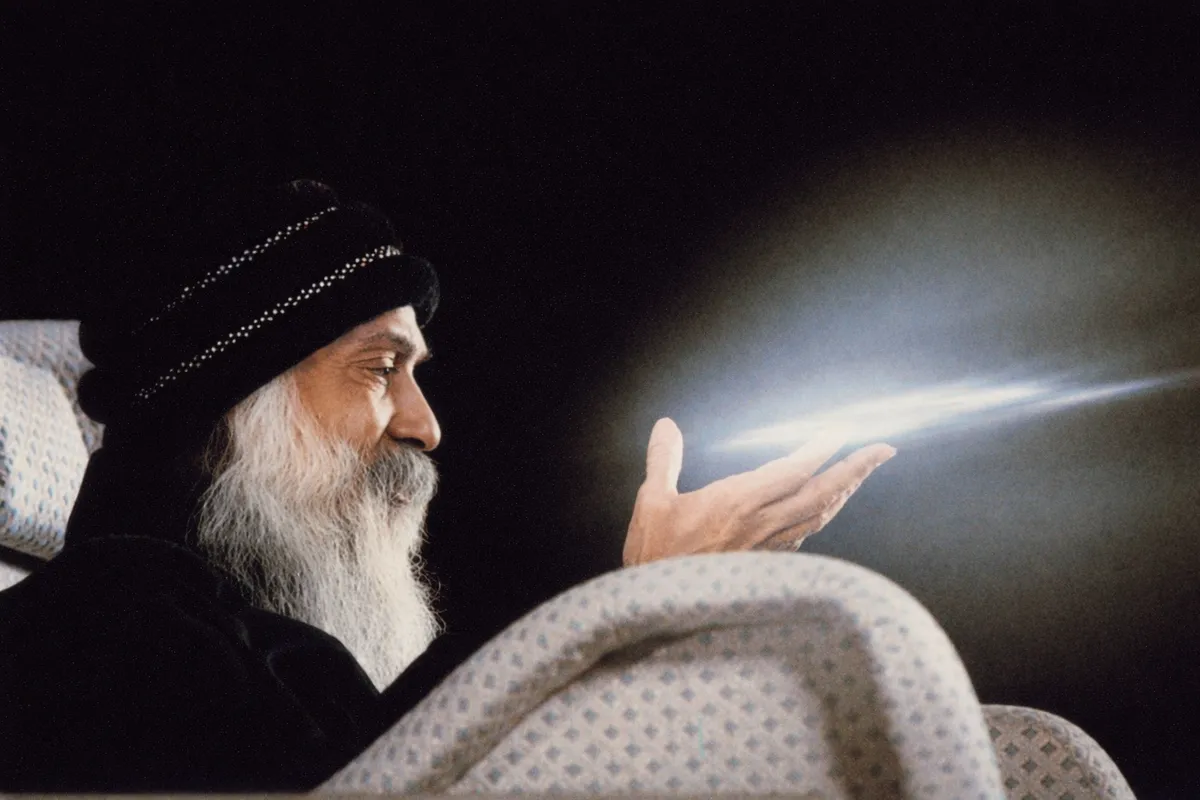
A master who prizes silence above all and yet talks for more than three decades: the paradox is the doorway to Osho's whole relationship with language. Silence has the greater power, he grants — but power needs a receiver, and ears trained only for words cannot hear the wordless. So speech becomes a device: the shout that stops you at the pit's edge, the sound used to smuggle in soundlessness.
Hence his claim, echoing Buddha and Mahavira, that in all those millions of words he never really said anything — the words were bait, the transmission was presence. The sections below give the distinction in Osho's own words, each linked to the full discourse.
The difference, in Osho's words
The short notes are Osho Live's; the quoted passages are his own words, checked against the talk.
Why Speak at All, If Silence Is Everything?
A questioner presses the obvious objection. Osho's answer: silence speaks only to those who have ears for it — the rest must first be shouted to.
Silence does have great power, but there has to be someone who can hear silence! Why does the need to speak arise? It arises because I see you heading toward a pit. I see that you will fall into it and break your arms and legs. I am standing here; I could say it to you from silence, but you don’t have ears to hear silence. So I shout, “You’ll fall into the pit!”
Silence and Speech across his talks
Each year, the share of Osho's talks in which the word is used — counted from 6,627 dated talks on Osho Live.
Lighter bars: years with few dated talks. Counts are of the words themselves, so they show how Osho's vocabulary moved — not every talk on the subject.
| Year | Silence | Speech | Dated talks |
|---|---|---|---|
| 1964 | 10 | 2 | 13 |
| 1965 | 11 | 8 | 19 |
| 1966 | 6 | 1 | 7 |
| 1967 | 24 | 3 | 33 |
| 1968 | 27 | 1 | 30 |
| 1969 | 85 | 19 | 110 |
| 1970 | 94 | 20 | 131 |
| 1971 | 78 | 23 | 111 |
| 1972 | 149 | 25 | 223 |
| 1973 | 164 | 30 | 205 |
| 1974 | 218 | 49 | 271 |
| 1975 | 250 | 24 | 303 |
| 1976 | 482 | 75 | 700 |
| 1977 | 459 | 63 | 679 |
| 1978 | 498 | 67 | 702 |
| 1979 | 507 | 70 | 683 |
| 1980 | 530 | 53 | 674 |
| 1981 | 95 | 8 | 122 |
| 1984 | 49 | 3 | 63 |
| 1985 | 301 | 28 | 356 |
| 1986 | 325 | 26 | 369 |
| 1987 | 446 | 42 | 486 |
| 1988 | 267 | 18 | 276 |
| 1989 | 59 | 15 | 61 |
More in his words
Talking Is to the Mind; Being Is to the Whole
Disciples sensed a second communication running beneath the discourse. Osho confirms it — the words are the carrier wave, not the message.
While I am talking to you, I am also BEING to you. Talking is relating to you through the intellect, and being is relating to you with my totality.
The Soundless Speech of Mahavira
Asked whether he, like Buddha, had spoken for decades without saying a word, Osho reaches for the Jain story of speech beyond language.
The story is that Mahavira never spoke, and yet people heard. This is a difficult matter: Mahavira did not speak, yet people heard. Mahavira did not speak in any language that the ears can hear. The Jains say his speech is soundless—nishabd. There are no words in it. Yet people heard—those who could. If they too became wordless, sat near Mahavira in silence, they heard.
From the discourses
Where Osho draws this distinction himself — each passage links to the exact place in the talk.
Osho, for forty years continuously Buddha gave discourses and sermons, and it is said that he did not speak a single word. Likewise, you too have been speaking and giving discourses for twenty years, and it could be said that you do not speak a single word. Is this true?
There is a sweet story about Mahavira. The Jains, in their rigidity, clung to the letter and missed the essence. The story is that Mahavira never spoke, and yet people heard. This is a difficult matter: Mahavira did not speak, yet people heard. Mahavira did not speak in any language that the ears can hear. The Jains say his speech is soundless—nishabd. There are no words in it. Yet people heard—those who could. If they too became wordless, sat near Mahavira in silence, they heard. Therefore there is another story in Mahavira’s life, important to note: wild animals heard him, gods of the sky came to listen, birds and beasts came, ghosts and spirits were present. The Jains have great difficulty explaining how birds and beasts can hear. Certainly, if Mahavira spoke in a language, then even among humans only those who knew that tongue could understand. If I am…
प्रश्न: ओशो, भगवान बुद्ध निरंतर चालीस वर्ष तक प्रवचन और उपदेश करते रहे, और कहा गया कि वे एक शब्द भी नहीं बोले। वैसे ही आप भी बीस वर्षों से निरंतर बोल रहे हैं, उपदेश कर रहे हैं, और कहा जा सकता है कि आप एक शब्द भी नहीं बोलते। क्या यह सच है?
महावीर के संबंध में बड़ी मीठी कथा है। जैन तो जड़ता से पकड़ लिए, इसलिए उसका सार नहीं निकाल पाए। कथा यह है कि महावीर बोले ही नहीं, फिर भी लोगों ने सुना। अब यह बड़ा मुश्किल मामला है। महावीर बोले नहीं, लोगों ने सुना। महावीर ऐसी किसी वाणी से नहीं बोले, जो कान सुन लें। तो महावीर की जो वाणी है, जैन कहते हैं, निःशब्द है। उसमें कोई शब्द नहीं है। फिर भी लोगों ने सुना--जो सुन सकते थे। अगर वे भी निःशब्द हो गए, महावीर के पास जाकर बैठ गए, तो उन्होंने सुना। इसलिए महावीर के जीवन में एक और कथा है, जो महत्वपूर्ण है, और वह यह कि महावीर को जंगली जानवरों ने भी सुना, आकाश के देवता भी सुनने आए, पशु-पक्षी भी सुनने आए, भूत-प्रेत भी मौजूद हुए। जैनों को बड़ी मुश्किल होती है समझाने में कि पशु-पक्षी कैसे सुनेंगे। निश्चित ही, अगर महावीर भाषा बोलते हों, तो पशु-पक्षी तो दूर, सारे मनुष्य भी नहीं समझ सकते। अब अगर मैं हिंदी बोल रहा हूं, तो जो हिंदी समझता है, वही समझ सकता है। जमीन पर हजारों भाषाएं हैं, वे लोग नहीं समझ सकते। …
Osho, every time after speaking I feel I have been dishonest; only when I remain silent do I feel honest—completely honest with myself. Why is this?
At Harvard University, psychologists ran an experiment. They split a class into two groups. To one half, in a separate room, they said: “The problem on the board is very difficult. There is hardly any hope that any of you can solve it. Even students in higher classes struggle with it. Only great mathematicians can solve it. We’re giving it just to see—by chance, perhaps—there is no assurance at all—maybe one of you might head a little in the right direction. Solving it completely is impossible, still try.” They tried. Out of fifteen students, only three solved it. To the other fifteen, in another room, they said—about the same problem—“It’s very simple. So simple that if any of you fail to solve it, it would be surprising. Students in lower classes have solved it.” Amazingly, twelve solved it; only three failed. What happened? Your confidence is borrowed—others hand it to…
पहला प्रश्न: ओशो, हर बार बोलने के बाद ऐसा अनुभव होता है कि मैंने बेईमानी की; चुप रहने पर ही अपने साथ ईमानदारी, पूरी ईमानदारी करती मालूम होती हूं। ऐसा क्यों है?
हार्वर्ड विश्वविद्यालय में मनोवैज्ञानिक एक प्रयोग कर रहे थे। उन्होंने एक कक्षा के विद्यार्थियों को दो हिस्सों में बांट दिया। आधे विद्यार्थियों को कहा अलग कमरे में, यह सवाल जो तख्ते पर लिखा जा रहा है, बहुत कठिन है; यह इतना कठिन है कि कोई आशा नहीं कि तुम में से कोई भी इसे हल कर पाएगा। तुमसे ऊपर की कक्षाओं के विद्यार्थी भी इसे हल करने में कठिनाई पाते हैं। यह तो बड़े गणितज्ञ ही इसे हल कर सकते हैं। लेकिन सिर्फ जानने के लिए दिया जा रहा है, हो सकता है संयोग से, शायद--इसका कोई जरा भी आश्वासन नहीं है--शायद तुम में से कोई थोड़ा-बहुत इसको हल करने की दिशा में ठीक चल पाए। पूरा हल कर पाए, यह तो हो नहीं सकता, फिर भी कोशिश करो।
Osho, if silence has so much power, why does anyone speak at all? If silence has great power and silence is everything, then why are words spoken? Why does anyone speak?
Silence does have great power, but there has to be someone who can hear silence! Why does the need to speak arise? It arises because I see you heading toward a pit. I see that you will fall into it and break your arms and legs. I am standing here; I could say it to you from silence, but you don’t have ears to hear silence. So I shout, “You’ll fall into the pit!” In that, is my power lost? Is there any harm in that? No, no, no—nothing is lost. The one who has come to know power never loses anything. The one who has not known keeps losing everything. The one who has known never loses anything. In whatever form, to speak of the wordless we use words... That is exactly what I am saying: the difficulty is that if I write something like an autobiography, it will…
ओशो, जब मौन में इतनी शक्ति है तो फिर कोई कहता ही क्यों है? मौन में बहुत शक्ति है और मौन ही सब-कुछ है, तो फिर शब्द क्यों कहे जाते हैं? कोई क्यों कहता है?
मौन में तो बहुत शक्ति है, लेकिन मौन को सुनने वाला चाहिए न! सुनाने की जरूरत क्यों पड़ती है? जरूरत इसलिए पड़ती है, जरूरत इसलिए पड़ती है कि तुम्हें मैं देख रहा हूं कि तुम गड्ढे में जा रहे हो। तुम्हें मैं देख रहा हूं कि तुम गिरोगे गड्ढे में, हाथ-पैर तोड़ लोगे। मैं खड़ा हूं, मैं मौन से कह सकता हूं, लेकिन मौन से सुनने का तुम्हारे पास कान नहीं है। तो मैं चिल्ला कर कहूं कि गड्ढे में गिर जाओगे! उसमें अपनी शक्ति लूज हुई, इसमें कोई हर्जा नहीं है? न, न, न, कुछ लूज तो होती ही नहीं है। जिसको शक्ति का पता चल गया उसका कुछ कभी नहीं खोता। जिसको पता नहीं चला उसी का सब खोता रहता है। जिसको पता चल गया उसका कभी कुछ नहीं खोता। किसी भी रूप में निःशब्द को कहने के लिए शब्द का प्रयोग किया जाता है...।
Osho, you have often said that the true master calls the disciple close, and then also sends him away. How can one know whether the master has sent him away in displeasure, out of anger, or as a blessing, out of joy, for the disciple’s further growth?
First thing: a master who gets angry is no master. Second: a disciple who, when sent away, thinks it must have been out of displeasure is not of the right mettle for discipleship. The master does not get angry; the very possibility of anger has ended. If ever a master seems angry, know that he is acting—for sometimes there is no other way. Gurdjieff would often appear angry—so angry it seemed there would be bloodshed. Those who ran away were deprived. Those who still remained came to know how rare it is to find a heart as tender as his. But why would he behave so angrily? Perhaps that was exactly what was needed for the disciple. Such things happened—and only Gurdjieff could do them—that two people would come to see him, one seated on the left, one on the right. When he looked to the left, it was with…
पांचवां प्रश्न: ओशो, आपने अनेक बार कहा है कि सदगुरु शिष्य को पास भी बुलाता है, फिर दूर भी करता है। कैसे पता चले कि सदगुरु ने अप्रसन्नता से, नाराज होकर दूर किया है, या आशीर्वाद रूप से, प्रसन्नता से, आगे के विकास के लिए शिष्य को दूर किया है?
पहली बात, जो गुरु नाराज हो, वह गुरु नहीं। और दूसरी बात, जो शिष्य दूर किए जाने पर ऐसा सोचे कि अप्रसन्नता से दूर किया होगा, वह शिष्य की योग्यता का नहीं। गुरु नाराज नहीं होता। नाराज होने की बात ही समाप्त हो गई है। अगर कभी गुरु नाराज भी दिखे, तो जानना कि अभिनय करता होगा; क्योंकि अन्यथा कोई उपाय नहीं है। गुरजिएफ बहुत बार नाराज हो जाता था। ऐसा नाराज हो जाता था कि जैसे खून-खराबा कर देगा। जो भाग जाते थे, वे वंचित रह जाते थे। जो फिर भी टिके रहे, वे जानते थे कि उस जैसा कोमल हृदय पाना कठिन है। लेकिन फिर वह इस तरह नाराज क्यों हो जाता था? शायद वही शिष्य के लिए जरूरी था। ऐसी भी घटनाएं घटी हैं--और वह गुरजिएफ ही कर सकता था, कि दो व्यक्ति मिलने आए हैं, एक बाएं बैठा है, एक दाएं, जब वह बाएं की तरफ देखे, तो नाराजगी से और दाएं की तरफ देखे तो बड़े प्रेम से। और दोनों जब बाहर गए तो वे विवाद में पड़ गए कि यह आदमी कैसा है? …
Beloved Osho, your words are so beautiful, yet we feel there is also another communication happening when you are talking to us. Would you talk to us about silent communication, and how we can become more open to it.
It is always there. While I am talking to you, I am also BEING to you. Talking is relating to you through the intellect, and being is relating to you with my totality. While you are listening to me, if you are really listening, then it is not only a listening to the words. Listening to me, your mind stops. Listening to me, you are not thinking. When you are not thinking, you are open. And when you are not thinking and your mind is not functioning, you start feeling. Then I can overwhelm you, I can move and fill you. Words are used only as a device. I myself am not interested much in words. But I have to speak, because this has been my feeling: while I am speaking you become silent. If I am not speaking, then you are speaking within and you are not silent. If…
Frequently asked
If Osho valued silence, why did he speak so much?
He called speaking a device: most people cannot hear silence, so words are used to catch the mind, quiet it, and point past themselves. He observed that while he spoke, his listeners stopped speaking inside — the discourse produced the very stillness it talked about. The goal of his words, he said repeatedly, was to persuade you to be silent.
What did Osho mean by saying he never said anything?
Truth, in his teaching, is wordless — whatever reaches language is already a translation, and whatever the listener receives is a translation of that. So the essential thing was never in the sentences; it traveled as presence, in the gaps and the meeting itself. Like Buddha's forty years of unspoken speaking, the words were fingers pointing to the moon.
Is silence just the absence of speech?
No — mere not-talking can still be noisy with inner chatter. Real silence is the absence of the inner speaker, not the outer voice. That is why a master's silence can communicate — and why, as with Mahavira's soundless speech, only those who themselves become wordless can hear it.