
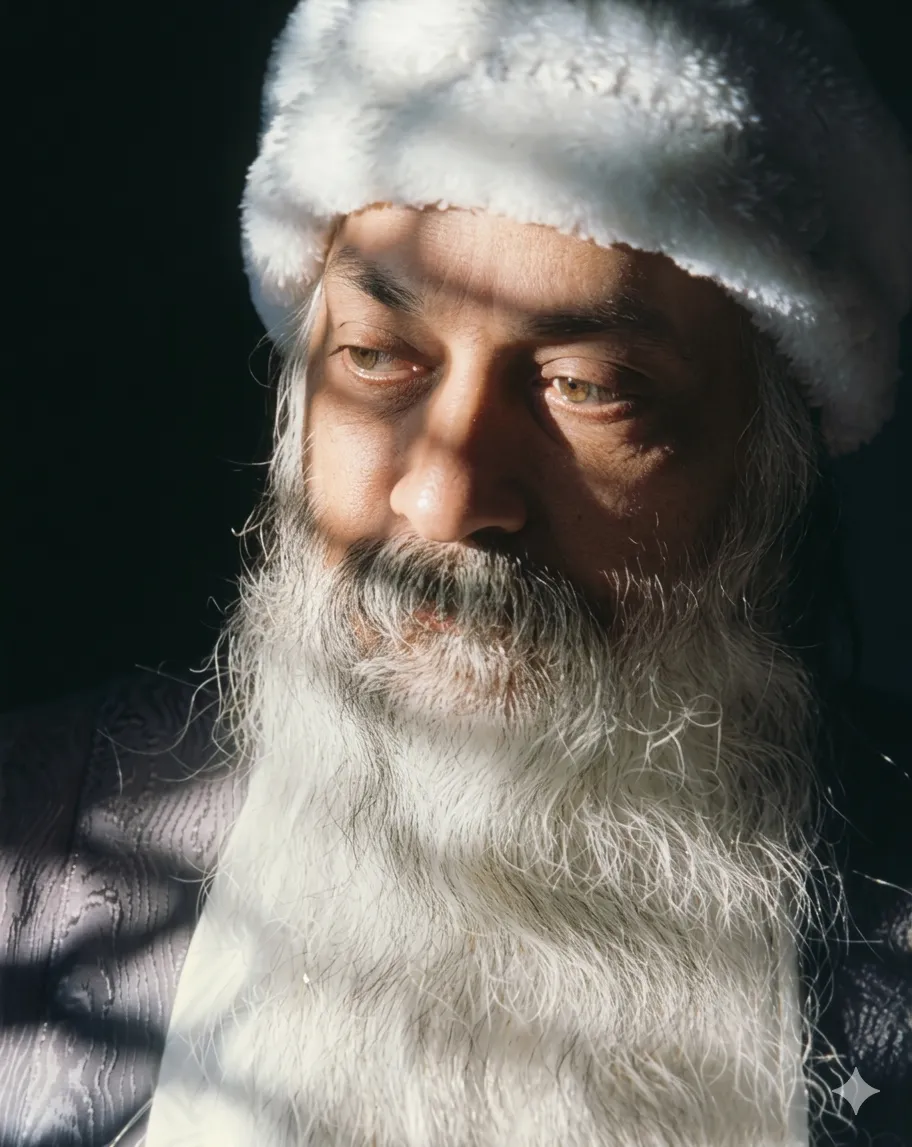
Many people — and many meditation teachers — treat the two words as synonyms. Osho treats them as opposite dimensions that never cross paths. Concentration is a faculty of the mind: energy forced to a single point, invaluable for science and work, and always a strain, because the excluded world keeps knocking. Meditation is not a narrowing but an opening — no chosen object, no exclusion, no effort of will.
One image makes the contrast physical: meditation is a mirror, reflecting whatever passes without holding anything. The sections below give the distinction in Osho's own words, each linked to the full discourse.
The difference, in Osho's words
The short notes are Osho Live's; the quoted passages are his own words, checked against the talk.
Not Related at All
Asked how one-pointedness, concentration and meditation connect, Osho begins by demolishing the premise.
one-pointedness, concentration and meditation are not related to each other at all. This is one of the confusions prevalent all over the world. One-pointedness is another name for concentration, but meditation is just the opposite of concentration.
Concentration and Meditation across his talks
Each year, the share of Osho's talks in which the word is used — counted from 6,627 dated talks on Osho Live.
Lighter bars: years with few dated talks. Counts are of the words themselves, so they show how Osho's vocabulary moved — not every talk on the subject.
| Year | Concentration | Meditation | Dated talks |
|---|---|---|---|
| 1964 | 5 | 12 | 13 |
| 1965 | 2 | 15 | 19 |
| 1966 | 0 | 6 | 7 |
| 1967 | 4 | 19 | 33 |
| 1968 | 3 | 23 | 30 |
| 1969 | 18 | 82 | 110 |
| 1970 | 23 | 103 | 131 |
| 1971 | 18 | 85 | 111 |
| 1972 | 44 | 175 | 223 |
| 1973 | 33 | 183 | 205 |
| 1974 | 35 | 250 | 271 |
| 1975 | 40 | 283 | 303 |
| 1976 | 88 | 628 | 700 |
| 1977 | 83 | 599 | 679 |
| 1978 | 73 | 631 | 702 |
| 1979 | 69 | 584 | 683 |
| 1980 | 68 | 629 | 674 |
| 1981 | 13 | 110 | 122 |
| 1984 | 11 | 32 | 63 |
| 1985 | 70 | 275 | 356 |
| 1986 | 50 | 311 | 369 |
| 1987 | 77 | 405 | 486 |
| 1988 | 36 | 235 | 276 |
| 1989 | 8 | 58 | 61 |
More in his words
Within the Mind vs Beyond the Mind
In an early darshan, Osho gives the distinction its sharpest geometry — two dimensions that never meet.
Not only are they not synonymous, they are absolutely opposite dimensions. They never meet anywhere, they never cross each other's path -- different worlds altogether. Concentration is something within the mind and meditation is something beyond the mind.
The Clenched Child and the Mirror
Concentration suppresses the mind's traffic; meditation watches it pass. Osho's mirror image is the practical heart of his whole approach.
Meditation is a non-focussed awareness. Meditation is more like a mirror: you simply watch whatsoever goes on happening in the mind. A thought comes, a thought arises, stays there for a time being, then moves, goes out, comes in from this door, goes out from another door; even another thought arises.
From the discourses
Where Osho draws this distinction himself — each passage links to the exact place in the talk.
[NOTE: This is an unedited tape transcript of an unpublished darshan diary, which has been scanned and cleaned up. It is for reference purposes only.] [Osho spoke about the difference between meditation and concentration. In the past the two have been thought to be synonymous, and they are not.] Not only are they not synonymous, they are absolutely opposite dimensions. They never meet anywhere, they never cross each other's path -- different worlds altogether. Concentration is something within the mind and meditation is something beyond the mind. Concentration has its own utility. If you are working on a scientific project then concentration is needed; then you have to focus all your mind-energy on a single point.
Osho, what is meditation?
But he was no ordinary man either -- otherwise they would have forced him -- he was the king of Varanasi. He said to the doctors, "But don't be worried" -- and the best doctors available in India were there; one expert from England was there. They all consulted: nobody was ready to do this operation, but the operation had to be done, otherwise any moment the appendix could kill the man. The state was serious, and both the alternatives seemed to be serious: if you left him without the operation he might die; if you did the operation without making him unconscious -- which had never been done, there was no precedent.... But the king said, "You don't understand me. There has never been any precedent because you have never operated on a man like the man you are going to operate upon. Just give me my religious book,…
The official, riko, once asked nansen to explain to him the old problem of the goose in the bottle. "if a man puts a gosling into a bottle," said riko, "and feeds him until he is full grown, how can the man get the goose out without killing it or breaking the bottle?" nansen gave a great clap with his hands and shouted, "riko!" "yes, master," said the official with a start. "see," said nansen, "the goose is out!"
To carry fantasies about the future is a problem. A passport is not such a burden. To think about tomorrow and to go and book a ticket is not a problem. These are factual things, ordinary, practical things. But to think that tomorrow you will be happy, not today, that tomorrow you will love, not today, that tomorrow you will sing, not today, is dangerous -- because tomorrow never comes. Again when it comes, it will be today, and your old habit will say, "Tomorrow I will be happy." Tomorrow again and again, you will be happy, and you will never be happy. What I am saying is psychological future has to be dropped. The ordinary future is okay, it is not a problem at all. The fifth layer consists of conditionings. You have been conditioned -- Hindu, Mohammedan, Jaina, Buddhist, English, German, Indian -- these layers are there. Start…
Beloved Osho, how are one-pointedness, concentration and meditation related to each other?
Prem Dinesh, one-pointedness, concentration and meditation are not related to each other at all. This is one of the confusions prevalent all over the world. One-pointedness is another name for concentration, but meditation is just the opposite of concentration. But in most of the books, in most of the dictionaries, and by the so-called teachers, they are used as if they are synonymous. Concentration simply means one-pointedness. It is something of the mind. Mind can be a chaos, a crowd. Mind can be many voices, many directions. Mind can be a crossroads. Ordinarily, that's what mind is, a crowd. But if the mind is a chaos, you cannot think rationally, you cannot think scientifically. To think rationally and scientifically, you have to be concentrated on the object of your study. Whatever the object is, the one thing necessary is that you are pouring your whole mental energy onto that object.…
But concentration is like when you force a child to sit in the corner of a room and be silent. Tell him to be silent, 'Be quiet, don't move,' and see what happens to him. He will force himself, he will close his eyes, his eyes will be clenched shut and he will be boiling within. He will be restless and he will want to jump out of himself. And that's what happens to people who try to concentrate. Meditation is a non-focussed awareness. Meditation is more like a mirror: you simply watch whatsoever goes on happening in the mind. A thought comes, a thought arises, stays there for a time being, then moves, goes out, comes in from this door, goes out from another door; even another thought arises. There is a constant procession, a traffic of thoughts, desires, memories, imagination.
Frequently asked
What is the difference between concentration and meditation according to Osho?
Concentration is one-pointedness — the mind's energy forced onto a single object, with everything else excluded. Meditation is unfocused, choiceless awareness — nothing excluded, nothing grasped. Osho calls them not two degrees of one thing but opposite dimensions: concentration works within the mind, meditation begins beyond it.
Is concentration bad, then?
No — Osho grants it full utility in its own domain. Science, study and any exacting work need concentration. His objection is only to selling it as spirituality: a concentrated mind is still a mind, often a more tense one. The trouble starts when seekers mistake the strain of focusing for the silence of meditation.
If meditation is not focusing, what does one actually do?
Watch, without choosing. Osho's instruction is the mirror: let thoughts, desires and memories parade past while you remain a non-participating witness. No fighting thoughts, no forcing stillness. Watching itself, sustained, becomes the door beyond the mind.