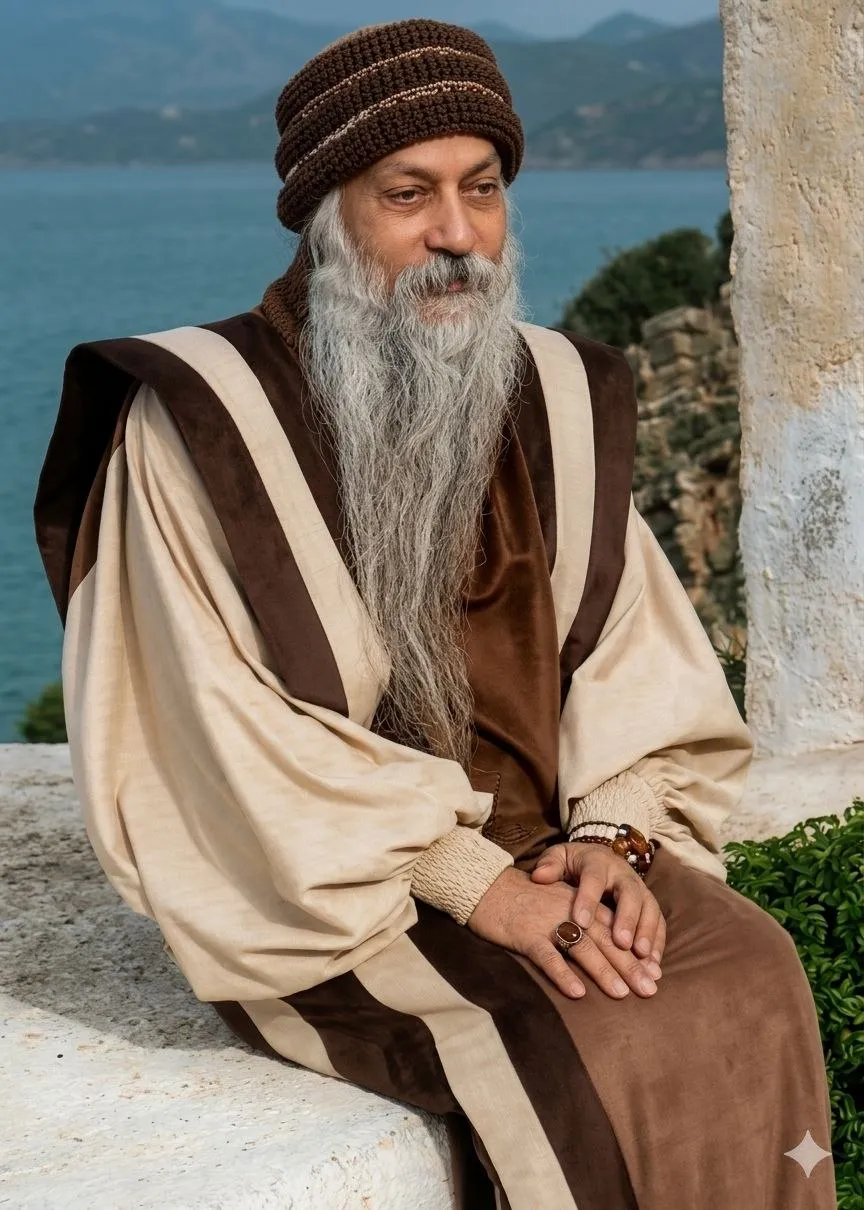
Explore Osho’s teachings across key topics such as meditation, love, ego, and awareness. Each topic contains structured questions, quotes, and insights derived from discourses.
In the dance of the subconscious, forgotten questions emerge from the depths of the unconscious, and as they are articulated, their repressed energy dissolves like a fragile soap bubble, transforming the mind and behavior through the alchemy of awareness.
Occultism, often seen as a pursuit of hidden truths, distracts from the divine that is ever-present in the world around us; true awareness lies not in secret paths but in the simplicity of silence and the openness of being.
In the dance between science and religion, the origin of life emerges not merely as a question of how, but as an invitation to embrace the mystery; while science delves into the mud, mysticism, as Osho might suggest, reveals the divine beauty blossoming within the lotus.
In Osho's perspective, the essence of anecdotes lies not in the stories themselves but in our interpretations; when we embrace their unifying threads rather than fixating on discordant facets, we find that perceived conflicts dissolve into harmony.
In the vibrant tapestry of modern India's spiritual landscape, figures like Ramana Maharshi and J. Krishnamurti have emerged, yet the absence of a cohesive lineage reveals that true spiritual transmission, as Osho suggests, thrives in the authenticity of living individuals rather than in rigid institutions.
When control slips away, life guides us through the necessary tension of struggle until we surrender into rest and silence, revealing that each path—whether immediate relaxation or the friction of Shakti sadhana—ultimately serves the same purpose of finding peace and momentum.
Self-condemnation, a mere echo of inherited conditioning often rooted in religious dogma, fractures our innate joy with learned guilt; by recognizing and releasing this burden, we allow our true well-being to blossom, transforming life into a dance of spontaneity rather than a struggle against self-judgment.
In the spirit of Osho, to embody unorthodoxy within a commune is to thrive in awareness rather than rigid rules, allowing each moment to breathe with fresh inquiry and love, transforming the collective into a living organism rather than a stifling doctrine.
In the essence of Osho's wisdom, the spiritual journey is but a symbol; the seeker and the sought are one, and it is in the stillness of the present moment that our inherent wholeness unfolds, free from the illusions of language and longing.
In the spirit of Osho’s teachings, raas embodies the cosmic dance of Purusha and Prakriti, celebrating the joyful harmony of opposites; it invites us to transform conflict into creative union, fostering a deeper connection through the rhythm of love and awareness.
Desiring to gain often entangles us in ego and burdens, while true receiving unfolds through the art of letting go—shedding identities, pride, and even spiritual status—allowing the inalienable core of our being to emerge and reveal what truly matters.
The spiritual path transcends choice, as love serves as the bridge unveiling the oneness of all teachings; through devotion, whether inspired by Nanak, Buddha, or Jesus, we dissolve the anxiety of comparison and embrace a singular truth that unites us all.
Greatness is a mirage, as Osho suggests; the essence lies not in idolizing heroes but in embracing our own ordinariness, awakening to the profound awareness that transcends notions of superiority or inferiority.
The essence of the perfect jewel lies in the depth of your consciousness; when true recognition emerges from within, even the faintest glimpse captivates, while borrowed beliefs only serve to blind you—leaving the treasure unnoticed amidst the throngs.
Birth, inherently laden with trauma as Freud suggested, imprints our nervous systems with echoes of prenatal and birthing shocks, yet it is only through the awakened consciousness of a Buddha that we can witness and transcend this binding experience.
Embracing the prospect of arrest, he sees it not as a mere confinement but as a profound revelation of American democracy's hypocrisy, transforming persecution into a joyous awakening that inspires a global movement of sannyasins united in love for truth and foundational values.
Osho illuminates the distinction between reaction and response, where reaction is a mechanical echo of the past, while response emerges from a present awareness, creating space for understanding and freedom, much like Buddha's poised encounter with insult.
In the essence of Osho's thought, all that we perceive as past—whether genuine or fanciful—exists merely as illusory dream-stuff, urging us to transcend the analysis of memories and instead embrace the present moment as the true witness to our consciousness.
In Osho's view, while 'God' often represents a rigid image demanding devotion, 'godliness' embodies a vibrant essence of love and awareness that transcends names and divides, inviting us to experience the sacred unity within all existence.
Embracing ordinariness and relinquishing the ego's desire for distinction reveals common sense as a return to our true nature; in this egoless simplicity, we discover a silent wisdom akin to buddha-being, where joy and clarity flow effortlessly through our lives.
In the spirit of Osho’s teachings, the quest for true peace transcends the mere dichotomy of attack and defense, inviting us to dissolve the mental and political borders that breed conflict, embracing our shared humanity instead of fueling the fires of nationalism.
The Rajneesh Mandir transcends mere labels, embodying the collective love and consent of the commune, where Osho remains a humble guest rather than an authority, and its true essence lies in the shared presence and responsibility of its community.
In the spirit of Osho's teachings, the art of mediumship flourishes through a receptive, feminine openness, where the medium, akin to a finely tuned radio, consciously empties their inner space to invite communication with disembodied souls, highlighting the importance of deliberate intention over fear-driven encounters.
In the dance of existence, sex and death emerge as two expressions of a singular energy, where transcending their allure unveils a profound awareness that liberates us from fear and desire, allowing us to embrace life as a witness—free, loving, and fully present.
Don't have an account? Sign up