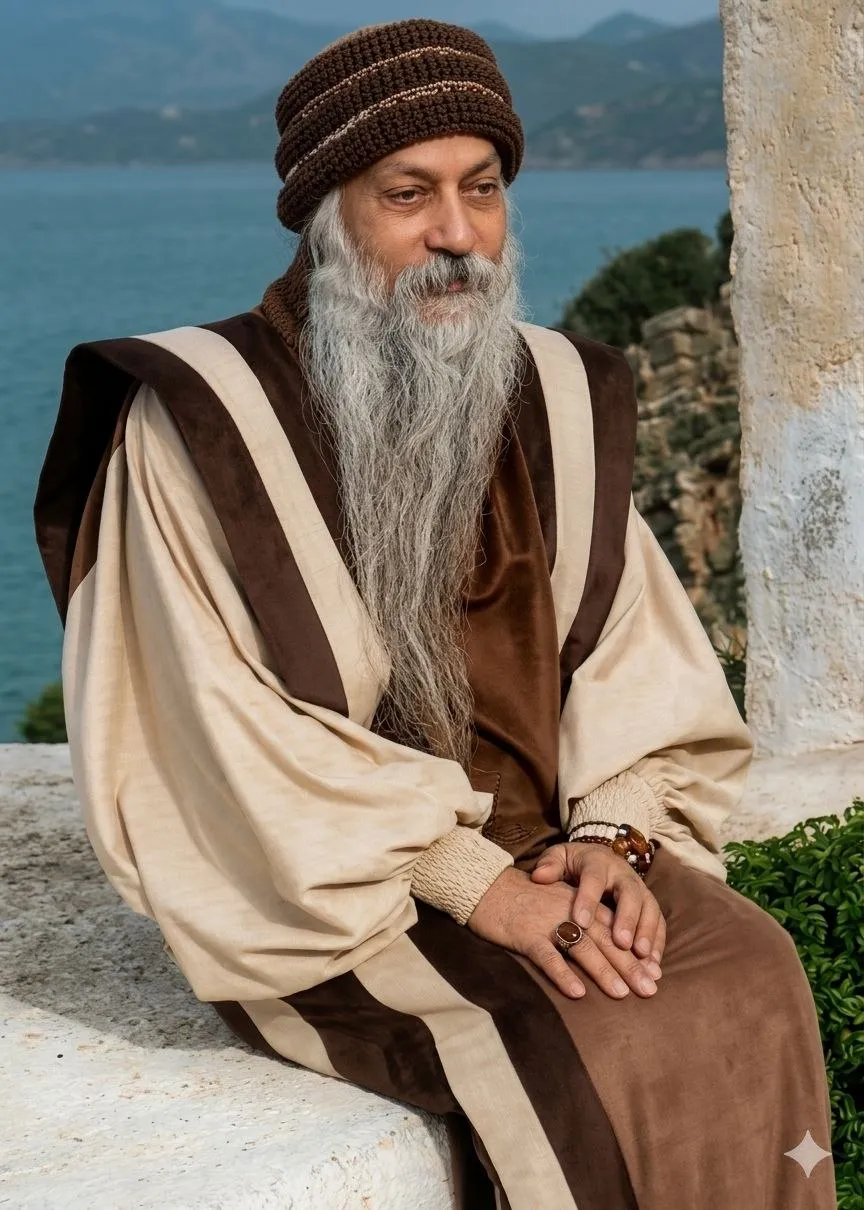
Explore Osho’s teachings across key topics such as meditation, love, ego, and awareness. Each topic contains structured questions, quotes, and insights derived from discourses.
In an out-of-body experience, one might observe their physical form from a distance, feeling the effortless pull of intention guiding their return; yet, as the body languishes, an intense hunger arises, reminding us that grounding through nourishment is essential to restore balance and vitality.
Conduct, much like Osho’s teachings, flows as a dynamic expression of one’s inner vision, shaped by the unique interplay of knowledge, language, and culture, evolving with time and circumstance, allowing the essence of truth to resonate authentically rather than through mere imitation.
In the dance of existence, divine qualities are as abundant as the demonic, revealing that our perception of scarcity stems from an unawakened inner state; when awareness evolves into witnessing, we recognize good and evil as equal, complementary forces harmonizing life.
In the spirit of Osho, the holy war unfolds as a profound journey of love and awareness, where the light of consciousness gently dismantles our inner thorns and illusions, transforming pain into a soothing fire that liberates the soul.
Asmita represents the mind's most refined self-awareness, a delicate veil at the threshold of the Divine, yet it remains entwined with duality; true liberation demands that even this subtle sense of self dissolve, revealing the boundless truth beyond all distinctions.
In the spirit of Osho's teachings, Sahjobai's essence reveals that women, guided more by a desire to live and evolve than by a thirst for metaphysical discourse, prioritize transformative questions over mere knowledge, seeking peace and meaning in their everyday existence.
Embracing the essence of existence, one transcends contradiction through egoless acceptance, where spontaneous assertion emerges not from the self but as a harmonious expression of the whole, revealing that true empowerment lies in surrendering to the present moment.
Human experimentation is a neutral tool, neither inherently good nor bad; its true nature unfolds through the intentions behind it—whether wielded by dogmatic powers or guided by a compassionate, nonpartisan pursuit of knowledge, it can embody nature’s evolution and profound progress.
In the tapestry of spiritualism, Osho reveals that true recognition arises from the unconditioned mind, free from the constraints of collective identity, allowing a few enlightened souls to embrace the living masters who defy past dogmas.
Osho invites us to embrace a non-technical journey toward equilibrium, where true balance flourishes through wholehearted living—rooted in prayer, trust, love, and gratitude—transforming the ordinary into the sacred, much like the effortless rhythm of breath.
Osho illuminates the profound truth that the inner self and man are inseparable; realization emerges not from a distant journey but from the gentle recognition of our essence, inviting us to relax into the simple presence of awareness that is already within.
Prajnaparamita embodies the essence of the Heart Sutra, revealing a wisdom that transcends the confines of cause and effect, inviting us to experience the profound unity of form and emptiness, where the self dissolves into the boundless whole, much like Osho's vision of awakening.
In the spirit of Osho's teachings, prana-pratishtha embodies the reawakening of a sacred bond, transforming an image into a vibrant conduit of presence through sacred rites and the subtle recognition of a realized adept, ensuring that a true temple, alive and resonant, cannot be diminished.
The Puranas reveal that the mythic narrative of human nature, with its saints and scoundrels, unfolds perpetually in our lives; it is our own cynicism and preconceived notions that obscure the sacred dance of consciousness playing out in the everyday.
In the dance of existence, the law of necessity binds us to a robotic existence, where life unfolds without our conscious direction; yet, through meditation, we awaken to the law of power, embracing freedom as we shape our reality with intention and presence.
Embracing the seat life offers, much like the unique number 326, reveals that true presence emerges not from anxious searching or comparison, but from a serene acceptance of our place, where harmony unfolds and the journey of self-discovery truly begins.
In the cosmic dance of Rasa Lila, where bliss unfolds, Krishna embodies a non-possessive presence while the gopis represent our senses harmonizing; here, the celebration transcends ego, transforming every interaction into a joyful flow around the silent essence of existence.
In the spirit of Osho's insights, the Bhoodan Movement reveals that true liberation from exploitation transcends mere acts of charity; one must dismantle the very structures of oppression, for as long as we exist within them, we are but cogs in a relentless machine.
In the dance between Satya Yuga and Kali Yuga, Osho illuminates humanity's descent from the innocence of childhood to the disillusionment of age, where the heart’s poetry fades beneath the weight of intellect, revealing that true progress lies not in accumulation, but in the preservation of inner joy.
Nonattachment, as Osho illuminates, reveals the profound truth that our essence exists in solitude, transcending the external ties of people, possessions, and circumstances, allowing us to engage fully with the world while nurturing an inner freedom that remains unbound and aware.
Osho embodies the essence of disaster, serving as a radical rupture with outdated traditions, religions, and ideologies, shattering the chains that bind humanity to an insane past, thus paving the way for a freer, more enlightened consciousness to flourish.
In the absence of thought, a profound silence envelops us, revealing an innate power where challenges dissolve effortlessly; as we immerse ourselves in singular, focused action, the ego fades, leaving only pure movement and a tranquil mind.
In the realm of Osho's wisdom, the notion of “three free wishes” reveals the restless nature of desire; true awakening comes from relinquishing all wishes, finding freedom in contentment as life unfolds in its purest form, untainted by craving or disappointment.
Agnosticism embodies a profound stance of choiceless awareness, where one transcends the duality of theism and atheism, allowing direct engagement with reality while remaining untouched by the nets of belief and argument, much like Osho's vision of spiritual liberation.
Don't have an account? Sign up