
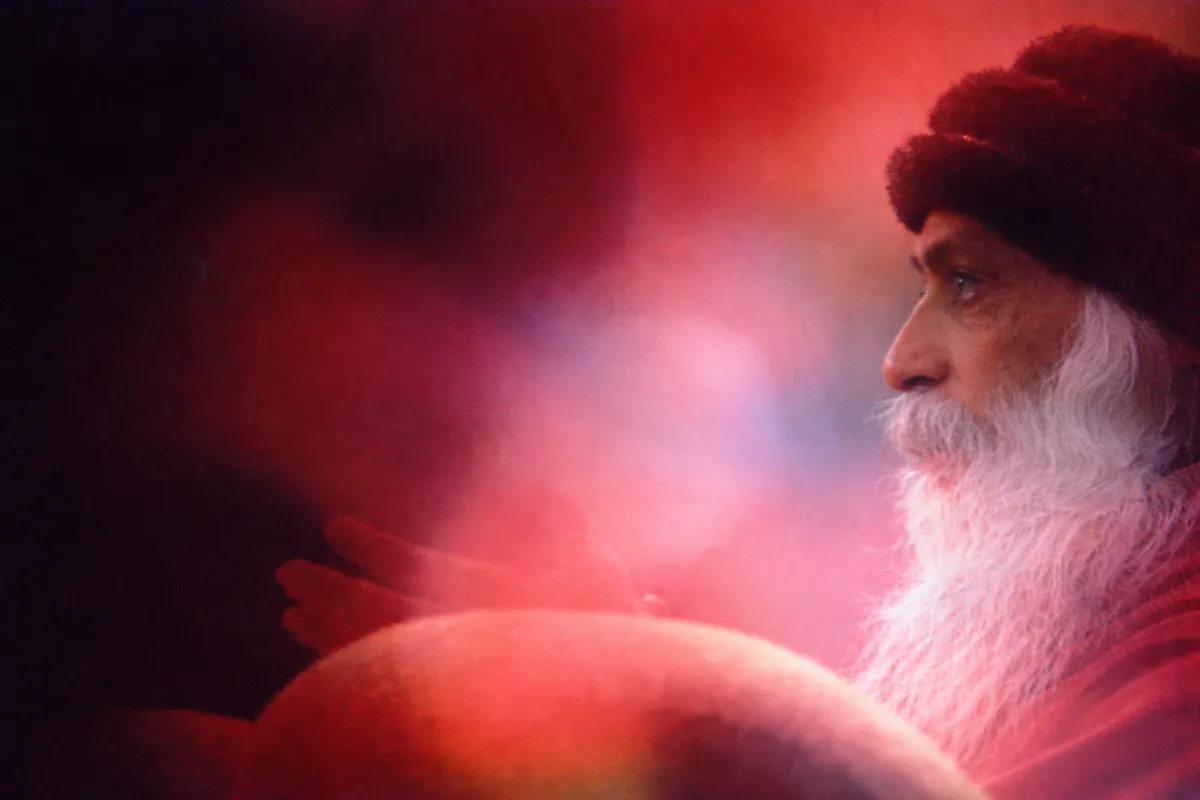
Friedrich Nietzsche occupies a place in Osho's world no other Western thinker approaches. Osho devoted two entire discourse series to Thus Spake Zarathustra — 'Zarathustra: A God That Can Dance' and 'Zarathustra: The Laughing Prophet' — and returned again and again to Nietzsche's fate: a man of Buddha-like potential born into a culture that offered him no meditation, who saw through God, morality, and herd-mind, and was broken by the weight of his own seeing.
The passages below carry the core of Osho's reading — the diagnosis, the defense, and the tribute. Each links to its full discourse.
From the Discourses
Passages where Osho speaks on nietzsche — each links to the complete discourse.
Beloved Osho, there is a revival of interest in nietzsche all over europe, from both the pre-and post-war generations. Nietzsche's appeal seems to lie in his views still being contemporary. Could you please comment?
But one thing has to be remembered: he was misunderstood, and all the people who have been misunderstood have one thing in common -- that nobody refutes them. It is as if misunderstanding is enough. Nobody has refuted Friedrich Nietzsche. Although he has challenged the whole of Christianity, the popes have been silent -- because what he is saying is so clear that it is better to ignore rather than to refute it; you cannot refute it. It is good -- it will help Europe to get rid of Christianity, which has been a calamity and has kept people retarded. It will also help people to think more aphoristically -- which looks like the person is jumping from one conclusion to another conclusion. That's how every great philosophical treatise should be written, because it is not written for children, it is not written for schools; it is written for the…
Question: BELOVED OSHO, NIETZSCHE WROTE, IN ECCE HOMO, HERE THERE SPEAKS NO PROPHET, NONE OF THOSE GRUESOME HYBRIDS OF SICKNESS AND WILL TO POWER CALLED FOUNDERS OF RELIGIONS. ONE HAS ABOVE ALL TO HEAR CORRECTLY THE TONE THAT PROCEEDS FROM THIS MOUTH, THIS HALCYON TONE, IF ONE IS NOT TO DO PITIABLE INJUSTICE TO THE MEANING OF ITS WISDOM.... HERE THERE SPEAKS NO FANATIC, HERE THERE IS NO PREACHING, HERE FAITH IS NOT DEMANDED: OUT OF AN INFINITE ABUNDANCE OF LIGHT AND DEPTH OF HAPPINESS THERE FALLS DROP AFTER DROP, WORD AFTER WORD -- A TENDER SLOWNESS OF PACE IS THE TEMPO OF THESE DISCOURSES. SUCH THINGS AS THIS REACH ONLY THE MOST SELECT: IT IS AN INCOMPARABLE PRIVILEGE TO BE A LISTENER HERE. OSHO, THIS IS CERTAINLY ABOUT YOU. WAS NIETZSCHE YOUR FORERUNNER? ... But truth you cannot create, you can only discover.
Beloved Osho, when you spoke about nietzsche's concept of will, it was so much the opposite pole to the concept of will that the nazis developed from the same source, and that is still so prevelant in the west. Could you speak about the difference?
My own feeling is, he was never mad. He was just too much ahead of his time, and he was too sincere and too truthful. He said exactly what he experienced without bothering about politicians, priests and other pygmies. But these pygmies are so many and this man was so alone, that they would not hear that he was not mad. And the proof that he was not mad is his last book, which he wrote in the madhouse. But I am the first man who is saying that he was not mad. It seems that this whole world is so cunning, so politically minded, that people say only things that bring reputation to them, which bring applause from the crowd. Even your great thinkers are not very great. The book that he wrote in the madhouse is his greatest work, and is an absolute proof because a mad man…
Maneesha's question:
IN HIS BOOK, The Antichrist, NIETZSCHE STATES: "PEOPLE WHO STILL BELIEVE IN THEMSELVES STILL ALSO HAVE THEIR OWN GOD. IN HIM THEY VENERATE THE CONDITIONS THROUGH WHICH THEY HAVE PROSPERED, THEIR VIRTUES -- THEY PROJECT THEIR JOY IN THEMSELVES, THEIR FEELING OF POWER ON TO A BEING WHOM ONE CAN THANK FOR THEM." WOULD YOU LIKE TO COMMENT? Maneesha, Nietzsche wrote his book THE ANTICHRIST in the insane asylum. But he was such a genius, that even though he was declared insane by all the psychiatrists, his books prove they were wrong. Even in his insanity he was far saner than your so-called sane psychiatrists. Even in his death -- he wrote his last letter to a friend -- he did not forget... He had always made his signature, "Antichrist, Friedrich Nietzsche". Even at the moment of death he did not forget to write "Antichrist" first, then his name. And…
Read 1 more passages on nietzsche
Osho, is god really dead, as friedrich nietzsche says?
Because the Jewish-Christian-Mohammedan idea of God is not of a very nice fellow; he is not a gentleman. The Jewish God who is at the root of both the Christian and the Mohammedan God says himself, "I am a very jealous God. Those who are against me, I will destroy them. Those who are not with me are against me. Those who are with me will have all the pleasures of heaven, and those who are not with me will suffer eternal hellfire.'' Nietzsche says, "Rejoice, God is dead! There is no heaven and no hell. Don't be afraid of hell and don't be greedy for heaven, because there is no God. God is dead, and man is absolutely free." This has been done in the East in a far more subtle, delicate way. Mahavira says there is no God -- for the same reason as Nietzsche. Mahavira says if…
Understanding Osho's Reading of Nietzsche
The threads that run through his discourses on nietzsche.
Why He Declared God Dead
Asked why Nietzsche made his famous declaration, Osho answers that there was nothing to declare — only a fact to report.
HE HAD to declare it, because God WAS dead. The God that had been worshipped for thousands of years was dead; not the real God, but the God that the human mind had created -- the God that was in the temples and the mosques and the churches and the synagogues, the God of the Old Testament, the God of the Vedas. Man has outgrown those concepts. Nietzsche simply declared a fact.The Guest, Chapter 14, Question 3 →
A Buddha Without Meditation
Osho's central verdict on Nietzsche: the insight of an awakened one, with no inner science to hold it — freedom that crushed the man who won it.
Nietzsche would have been a Mahavira or a Buddha, but there was no meditative dimension available to him. Once you deny God, the whole mountainous responsibility of your being falls on your own head. You can be crushed by it. That's what happened: Nietzsche was crushed under his own freedom, he was not able to cope with the freedom.Theologia Mystica, Chapter 8, Question 2 →
He Was Never Mad
Against the psychiatric record and a century of consensus, Osho declared Nietzsche sane — too sincere and too far ahead for pygmies to hear.
My own feeling is, he was never mad. He was just too much ahead of his time, and he was too sincere and too truthful. He said exactly what he experienced without bothering about politicians, priests and other pygmies. But these pygmies are so many and this man was so alone, that they would not hear that he was not mad. And the proof that he was not mad is his last book, which he wrote in the madhouse. But I am the first man who is saying that he was not mad.The Golden Future, Chapter 7, Question 1 →
A Genius Ahead of His Time
Asked about Nietzsche, Osho explained why every genius is bound to be misunderstood by his contemporaries.
Friedrich Nietzsche is one of the philosophers with the most potential in the whole world, not only in the West, not only in Germany. His insights are significant for everybody. But he was misunderstood by all his contemporaries. That's the usual fate of every genius. It is almost routine, not an exception but a rule, that the genius is bound to be misunderstood by his contemporaries, for the simple reason that he is far ahead of his time.Light on the Path, Chapter 29, Question 1 →
Questions Osho Answered on Nietzsche
1 questions in the library — the most sought-after:
People like Nietzsche today because we’re finally ready to understand his bold ideas that were too new for his own time.
Frequently Asked
He embraced the aspiration and corrected the direction. Nietzsche's superman, reaching beyond man through will, was for Osho a flash of the same truth the East calls Buddhahood — but will alone cannot deliver it, and misread as power it produced the Nazi caricature. Transcendence, Osho said, comes through meditation, not through force.
He called it one of the greatest books ever written — a mystic's poetry trapped in a philosopher's fate — and gave two series to it in 1987. Zarathustra, the laughing, dancing prophet, was for Osho the West's closest glimpse of a god that can dance — his own vision of the religious man.
With the funeral, yes; with the despair, no. The God of churches and priests deserved to die, and Nietzsche had the honesty to say so. But Osho added the step Nietzsche could not take: when the fictional God dies, godliness — life itself, experienced in meditation — remains, and only then can it truly be found.