
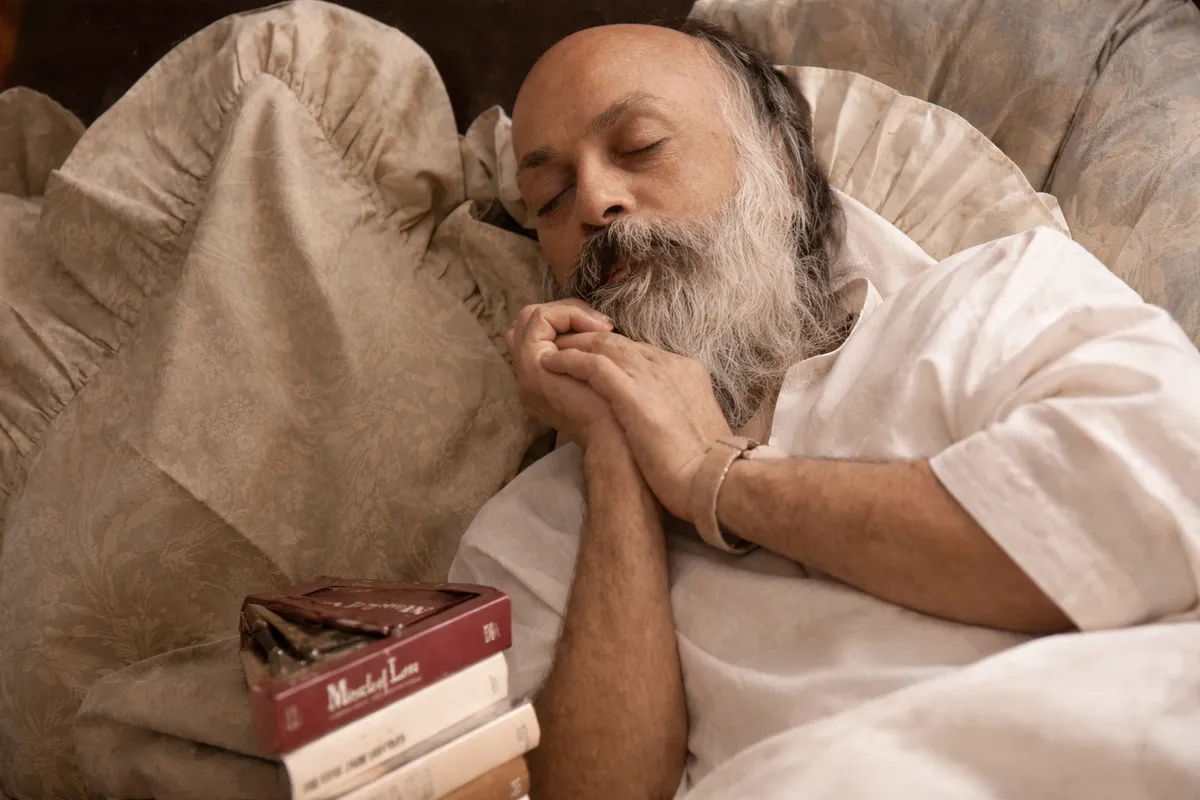
In "The Messiah, Vol 2," Osho delves into the intricate fabric of spiritual enlightenment, offering a transformative exploration of the essence of being. With his characteristic profundity and eloquence, Osho unravels the concept of the "Messiah" as both a symbolic and literal guide towards awakening one's inner consciousness. He emphasizes the requirement to transcend traditional dogmas and embrace a path of self-discovery and internal evolution. The series challenges conventional religious interpretations, prompting individuals to see divinity as an inherent state rather than an external pursuit. Osho articulates the idea that each person holds the potential to manifest their own unique version of a Messiah within, urging a redefinition of authenticity and truth. Through this discourse, he skillfully interweaves philosophical insight with practical wisdom, empowering seekers to cultivate mindfulness, freedom, and love. Osho's profound reflections invite listeners to dismantle mental barriers, encouraging a journey into self-awareness and the ultimate realization of one's own divine nature, unencumbered by societal constraints. Throughout, Osho's unique perspective radiates a message of liberation, steering souls towards the serenity of embracing existence in its purest form.
-
Chapter 1: In this silence
Freedom is inner, spiritual—freedom from past and future, not political or economic; turn inward through meditation until even the desire for freedom falls away.
-
Chapter 2: The real freedom
True freedom is inner: shedding fragments of the socially created self to awaken the indestructible soul; outer revolutions or burned laws can't free you.
-
Chapter 3: Each moment a resurrection
Harmony of reason and passion makes the whole man; be Zorba the Buddha—learn inner alchemy to die and be reborn each moment to live fully, forever renewed.
-
Chapter 4: Breaking the shell of the past
Women's pain is not poetic consolation but centuries-long oppression; distinguish natural healing pain from imposed suffering and call for revolt.
-
Chapter 5: Not even the heart... only a witness
Self-knowledge transcends heart and mind; be a witness. The soul is boundless, not an object to touch; truth is one and comes when the ego dissolves.
-
Chapter 6: Within your own self
A teacher cannot hand you wisdom; only awaken what lies half-asleep. A master builds trust and solitude so inner knowledge, not borrowed faith, can arise.
-
Chapter 7: Friendliness rises higher than love
Friendliness transcends possessive friendship and love: give freely without purpose, keep mystery, live in the moment; Gibran's poetry praised yet critiqued.
-
Chapter 8: Into the very center of silence
Talking often masks fear and shallow knowledge; true speech arises from the silent center of being — go beyond mind and heart to speak from the inner voice.
-
Chapter 9: This moment... the only reality
Astronomer's question: 'What of time?' — Only the present moment is real; time, like love, is indivisible and timeless, embracing past and future.
-
Chapter 10: Evil is nothing but an absence of good
An elder asks about good and evil: evil is merely the absence of good — create light, integrate your divided self, and transform darkness through compassion.
-
Chapter 11: Only a question of awareness
Kahlil Gibran's insight: evil is a priestly invention; awareness, not punishment, transforms 'not-good' into good, restoring human dignity and inner unity.
-
Chapter 12: The silent gratitude
Prayer is silent gratitude, an expansion of being into existence; not begging but joyful giving—rise from need to abundance and deep communion.
-
Chapter 13: The seed of blissfulness
Speak to us of pleasure: pleasure is a freedom-song, the beginning that awakens longing and wings; enjoy it fully but witness it so it can transmute into bliss.
-
Chapter 14: A dewdrop cannot offend the ocean
Live your pleasures with gratitude not shame; the spirit cannot be offended - a dewdrop cannot offend the ocean - reject priestly guilt and embrace joy.
-
Chapter 15: A heart aflame, a soul enchanted
Beauty is not a need but an ecstasy—an inner flame and reflection of eternity; seek it by living and being the mirror, not by defining it through concepts.
-
Chapter 16: From dawn to dawn, a wonder and surprise
Religion is not a priestly profession but a lived wonder: unity of body and soul, love not ritual, meditation as dawn-to-dawn presence and freedom.
-
Chapter 17: In you are hidden all men
Make daily life your temple: God is presence, not person—found in silence, children and everyday acts; carry your whole self and all humanity to know God.
-
Chapter 18: I call it meditation
Life and death are one: death is a change, not annihilation; seek the secret of death in the heart of life through silence and meditation to transform fear.
-
Chapter 19: Let my words be seeds in you
Metaphor as seed: surrender, be receptive soil so a teacher's words grow; the messenger returns not in body but when one yields to the universal spirit.
-
Chapter 20: Don't judge the ocean by its foam
Don't judge the ocean by its foam: you are a vast, boundless Self; failures are transient, spring sleeps within—remember, awaken, don't merely believe.
-
Chapter 21: Become again an innocent child
True mastery strips away borrowed wisdom so you unlearn and regain childlike innocence, becoming the living flame of being rather than a collector of truths.
-
Chapter 22: A peak unto yourself
Solitude and aloneness are the mystic's instrument: be in the world but not of it, a 'peak unto yourself' whose distance makes true closeness possible.
-
Chapter 23: Doors to the mysterious
The fragile inner dream and stranger-breath are the strongest forces; compassion waits patiently until the seeker is ready to hear and return to the source.
-
Chapter 24: We shall speak again together, I shall come back to you
Mystics' unending hope and love endure beyond persecution; their return renews life like a water-lily; women bear the next messenger and birth transformation.