
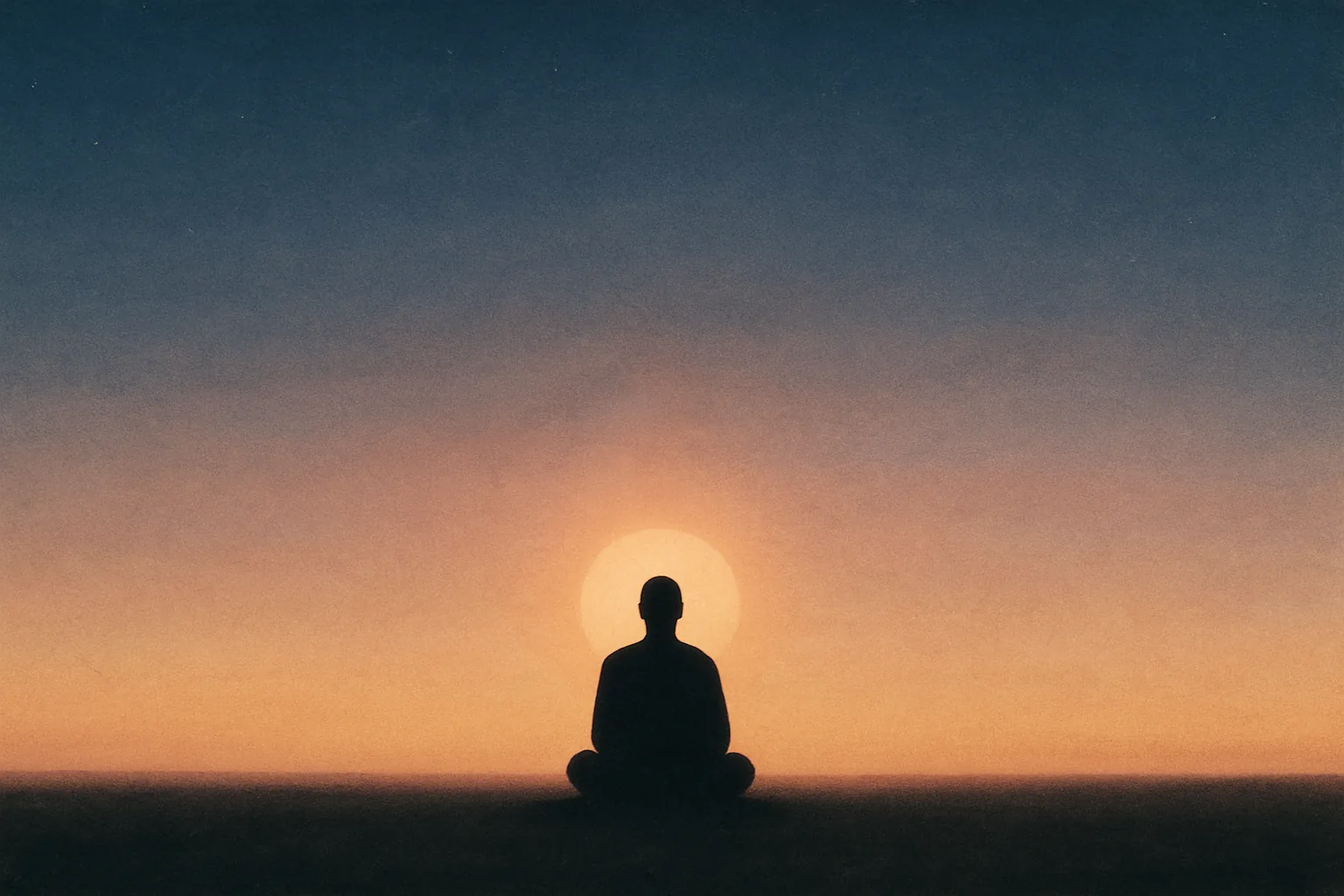
Meditation is the flower; compassion is its fragrance. In Osho’s vision, compassion cannot be practiced or produced by will. It arrives unbidden when the inner bud of awareness blooms. The more you try to manufacture compassion as a discipline, the more it remains contaminated by desire, duty, and hidden ambition. True compassion is undirected and unaddressed—like scent on the wind—free of motive, free of tension, free of the one who does. It is the natural overflow of fulfillment.
This method turns you from concentration and doing to spacious, choiceless awareness. As passion relaxes in the light of meditation, the same energy is transfigured upward into compassion. Let meditation be the cause; let compassion come as the consequence. Use compassion not as a goal to chase, but as a criterion: when awareness is right, compassion follows like a shadow. When it does, simply allow it—no target, no mission—just a gentle radiance reaching the whole of existence.
Phase Instructions
First Stage: Turn from Doing to Being
Sit comfortably with a relaxed, upright posture. Let the breath be natural. Drop every idea of practicing compassion or improving yourself. Set a single orientation: to be aware. Allow the body to soften and the face to unmask; rest as you are, without trying to become anything.
Second Stage: Open Awareness (Not Concentration)
Let attention be spacious rather than one-pointed. Do not fixate on an object; include the whole field—breath, sensations, sounds, thoughts, and the sense of being. If you notice narrowing or strain, soften immediately. Replace effort with alert ease. Let everything arise and pass without exclusion, preference, or resistance.
Third Stage: Witness Passion Without Suppression
As desires, restlessness, or emotional heat surface, neither indulge nor fight them. Simply see them—clearly, tenderly, without judgment. Feel their sensations in the body and the momentum in the mind, and allow them space to breathe. In this non-doing light, passion loses the gravity of grasping and begins to lift.
Fourth Stage: Flowering—Rest in Fulfillment
Abide in a quiet, desireless suchness. Do nothing, seek nothing, exclude nothing. Let a sense of enoughness spread—no goal, nowhere to go, nothing missing. Remain present, relaxed, and vividly awake. This effortless clarity is the flowering of meditation.
Fifth Stage: Fragrance—Compassion Without Address
If a warm, gentle radiance begins to arise, do not claim it, direct it, or assign it a target. Allow it to move by itself, like fragrance carried by the wind—undirected, unaddressed, unmotivated. Let it pervade within and without, touching all beings without choosing. If nothing arises, simply continue resting in awareness—there is nothing to manufacture.
Sixth Stage: Criterion and Continuation
Use spontaneous compassion as the criterion of right meditation. If it blooms naturally, the cause (meditation) is true. If it does not, gently release any lingering concentration, tension, or purposefulness, and return to open, inclusive awareness. Do not practice compassion as a role or duty; keep meditating, and let sharing happen by itself whenever it wishes.
Core Benefits
- Development of undirected and unaddressed compassion.
- Experience of spacious, choiceless awareness.
- Transformation of passion into compassion.
- Achievement of a natural overflow of fulfillment.
- The alignment of awareness leading to compassion.
What Osho Said About This Technique
When they were left along with their disciples their disciples said, 'Master, this is too much! For two days we waited and waited and waited, and we have been waiting for this opportunity for years, thinking that at the meeting of two great enlightened persons something would be bound to transpire. We were thrilled, so excited, but you both remained utterly silent.' Farid said, 'When two mirrors face each other, nothing is reflected or only nothing is reflected, again and again. He is silent, I am silent; he knows, I know; I am not, he is not. We have both disappeared into the ultimate. what is there to say? Who is there to say it?' And the same was said by Kabir. When his disciples asked him, 'Lord...' he said, 'If either of us had spoken, that would have proved that he knew nothing.
The monk zuigan used to start every day by saying out loud to himself, "master, are you there?" and he would answer, "yes sir, I am." then he would say, "better sober up." and he would reply, "yes sir, I'll do that." then he would say, "look out now, don't let them fool you." and he would answer, "oh no sir, I won't, I won't."
In America, the whole market depends on how you can befool the customer, how you can create an idea in the minds of others. Now, a two-car garage is a must if you want to be happy; in America, a two-car garage is a must. Nobody asks why. If you are not happy with one car, how can you be happy with two cars? If there is fifty percent happiness with one car, how can you be happy with two cars? With one car you are unhappy; with two cars you will be doubly unhappy, that's all. The mathematics is simple. But there is advertisement, propaganda; the whole society exists by manipulating others. Happiness is something like a commodity in the market -- you go and purchase it, it has to be purchased. How can happiness be purchased? Happiness is not a commodity, it is not a thing; it is…
When bankei held his seclusion-weeks of meditation, pupils from many parts of japan came to attend. During one of these gatherings a pupil was caught stealing. The matter was reported to bankei with the request that the culprit be expelled. Bankei ignored the case.
LATER THE PUPIL WAS CAUGHT IN A SIMILAR ACT, AND AGAIN BANKEI DISREGARDED THE MATTER. THIS ANGERED THE OTHER PUPILS, WHO DREW UP A PETITION ASKING FOR THE DISMISSAL OF THE THIEF, STATING THAT OTHERWISE THEY WOULD LEAVE IN A BODY. WHEN BANKEI HAD READ THE PETITION HE CALLED EVERYONE BEFORE HIM. 'YOU ARE WISE BROTHERS,' HE TOLD THEM. 'YOU KNOW WHAT IS RIGHT AND WHAT IS NOT RIGHT. YOU MAY GO SOMEWHERE ELSE TO STUDY IF YOU WISH, BUT THIS POOR BROTHER DOES NOT EVEN KNOW RIGHT FROM WRONG. WHO WILL TEACH HIM IF I DO NOT? I AM GOING TO KEEP HIM HERE EVEN IF ALL THE REST OF YOU LEAVE. A TORRENT OF TEARS CLEANSED THE FACE OF THE BROTHER WHO HAD STOLEN. ALL DESIRE TO STEAL HAD VANISHED. ... I was reading in some history book that twenty persons were expelled from England; they were sea robbers.
Beloved Osho, buddha was saying again and again to his disciples that meditation and compassion should grow side by side. These days I have been feeling your compassion as never before, and I have also been feeling the urge to start learning from it, at least the abc. For now, the only thing that makes me feel close to it are those warm tears that flow down my cheeks as I look at you. Beloved, can you please talk about compassion, and how to go into it from the stage I'm at.
Chidananda, Gautam Buddha's emphasis on compassion was a very new phenomenon as far as the mystics of old were concerned. Gautam Buddha makes a historical dividing line from the past; before him meditation was enough, nobody had emphasized compassion together with meditation. And the reason was that meditation brings enlightenment, your blossoming, your ultimate expression of being. What more do you need? As far as the individual is concerned, meditation is enough. Gautam Buddha's greatness consists in introducing compassion even before you start meditating. You should be more loving, more kind, more compassionate. There is a hidden science behind it. Before a man becomes enlightened, if he has a heart full of compassion there is a possibility that after meditation he will help others to achieve the same beautitude, to the same height, to the same celebration as he has achieved. Gautam Buddha makes it possible for enlightenment to be…
Common Questions
In Osho’s vision, compassion cannot be practiced or produced by will. It arrives unbidden when the inner bud of awareness blooms.
Compassion should not be used as a discipline or a goal to chase; rather, it should be a criterion for when awareness is right.
As passion relaxes in the light of meditation, the same energy is transfigured upward into compassion.
One should allow compassion to come naturally, without a target or mission—just a gentle radiance reaching the whole of existence.