
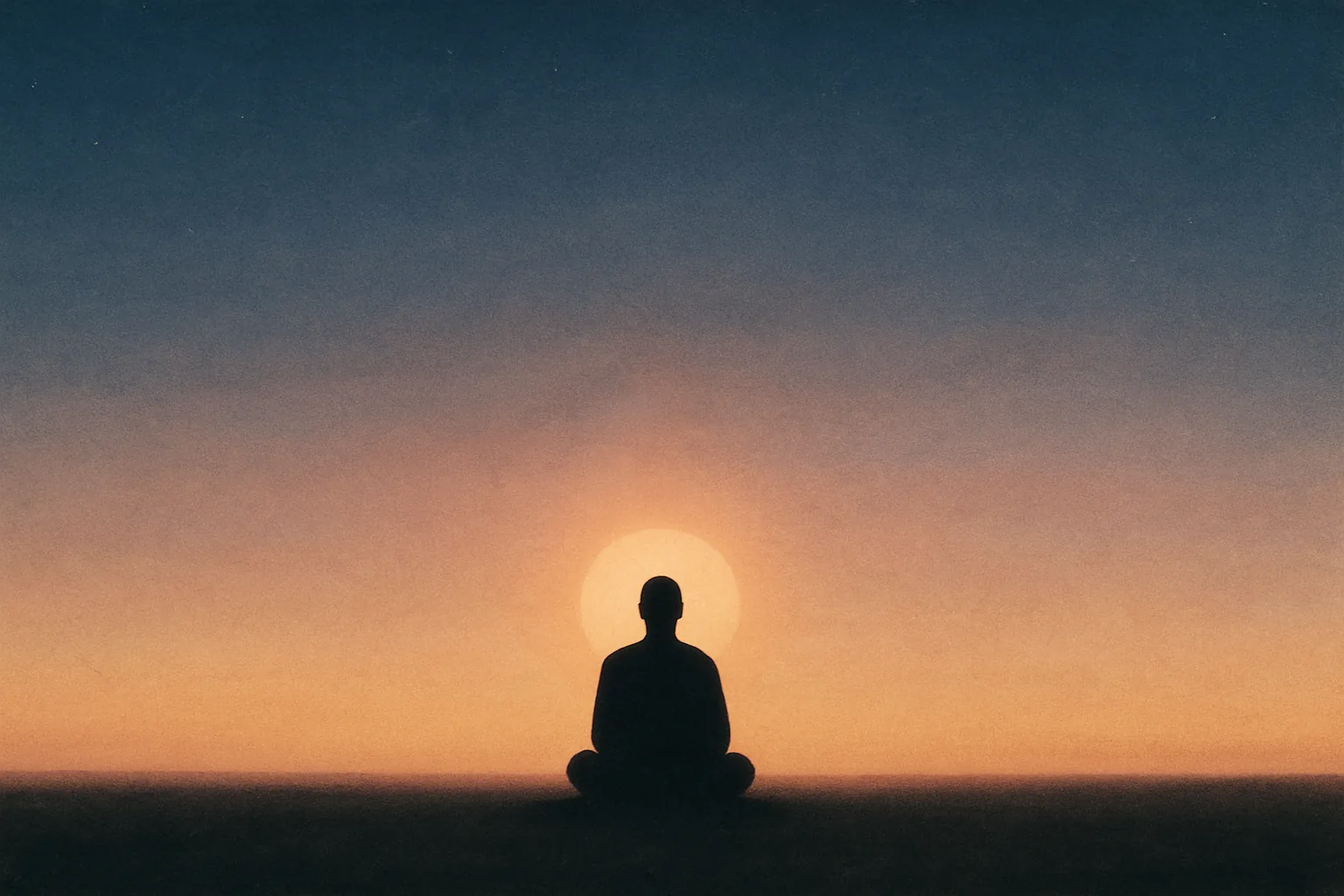
Rooted in the Buddha’s Anapanasati — the simple, luminous awareness of the incoming and outgoing breath — this guided meditation cultivates what Osho calls an inner sun of awareness. By staying with the living rhythm of breathing, attention settles, thought subsides on its own, and awareness begins to permeate the whole body, cell by cell, until presence is felt throughout one’s being.
This 45-minute practice unfolds in three deepening stages: first, unbroken breath awareness; second, the effortless acceptance of all surrounding sounds; and third, the felt sense of dissolving into existence itself, like a drop into the ocean. It is best practiced in the early morning, or at night as you fall asleep. Sit comfortably — a lotus posture if it suits you — or, at bedtime, simply lie in bed and allow the practice to carry you into sleep.
Phase Instructions
First Stage: Conscious Breathing
For 10 minutes, breathe deep and relaxed. Move with each breath: as the breath comes in, go in with it; as it goes out, move out with it. Do not allow a single in-breath or out-breath to pass without awareness. Keep your attention with the breath continuously. If a thought appears, notice that your attention has left the breathing and gently return to the breath at once. Let the natural rhythm guide you; the very act of breathing consciously quiets the mind.
Second Stage: Open Listening with Total Acceptance
Continue breathing with unbroken awareness for another 10 minutes, and add effortless listening to all sounds around you. Receive every sound from every direction without resistance and with quiet gratitude — birds, wind through trees, children, traffic, anything whatsoever. Remain at ease with your surroundings. Let sound come and go on its own while your primary attention stays with the breath. Do not feel that any sound is disturbing you; simply include it, openly and without preference.
Third Stage: Dissolving into Existence
For the remaining 25 minutes, continue both breath awareness and open listening, and add a deep, spacious feeling that you are no more. Like a drop dissolving into the ocean, feel yourself falling into the infinite ocean of existence and dissolving utterly. Let the sense of ‘I’ soften and vanish; only existence is. Keep the continuity of awareness with breathing and the effortless acceptance of sounds as this feeling of boundlessness deepens. If practicing at night, allow the meditation to continue naturally as you drift into sleep.
Core Benefits
- Cultivates an inner sun of awareness.
- Settles attention and subsides thought.
- Awareness permeates the whole body.
- Facilitates a felt sense of presence throughout one's being.
- Dissolving into existence like a drop into the ocean.
What Osho Said About This Technique
Questioner: how does the buddhist technique of anapansati--constantly watching one's breath--affect the state of oxygen in our bodies?
Anapansati has great effect on our body oxygen. This is a good question which needs to be rightly understood. Every activity of life, every function of our body is accelerated when you pay attention to it. Most of the bodily functions are autonomic; you don't have to pay attention to them, but when you pay attention they are affected. For instance, when a doctor puts his finger on your pulse, your pulse beat does not remain the same, it immediately quickens a little; it is more than what it was before. It is so because it has received attention, the attention of two persons--the doctor's and yours. And it will quicken a lot if the doctor happens to belong to the opposite sex, because now it will receive more attention. You can try it like this: check your own pulse first, and then watch for ten minutes how it beats…
Osho, in the Buddhist practice of anapanasati, when one meditates on the breath, what effect does it have on the amount of oxygen?
A great deal. In fact—this is very amusing and worth understanding—whatever functions of life there are, if you take your attention to any one of them, its speed increases. The functions of life are going on outside your attention. For example, your pulse is beating. When your doctor checks your pulse, it is not exactly what it was before he checked; it goes up a little, because your attention and the doctor’s—both—have gone to it. And if a lady doctor is checking, it will go up even more; because even more attention goes there. You understand, don’t you? It isn’t exactly what it was; a slight difference appears. Try this experiment: first check your own pulse; then keep your attention on the pulse for ten minutes—how it is beating—and check again; you will find its vibrations have increased. In truth, whatever processes are running inside the body are running outside…
Sutras: shiva replies:
1. RADIANT ONE, THIS EXPERIENCE MAY DAWN BETWEEN TWO BREATHS. AFTER BREATH COMES IN (DOWN) AND JUST BEFORE TURNING UP (OUT) -- THE BENEFICENCE. 2. AS BREATH TURNS FROM DOWN TO UP, AND AGAIN AS BREATH CURVES FROM UP TO DOWN -- THROUGH BOTH THESE TURNS, REALIZE. 3. OR, WHENEVER IN-BREATH AND OUT-BREATH FUSE, AT THIS INSTANT TOUCH THE ENERGY-LESS, ENERGY-FILLED CENTER. 4. OR, WHEN BREATH IS ALL OUT (UP) AND STOPPED OF ITSELF, OR ALL IN (DOWN) AND STOPPED -- IN SUCH UNIVERSAL PAUSE, ONE'S SMALL SELF VANISHES. THIS IS DIFFICULT ONLY FOR THE IMPURE. You were afraid in the city. Everywhere there were others present and you were controlling. You could not scream, you could not laugh. What a misfortune! You could not sing on the street and dance. You were afraid -- a policeman was somewhere around the corner, or the priest or the judge or the…
And relax the body as well, so that the body does not hinder you in any way, so there is no strain. Whoever wishes to lie down may lie down right now. Leave the body loose as well. The eyes are closed; the body has been left loose. Whoever wants to lie down should lie down quietly. Now take your attention to the breath. Look within: breath is going in, coming out. Watch the breath. As soon as you begin to watch the breath, you will be standing at that place, at that door from which meditation opens. Begin to watch the breath—this breath has gone in. It is a very subtle thing; if you watch within carefully, it will begin to be seen. To be seen means it will begin to be felt: breath is going in, breath is coming out.
Osho, what is the first experience of samadhi like?
You will know only when it happens. It cannot be said; at most a few hints can be given. It is as if, in the dark, a lamp is suddenly lit. Or as if a dying patient, right at the edge of death, suddenly finds a medicine that works; life’s wave, life’s thrill spreads again—so it is. As if a corpse becomes alive—such is the first experience of samadhi. It is the taste of nectar. The experience of the ultimate music. But it will be only when it happens; and only then will you understand. You will not understand by my saying it. It is as with love. How can anyone explain it? To someone who has never loved, never known love, no matter how many explanations you offer—he will hear it all and still ask, “I haven’t understood; please explain a little more.” It is like explaining light to…
Common Questions
The primary focus is the simple, luminous awareness of the incoming and outgoing breath.
This meditation is typically practiced for 45 minutes.
It is best practiced in the early morning, or at night as you fall asleep.
The meditation unfolds in three stages: unbroken breath awareness, effortless acceptance of surrounding sounds, and dissolving into existence.
One can sit comfortably in a lotus posture or lie in bed when practicing at bedtime.