
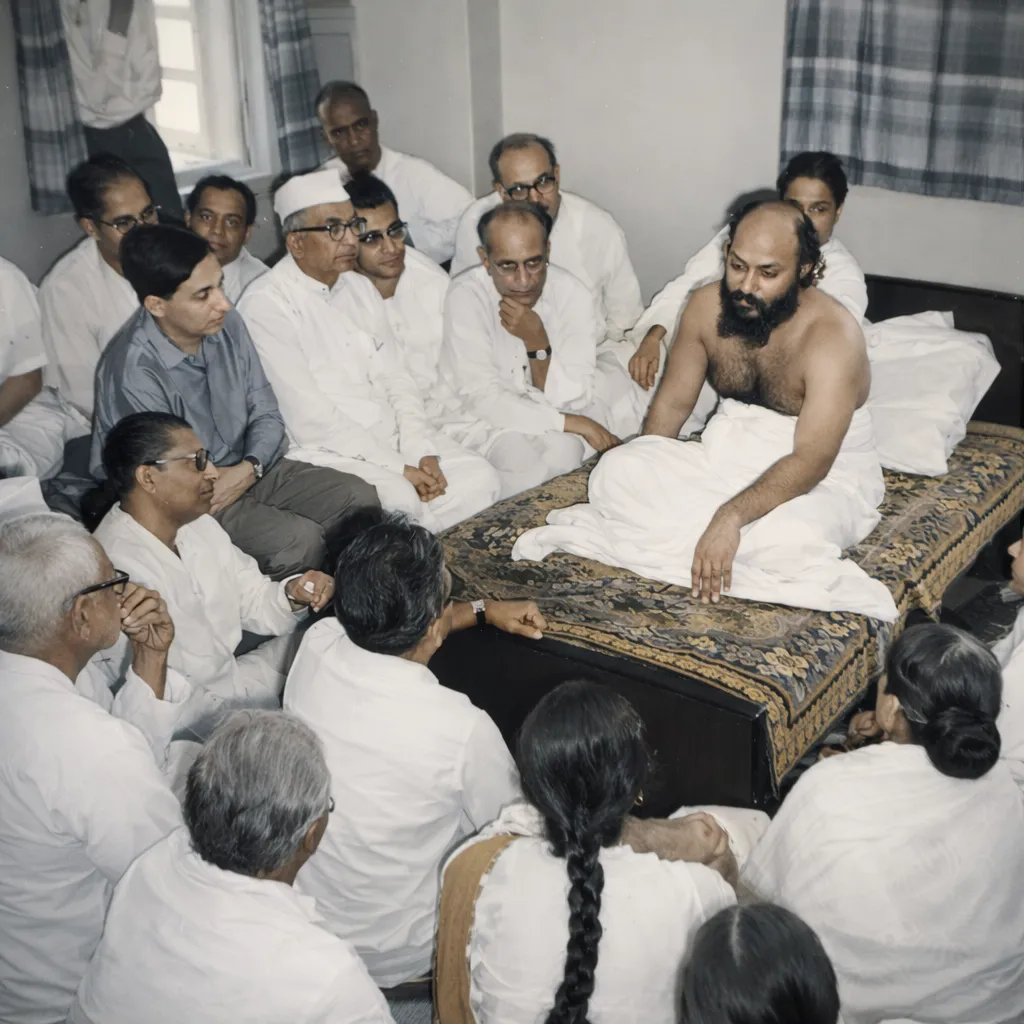
"Mahaveer Meri Drishti Mein" is a profound exploration of spiritual enlightenment as envisioned by Osho, using the life and teachings of Mahaveer as a backdrop. Through this discourse series, Osho delves into the intricate relationship between samayik (equanimity and meditative practice) and vitaragata (detachment and ultimate liberation). He illustrates that attainment of consciousness is akin to breathing: a natural, self-sustaining process once realized. Osho articulates that spiritual states, like wealth or poverty, remain with an individual irrespective of their awareness, emphasizing that genuine spiritual transformation reflects permanence in consciousness. This discourse aligns the paths of samayik and vitaragata, positing that they are not distinct but rather parts of a continuum where one evolves into the other. Osho bridges ancient wisdom, comparing the steadiness of Mahaveer with the Bhagavad Gita's concept of sthita-prajna—unwavering wisdom and steadiness of mind. Through these analogies, Osho perpetuates a nuanced view that spiritual practices are both the journey and the destination, revealing his unique perspective that liberation is not separate from the path itself but its flowering.
-
Chapter 1
Love Mahavira as flame, not the lamp - transcend followers, scriptures and imitation; remember the formless through inner attention and breath meditation.
-
Chapter 2
Scripture cannot give wisdom; it only reflects what we already are. Real knowing must be lived, not fossilized into scripture, and inner seeing precedes text.
-
Chapter 3
Mahavira returned from final attainment to guide others, growing silently; facts mislead while myth reveals truth—was he married, clothed, or male?
-
Chapter 4
Mahavira's vitaragata: freedom beyond attachment and aversion; compassion bridges moksha and world; witnessing dissolves desire and preserves lineage.
-
Chapter 5
Mahavira didn't renounce; he simply saw nothing was mine, so clinging vanished. True freedom is being the witness, not performing renunciation.
-
Chapter 6
Bondage ends by inner awakening, not austerity; Mahavira's sadhana was constant vivek—wakeful attention. Compassion is the bridge from desire to desirelessness.
-
Chapter 7
Mahavira sought to express realized truth across all planes by descending into mute life; identification with nature produced ahimsa, silence and direct resonance.
-
Chapter 8
Mahavira separated the Shramana into Jain sampradaya, taught syadvada’s sevenfold relativity, and insisted inner vision precedes conduct, so few followed.
-
Chapter 9
Devas, pretas and humans coexist parallelly; by opening the Ajna, practicing pratikraman and Samayik one can hear divya-dhvani and become a true shravaka.
-
Chapter 10
Subtle heights collapse before brute force; real liberation comes by wakeful awareness and understanding desire, not by vows, repression, or rigid predictions.
-
Chapter 11
Samayik is pure non-doing: drop roles and rest in present-time (Atman); a brief effortless pause—micro-instant—reveals it; 48 minutes mean nothing.
-
Chapter 12
Samayik—steady Self—is an inner light that, once seen, abides; karmic fruits are experienced but leave dry traces (samskaras) that awareness can dissolve, and nothing is truly accidental.
-
Chapter 13
Liberation comes by surrendering to life's flow and melting the subtle karmic body through witnessing; evolution advances by conscious will, not mere automatism.
-
Chapter 14
Why did Mahavira accept no guru? He sought direct, self-attained truth and unconditional surrender to the Whole, living day-to-day as existence’s guest.
-
Chapter 15
Mahavira's radical egolessness: non-surrender beyond humility or arrogance; ahimsa as 'do no harm'; presence heals like a catalyst, not public charity.
-
Chapter 16
Existence is beginningless and endless; forms are transient waves on an eternal ocean; Mahavira rejects a creator and embodies nonreactive, mirror-like awareness.
-
Chapter 17
True nonviolence springs from inner samadhi, not surface rules; opponents reveal their own violence-Mahavira's foes affirmed his depth, not disproved his path.
-
Chapter 18
A liberated being may return once by choice to share realization; moksha is stepping outside desire’s wheel through witnessing—stand still and be free.
-
Chapter 19
Mahavira must fight karma alone: refuse even Indra’s aid. True inner work needs radical aloneness and acceptance of insecurity so the cosmos can then support.
-
Chapter 20
Mahavira spoke in Prakrit to keep truth living and accessible, rejecting Sanskrit scholasticism and scriptures so knowledge remained direct to the people.
-
Chapter 21
Drishti fragments, darshan is whole: true realization dissolves the seer. Mahavira found the vast home—renunciation is natural consequence, not goal.
-
Chapter 22
True meditation is total wakefulness, not single-point concentration; torpor is self-created, traditions persist as dead grooves, and sects mask irreligion.
-
Chapter 23
Soul's supreme freedom lets it choose bondage or liberation; the world's loss and return make nigod into moksha—suffering and compassion reveal awakening.
-
Chapter 24
Happiness and suffering are degrees of one unrest; when hope-driven escape ends and suffering is fully faced, bliss (anand) arises beyond both.
-
Chapter 25
To know Mahavira one must inwardly realize him: love, not scripture or knowledge, dissolves boundaries between sages and reveals truth through inner awakening