
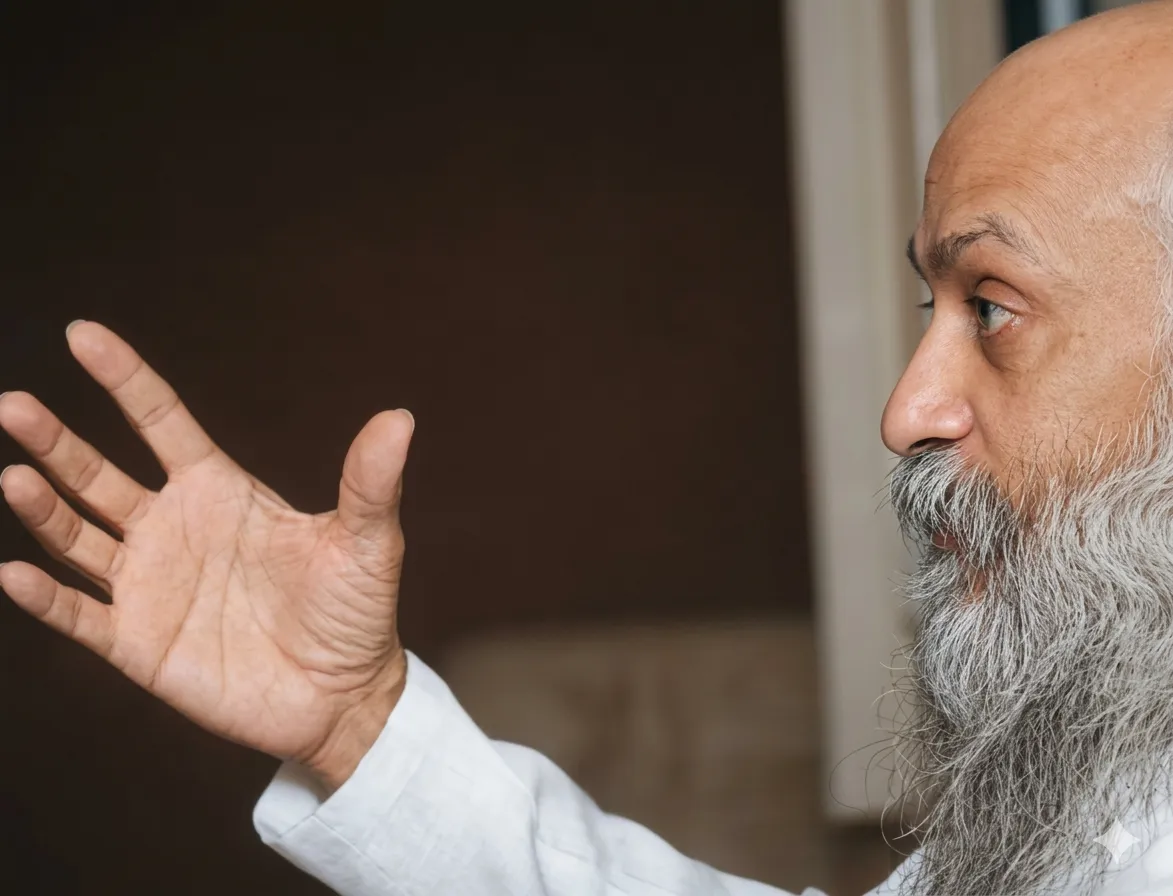
"Krishna Smriti" by Osho delves into the profound relationship between ritual and human consciousness, emphasizing the delicate balance between ritual as a form of play and as a potential source of existential malaise. Osho revisits the dawn of human discovery, highlighting fire as a pivotal catalyst in the evolution of human civilization. He contrasts the elemental power and transformative impact of such discoveries with the mundane ritualistic practices that have emerged throughout history. Osho's reflections suggest that the essence of ritual lies not in rigid adherence but in its ability to be experienced as a celebration of life. Underpinning his discourse is the symbiotic relationship between light and darkness, symbolizing knowledge and ignorance, respectively. Fire serves as a metaphor for enlightenment that dispels fear and ignorance. Osho urges his audience to embrace rituals in life as playful acts of consciousness, thus redefining spiritual practices as creative expressions rather than obligatory ceremonies. Through "Krishna Smriti," Osho provides a compelling narrative that urges individuals to transcend conventional spiritual practices, inviting them to discover a more profound, personal connection with existence itself.
-
Chapter 1
Krishna embodies a non-repressive, life-affirming totality: embracing body and soul, accepting opposites as play (leela), a laughing post-dual religion.
-
Chapter 2
Krishna embodies choiceless totality: acceptance of life’s polarities, a sannyas born of joy, and the zero‑state that dissolves ego into abiding bliss.
-
Chapter 3
Two paths to egolessness: negation (Buddha/Mahavira) peels away the ego leaving a subtle 'I'; Krishna expands the self into the All—remembrance, not practice.
-
Chapter 4
When was Krishna born? Time is mind-made; samadhi is timeless, so dates were deliberately unkept—Krishna’s being is eternal beyond birth and death.
-
Chapter 5
Krishna’s birth is uncaused—an expression of inner freedom, not born from social or political need; avatars arise from spontaneous, joyous being.
-
Chapter 6
Birth occurs in darkness; Krishna is an archetype embodying life's opposites and freedom from ego, sexuality as natural, and love as surrender in Radha-Krishna.
-
Chapter 7
Marriage as an institution is immoral; love frees. Make love the basis: shared parenthood and technology will dissolve proprietary ties, turning life into celebration.
-
Chapter 8
Krishna wins by not seeking victory - playful surrender like judo; divine sight is catalytic and fleeting; apparent killings dissolve samskaras, freeing them.
-
Chapter 9
Raas is the cosmic dance of opposites—Purusha and Prakriti—where love and creation flow; Krishna embodies nondual union; with Kubja and the cow‑mother he affirms body‑soul continuity.
-
Chapter 10
Krishna embodies total spirituality—accepting life whole and using relative means in politics; purity of means is utopian, choices are between lesser evils.
-
Chapter 11
Draupadi’s polyandry reveals love as a boundless state, not possessive ownership; Krishna responds to pure giving (Sudama) and mythic symbols point to inner readiness and time's transcendence.
-
Chapter 12
Krishna's multi-dimensional completeness sanctifies all life; his way is upasana - melting the I - restraint as balance, not repression, and worship, not effort.
-
Chapter 13
Krishna is the ocean behind the wave; images, names and kirtan can be seed-bridges if implanted in deep meditation, but ultimately silence is the goal.
-
Chapter 14
Krishna’s path rejects sadhana and divisive seven-body methods: remembrance (punar-ātma-smaran) arises suddenly when the doer dissolves into akarma.
-
Chapter 15
Krishna-visions may be mental projections or the oceanic loss of mind; projection gives pleasure, while true surrender dissolves self into freedom, not slavery.
-
Chapter 16
Aurobindo's Krishna-vision was projection; true enlightenment dissolves the 'I'. Osho rejects Pondicherry's descent-of-God, doubts mediums, and has no master.
-
Chapter 17
Truth is beginningless and timeless; Krishna invokes a living tradition to reassure the bewildered, urging realization of innate fullness rather than imitation.
-
Chapter 18
Nonattachment is our innate nature, not renunciation; by witnessing the inner film and going within one becomes a non-attached actor, realizing equanimity.
-
Chapter 19
Jnana- and japa-yajna are inner fires that burn ignorance and themselves; renouncing attachment to results turns action into immediate living liberation.
-
Chapter 20
Krishna’s choiceless non-attachment and total acceptance contrasts with Jesus’ sorrow, Buddha’s peace, Mahavira’s joyful dispassion—different paths, one goal.
-
Chapter 21
Choose Krishna's flute - joyful, moment-to-moment affirmation of life - rather than the cross's sorrow; choices are contagious and shape dharma or collective destruction.
-
Chapter 22
Sannyas as rejoicing, not renunciation: live as a witness/actor in the world, time‑bound initiation, robes as conditioning for meditation and freedom.