
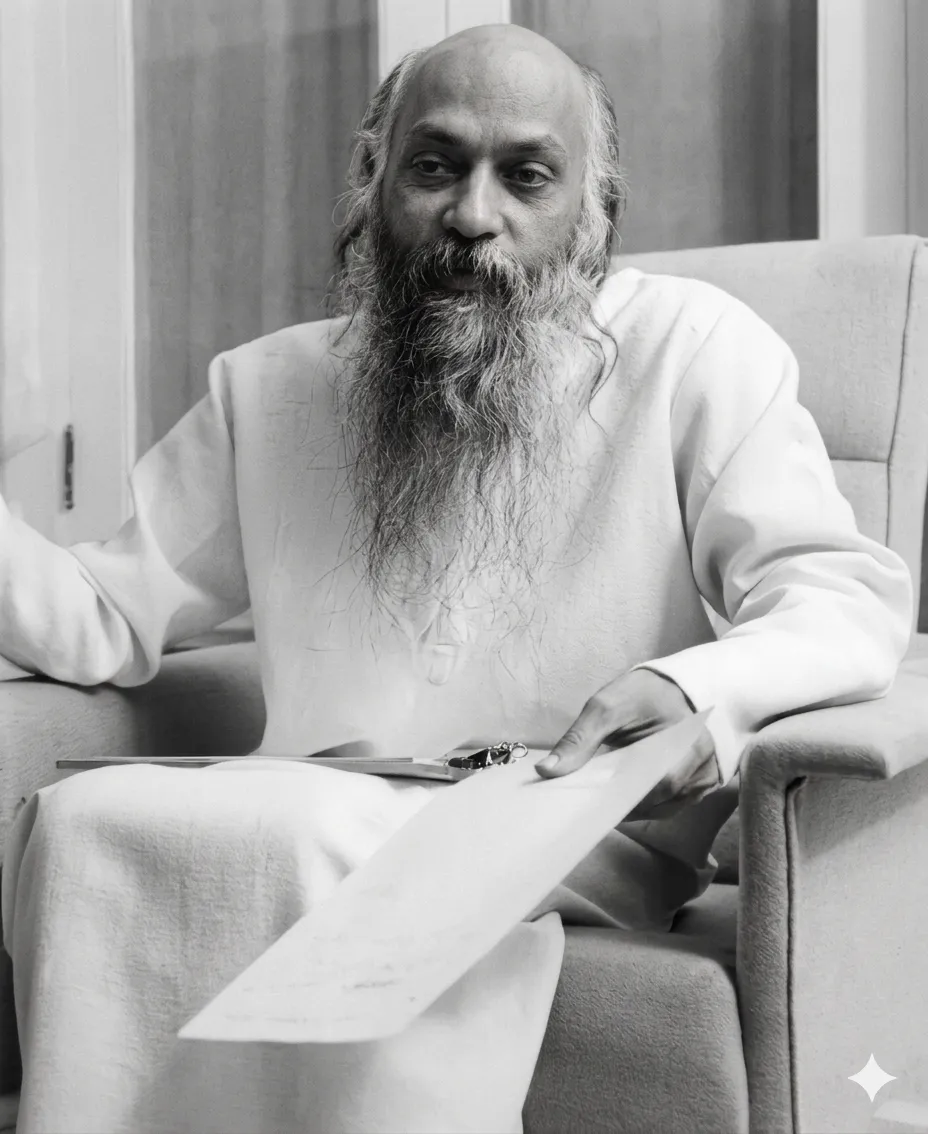
The "Kaivalya Upanishad" discourse series by Osho transcends traditional meditation teachings to explore the profound journey toward ultimate awareness and liberation. This series delves into the enigmatic pursuit of a state where consciousness is pure and unattached, akin to a mirror without reflections. Osho acknowledges the daunting challenge of achieving no-thought, given the mind's incessant activity and the futility one often feels when attempting to quiet even the smallest mental ripple. Contrary to the despair that might ensue, Osho unveils an innovative approach taught by sages: employing structured meditations on forms and thoughts as scaffolds to ascend toward emptiness. Through this, he illustrates a path where engaging with the Divine's form, albeit temporary, becomes a necessary step toward shedding all forms and thoughts. Osho's unique perspective emphasizes the importance of these intermediate steps, offering hope that while emptiness is elusive, it is accessible through disciplined practice and acceptance of human limitations. Ultimately, Osho guides seekers toward the realization that true fulfillment lies beyond any form or thought, in an unconditioned state of awareness.
-
Chapter 1
Yearning for Kaivalya: freedom as inner completeness—dependence breeds suffering; strengthen and purify the senses, unite prayer with radical effort to awaken.
-
Chapter 2
The deepest quest: science fragments and only shifts ignorance; Brahmavidya dissolves limitation by perceiving wholeness through faith, devotion and meditation.
-
Chapter 3
Fear of death drives all grasping; only renunciation as non-clinging and entering the heart's cave through meditation dissolves fear and reveals the deathless.
-
Chapter 4
Vedanta is the end of knowing: drop both ignorance and knowledge, unite renunciation and practice to purify the self and realize Brahman through direct experience.
-
Chapter 5
True meditation needs inner solitude, posture, purification and gathered senses; dissolve the inner crowd to awaken one-pointed Bhakti and inner freedom.
-
Chapter 6
Meditation alone reveals the Achintya—unthinkable, unmanifest, formless consciousness—beyond words and thought; drop thinking, dive inward to know.
-
Chapter 7
Single-form meditation is a step toward thoughtless awareness; Shraddha (leap of trust) turns the bud into a flower and frees one to the formless.
-
Chapter 8
How to call upon the Nameless? All names are His; liberation comes when the 'I' dissolves, everything is seen as His and the Atman pervades all beings.
-
Chapter 9
Find antahkaran beyond society's conscience: rub Om on the inner witness to kindle a knowing-fire that burns karma; how to hear the true voice?
-
Chapter 10
Maya is collective hypnosis that makes us identify with the body and its pleasures across waking, dream and deep sleep; meditation is de‑hypnosis.
-
Chapter 11
Life cycles through waking, dream and deep sleep; the Fourth (Turiya) lies beyond them. Liberation comes by mindful awakening through all three states.
-
Chapter 12
Pass through the ravines of the non-self without fighting; witness into the void where Parabrahman, 'That thou art', is realized. Who am I ultimately?
-
Chapter 13
True freedom arises when consciousness withdraws from being the doer and rests as the sakshi — the witnessing mirror beyond desire and identification.
-
Chapter 14
All parts arise from and hide a One; life is an organic whole beyond analysis; realization is via sakshi witnessing and experiential rebirth, not logic.
-
Chapter 15
The Self is suprasensory and cannot be proved by logic or the senses; only inner experience—meditation and tapas that melt the ego—reveals Atman.
-
Chapter 16
All duality is a play of one reality: the Divine authors and enacts the Vedas, transcending good and evil; liberation arises by seeing life as leela.
-
Chapter 17
Union of Sankhya (pure knowing) and Yoga (practical sadhana) awakens the witnessing heart: cultivate wakefulness and conserve prana, opening the heart's cave.