
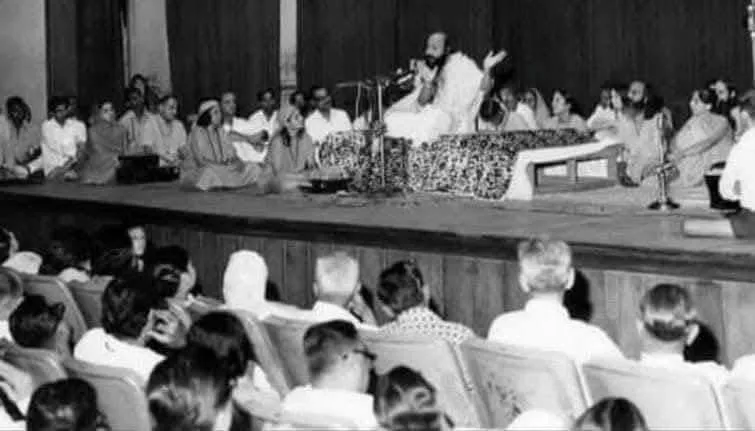
The "Ishavashya Upanishad" discourse series by Osho delves into the profound depths of life, death, and enlightenment, inviting seekers to explore the transcendental journey beyond duality. Osho challenges traditional interpretations of the Upanishadic sutras, offering a refreshing and radical vision that aligns more with the inner realization of Samadhi rather than the literal moment of death. He invites listeners to perceive death not as a terminal event but as a transformative passage akin to Samadhi—a sublime state of consciousness where individual identity dissolves into the universal essence. Through a tapestry of spiritual insights, Osho emphasizes the essence of remembering one's deeds not as a mere ritual at the time of death, but as an ongoing practice of mindfulness leading to spiritual awakening. This series illuminates the profound mystery of existence, underscoring the importance of living with awareness and dying without fear. The dialogues serve as a gateway for becoming one with the eternal, obliterating the boundaries between the self and the cosmos, and embracing a life that is a continuous remembrance of one's divine nature.
-
Chapter 1
Purnam idam: the Whole births the whole yet remains untouched—truth arrives like lightning, known by love; live as witness, breathe deep, fast senses.
-
Chapter 2
Everything is Paramatma's; dropping 'mine' dissolves the ego—only by letting go does one receive true enjoyment and the inner answer to 'Who am I?'.
-
Chapter 3
Surrender doership to the Divine: act as actor, not ego-doer, so actions leave no karma; become a self‑knower, not a self‑slayer—how? surrender.
-
Chapter 4
Atman is the unmoving root beneath the mind’s leaves; halt the mind’s race and enter Shunya (the zero-stone) to unveil the near-yet-far Self.
-
Chapter 5
Hatred is the root of suffering; polishing oneself into a mirror by freeing memory and desire and seeing Self in all beings ends hatred and reveals love
-
Chapter 6
The Self is the self-born, uncreated Satchidanand beyond body, matter or energy; true knowing dissolves ignorance, while pride and knowledge deepen darkness.
-
Chapter 7
Avidya is knowledge of matter that leaves the self unchanged; vidya is transformative self-knowledge that becomes liberation—cultivate receptivity, not ego.
-
Chapter 8
Attachment to senses or ego leads into darkness; freedom arises by relinquishing both, turning inward to the unmanifest Brahman so the Divine draws you.
-
Chapter 9
Truth is veiled not by darkness but by overwhelming inner light; surrender beyond meditation is required to remove the radiant veil and touch the formless.
-
Chapter 10
Life is a circle of Sambhuti (manifest expansion) and Asambhuti (unmanifest point); conquer death through acceptance, attain immortality by dying while alive.
-
Chapter 11
Samadhi dissolves the volitional mind while the true self remains; the Rishi mocks sankalpa—remember your deeds, pause before action, and drop the doer.
-
Chapter 12
Fire as symbol of inner ascent: prayer dissolves ego, burns impurity, and opens the path inward to the formless—will you surrender and be led?
-
Chapter 13
Life is trans‑logical: the Whole issues from the Whole; intellect cannot grasp it—shraddha (faith) and experiential leap reveal the inner Whole.