
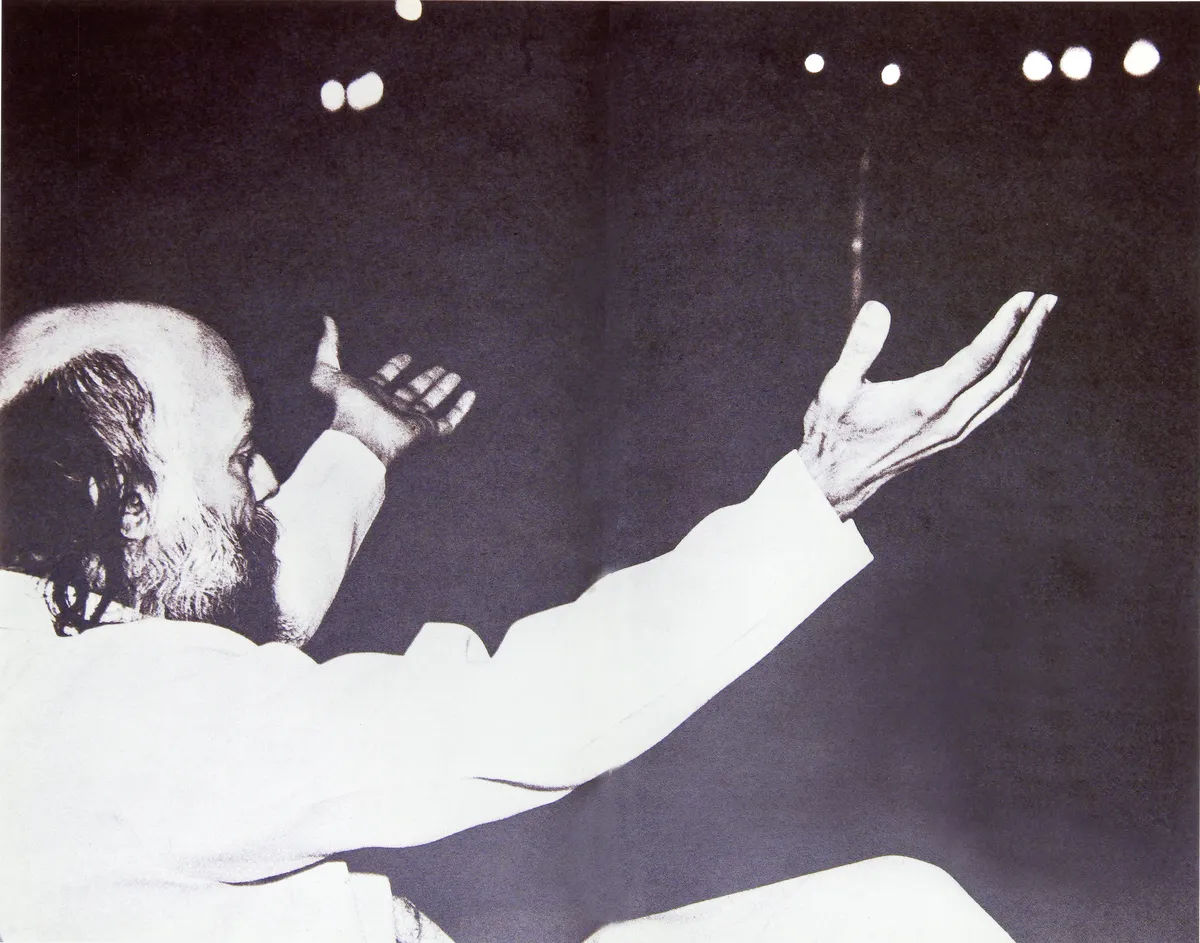
Hari Om Tat Sat is a profound discourse series by Osho, exploring the mystical confluence of Eastern spiritual traditions, with a particular emphasis on understanding the essence of existence. The series delves into the mantra “Hari Om Tat Sat,” unraveling its significance in the realm of personal and cosmic consciousness. Osho invites listeners to transcend the superficial layers of identity and connect with the divine, emphasizing that true liberation and self-realization arise from inner silence and awareness. Through his unique approach, Osho challenges conventional spirituality, urging seekers to transcend religious dogmas and embrace a more fluid, experiential understanding of the divine. He articulates the interconnectedness of all life forms, advocating for authenticity and inner truth as the pathways to enlightenment. Osho's discourse seamlessly weaves philosophical inquiry with practical wisdom, empowering individuals to break free from societal conditioning and unlock their true potential. His teachings reiterate that the realization of “Tat” or the ultimate reality dwells within each being and is accessible through meditation and inner observation. Hari Om Tat Sat is an invitation to embark on a spiritual journey towards oneness, encouraging seekers to embrace life in its entirety with awareness and love.
-
Chapter 1: The master thief sound
Hari Om Tat Sat: the divine master-thief sound that steals hearts and reveals our innate enlightenment - truth can resonate within before realization.
-
Chapter 2: Nobody is at home
Transform destructive guilt into creative energy: be present in love, cultivate juice and playfulness, honor women's pleasure and free love from institutions.
-
Chapter 3: In the search is the ego
The mind prefers endless seeking; arrival dissolves ego and personality. You were 'freaked out' because enlightenment means disappearance into silent no-mind.
-
Chapter 4: Fear is to be understood, not conquered
Fear cannot be conquered but understood; death is a change grasped in deep meditation, not by watching others die. Awareness dissolves fear and transmutes it.
-
Chapter 5: This earth is more than a paradise
Ecological suicide looms; only conscious, joyful individuals can save Earth by abandoning nations and religions and provoking the divine within.
-
Chapter 6: Guilt is inverted revenge
Homosexuality deemed a perversion linked to celibacy's distortions; accept reality, transform guilt into righteous revolt against its creators.
-
Chapter 7: Your master is your whole universe
True master is a living presence that burns ego; sannyas requires totality and inner resonance - test discipleship by disappearance of questions and relentless honesty.
-
Chapter 8: No one is insignificant
Feeling terrified of planetary destruction? No one is insignificant: love, meditation and individual awakening can nullify violence and prevent catastrophe.
-
Chapter 9: A god is a despot
Existence is reality accessed through meditation; God is a human-made fiction and a despot that enslaves consciousness—know yourself and be free.
-
Chapter 10: The greatest art of being silent
Realizing your own stupidity begins true intelligence; innocent not-knowing and the art of silence stop inner chatter and let you feel truly at home.
-
Chapter 11: Go dancing in
Questions stem from ego; answers are dissolved by experience, not debate. Existence is a playful mystery—drop fear, dance with your inner energy and silence.
-
Chapter 12: Every joke has a great reason
Jokes expose repressed consciousness and free the mind through sudden catharsis; true action arises from silent, spontaneous response-ability, not duty.
-
Chapter 13: Ride on the wave of joy
Why meditate only when you're down? Ride the wave of joy into effortless meditation; joy, not suffering, is the true springboard for inner awakening.
-
Chapter 14: Was god thinking of a circus
Fear of exposure arises from religious and social conditioning; love demands we drop masks and expose our true selves, risking respect to find authentic being.
-
Chapter 15: Everybody is unique, not equal
Love isn't authority; it arises spontaneously. Equality is false — everyone is unique. Beware ego's authoritativeness; cultivate gratitude and humility.
-
Chapter 16: No master can betray love
Mastery is love, not slavery: a true acharya transmits freedom, trust and dignity through presence; pretenders bind with faith, rules and exploitation.
-
Chapter 17: Buddhas are trying to be buddhas
Laughter reveals our innate buddhahood; a brief glimpse frees you from false identities, leaving tears, fragility and the choice to move beyond conditioning.
-
Chapter 18: A gathering of friends
Physical closeness breeds being taken for granted; deliberate absence and waiting open hearts, freeing love and laughter to create an intimate circle of seekers.
-
Chapter 19: Truth is nobody's monopoly
Truth is nobody's monopoly: Zen's silent gift shows meditation can be centering or grounding—navel-centre gravitation in Aikido or levitation atop a tree.
-
Chapter 20: Religion can only be aesthetic
Religion must be aesthetic: consciousness as art - music, dance, craft can be meditation and paths to enlightenment; ascetic renunciations are condemned.
-
Chapter 21: Logic is not the way to life
Logic misreads reality as contradiction; life is complementary, not dualistic — masters dissolve prejudice (Gandhi–Jinnah) to restore childlike innocence.
-
Chapter 22: Here everyone is the best
Fear of rejection ends when you stop comparing; here everyone is the best in their own way. Be an individual, not an obedient slave, live free.
-
Chapter 23: A woman is more poetic
A woman's heart makes her more poetic and nearer to enlightenment; historical myths show men's repression blocked women's awakening while love remains the path.
-
Chapter 24: A complete holiday for your whole life
Super-intelligent computers and robots can free humans from memory, work and past conditioning, creating a lifelong holiday for inner awareness if embraced.
-
Chapter 25: Zen: a contagious blissfulness
Durkheim translated Zen but missed its silence; recognition comes in presence. Osho contrasts Gurdjieff's crude methods with Zen's contagious blissfulness.
-
Chapter 26: The first religious people in this world
What is the 'dark night of the soul'? Osho says it's a product of life-denying religions that prize suffering; authentic faith affirms joy love dance silence.
-
Chapter 27: The vertical line opens a door to eternity
Vertical pierces horizontal: rare moments of meditation let eternity enter time, turning the endless 'more' into blissful emptiness and a no-I state.
-
Chapter 28: Vipassana comes in the end
Vipassana belongs at the end: without first living fully and heart-open, intensive awareness breeds suffering. Live hotly, embrace heart and joy, then silent seeing ripens.
-
Chapter 29: Nobody is missing anything
Stop seeking; life itself is the answer—witness the present, drop the torturing question 'What am I doing with my time here?' and know nothing is missing.
-
Chapter 30: Truth: beyond mind, beyond language
Osho rejects God and organized traditions, criticising following, urges meditation to decondition the mind; truth is beyond language and cannot be described.