
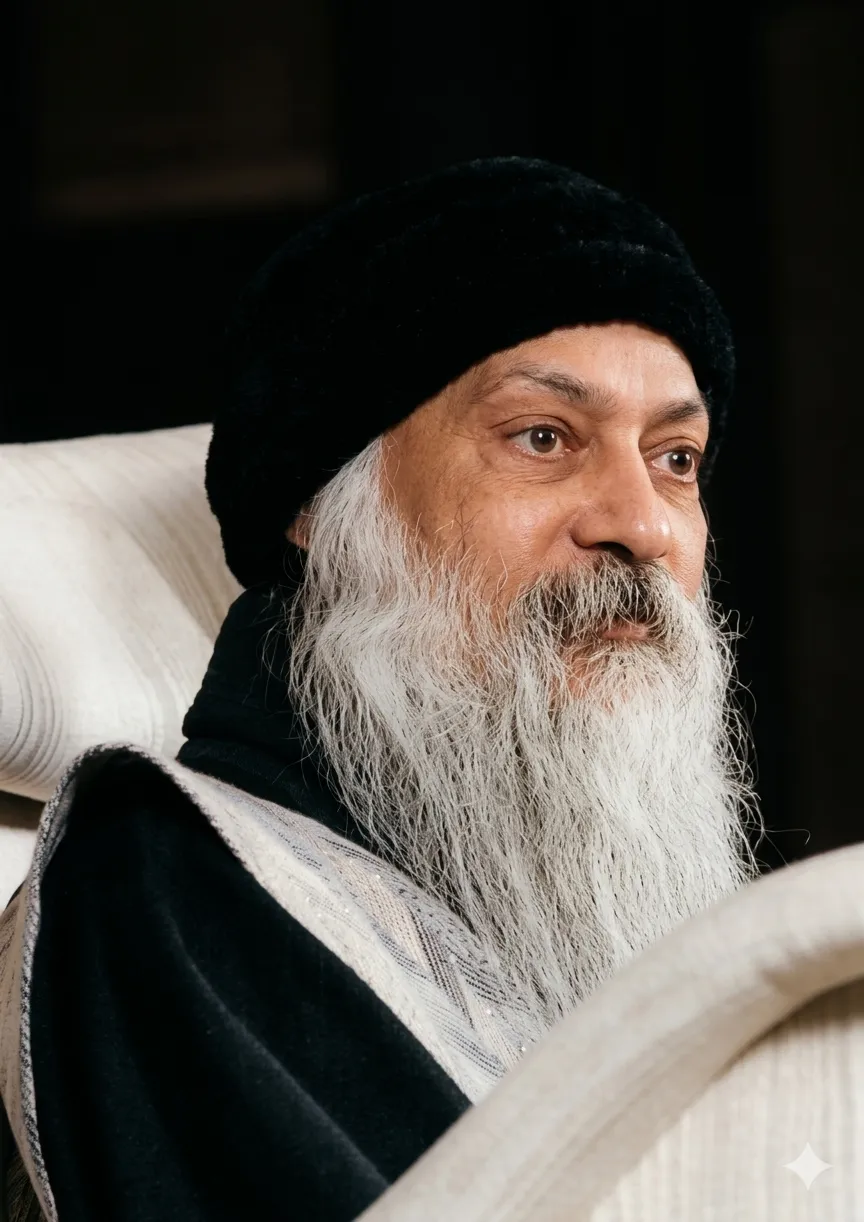
From Misery to Enlightenment is a profound exploration into the human condition as articulated by the spiritual mystic Osho. This discourse series delves into the duality of misery and enlightenment, presenting them not as opposites but as interconnected states on the path to spiritual awakening. Osho challenges conventional religious doctrines, proposing that suffering is not an inherent condition to be eradicated but a transformative catalyst toward higher consciousness. Through his incisive and often provocative insights, he encourages listeners to embrace awareness, self-inquiry, and acceptance. Osho emphasizes the importance of transcending societal norms and conditioning, suggesting that true enlightenment is found within the individual journey towards self-awareness rather than in adherence to external ideologies. His teachings underscore meditation as an essential practice, facilitating the inner silence necessary to transcend the limitations of the ego. The series is a call to courage, urging individuals to break free from fear which he identifies as the root of all misery, and to embrace love and trust as fundamental aspects of a liberated life. Osho's perspective is both radical and deeply compassionate, offering a clear path from illusion to truth, from darkness to light.
-
Chapter 1: Your birthright: to take flight
Born with wings and a birthright to fly, most sit in shelters until pushed; are we all capable? Yes — the first daring leap reveals our true freedom.
-
Chapter 2: Meditation -- jumping board to your being
Meditation is not concentration or contemplation but pure being - a relaxed, watchful center; answer to "What is meditation?": simply be, not do.
-
Chapter 3: Initiation: when one and one add up to none
Initiation is the disciple's leap from intellect to existence: surrender into the Master's presence, transcending curiosity and study into direct knowing.
-
Chapter 4: Above all, the truth of man -- beyond that, nothing
Intuition is the highest rung above instinct and intellect; free and fulfill the unconscious so energy rises into intuition to reveal the truth of man.
-
Chapter 5: Sex to ecstasy
As consciousness rises, sex becomes playful, love turns into friendship, happiness into joy, and religion and authenticity become lived reality.
-
Chapter 6: From pseudo-faith to your original face
Asked if he drifted, Osho admits constant drift and maps three faiths—magic, pseudo-religion, and true religiousness: a wordless bliss beyond conversion.
-
Chapter 7: Politics brings out the beast in you
Politics is instinctive will-to-power born of inferiority; humanity moves from 'might is right' to intelligence—'right is might'—and beyond to intuition.
-
Chapter 8: From idiotocracy to meritocracy
Replace politician rule with meritocracy: voting and candidacy tied to education; deprogramming and meditation institutes to purify leaders and save humanity.
-
Chapter 9: Courage is a love affair with the unknown
Courage is learning to drop the known and leap into the unknown; how you die shapes how you’re born, so practice choosing newness to awaken.
-
Chapter 10: Drop god, drop guilt -- become religious
Accepting vs loving myself: drop priestly guilt and repression. Acceptance is medicine; loving yourself is celebration of nature—joy, freedom, true religion.
-
Chapter 11: Consciousness: the only criterion of virtue
Responsibility is response-ability: virtue depends on consciousness, not fixed rules; act from awareness, not reaction to others' manipulation.
-
Chapter 12: God: an idea whose time has come -- and gone
God is a mental patch to close existence's mystery; neither for nor against God — embrace the middle where mind dissolves. Jesus was a tragic, misunderstood soul.
-
Chapter 13: Real love is real wild!
Society's taught 'love' is hypocritical; authentic love is wild and transforms hate through awareness—why is there more hate than love and how to reclaim it.
-
Chapter 14: Don't walk on water -- jump into consciousness
Miracles as exceptions to nature are myths and power-games; the only true miracle is a spontaneous jump of consciousness from master to disciple, here and now.
-
Chapter 15: From oy-veh to ole
Misery comes from destroying the child within and forcing borrowed ideals so institutions thrive on pain; drop the masks, assert self, reclaim natural bliss.
-
Chapter 16: The Master: a gesture to the light within
Fingers pointing to the moon mean pointing to your inner light; true knowing is silent, here-and-now, not distant gods or future promises. (on Jesus' finger)
-
Chapter 17: Religion begins where ideas end
Destruction as creative: uproot wrong beliefs so true religion—where ideas end and meditation begins—can arise; there are no leaders, only silence.
-
Chapter 18: In the silences, the semi-colons and the full stops
Enlightenment is the most insignificant thing: becoming ordinary, disappearing into a zero-like presence beyond light and darkness, not a grand arrival home.
-
Chapter 19: Man: the greatest problem -- and the only solution
Man is both the world's problem and its only solution: reject imposed destinies, unwind self-tightened knots through awareness, and become a hollow bamboo of presence.
-
Chapter 20: The pagan: chrysalis of consciousness
Rediscover pagan innocence: being a pagan is a clean, unconditioned slate—precondition for true religion; clarity and self-witness dissolve borrowed problems.
-
Chapter 21: My message -- a matter of life and death
Most people belong to mobs or organized crowds, not individuals; true listening is a risk of death and rebirth - only the alert can hear and transform.
-
Chapter 22: Exactly how do you do it!
Non-doing dissolves the ego: stop striving and watch simple acts like breathing; doing feeds the ego. Question: 'Exactly how do you not do it?'
-
Chapter 23: You'll never find a lion in the lion's club
Fanatic group-commitment springs from ancient insecurity and doubt; leaders exploit it with certainty. Freedom arises via individual growth, not blind loyalty.
-
Chapter 24: The key to unawareness: keep thinking
Ayatollah Khomeini and Einstein occupy one 'mind' pyramid; the third way is to stop identifying with thoughts—become the silent watcher and slip free.
-
Chapter 25: Religions, like diseases, are many: truth, like health, is one
Religion is the inward science of the knower; pseudo-religions keep you a beggar while true religion lights your inner kingdom — many faiths, one truth.
-
Chapter 26: Innocence -- the natural outlaw
Nature is innocent; corruption is taught by society that forces children to become 'becomings', trading true self for respectability and lifelong hypocrisy.
-
Chapter 27: One ma, one swami -- and we can start the whole game again
Humanity may deserve destruction in its rot, yet hope survives: better to save a chosen few - one ma, one swami - to begin again after apocalypse.
-
Chapter 28: AIDS: disease of the existential orphan
AIDS is an existential sickness: loss of will to live weakens sexuality and immunity; living fully herenow through meditation restores vitality.
-
Chapter 29: Rebel or robot?
Rebellion is individual: preserve intelligence and uniqueness in a commune as an organism, not an orthodox organization; guard freedom and responsibility.
-
Chapter 30: Rebellion: hallmark of the new man
Revolution breeds violence and power; true rebellion is inner: drop hypocrisy, live fully in the moment, transform yourself instead of overthrowing systems.