
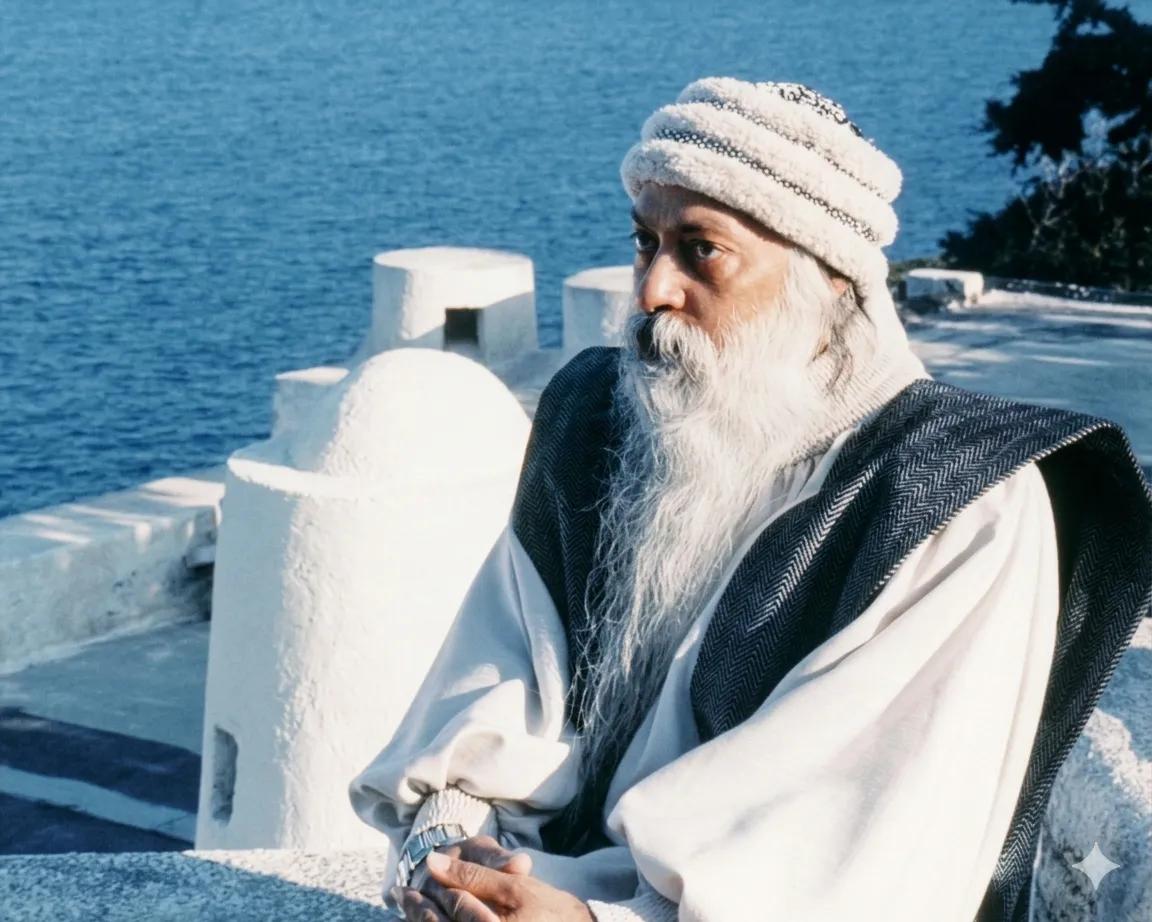
English translation by Osho Live from Osho's original Hindi discourse. Read the Hindi original.
Chapter Summary
Main Teaching: Longing is the indispensable first flame; without an inner thirst life remains mechanical and burdensome, and only a genuine ache draws one toward the search for Paramatman. Osho observes that most people live as strangers to themselves, unaware of the mysterious presence within, so existence often becomes sorrowful and meaningless. He welcomes both the thirsty and the merely curious because an unbidden truth can strike the heart and begin a preparation for deeper seeking. He frames the series in four stages—longing, the path, the door, and the entry—and begins with an anecdote about a villager asking Buddha how many attain Paramatman to underline that thirst precedes attainment. On longing: thirst is not a defect but the very fuel of spiritual life, the necessary impulse that initiates the search. On life's meaningfulness: purpose is revealed only through inner awakening; without it events merely pass and life feels like a burden. On readiness: sudden, uninvited truths can touch the unprepared and catalyze a readiness to pursue truth, so attendance alone can be significant. On the path: the journey unfolds stage by stage and each practical doorway and entry presupposes the original longing Osho elevates as primary.
When Osho gave this talk
28 December 1965, Bombay
- ← Previous talk: Prem Nadi Ke Teera #1 · 9 October 1965
- Next talk → Jeevan Ki Khoj #2 · 29 December 1965
Osho's Commentary
My beloved Atman!
I welcome you. There can be no greater joy than that a few are eager for Paramatman. That some are thirsty to know the truth and the meaningfulness of life. If truly there is in you any thirst, any longing, any ache in the heart to know life, then I welcome you. It may also be that many have come merely to listen; it may be that there was a little time to pass and they have come to spend it—still, I welcome them as well.
I welcome them in this spirit: many times, quite unbidden, truths for which we do not seem prepared touch us. Many times, a truth, utterly unannounced, strikes a string in the heart—and for that which we were not ready, the preparation begins.
So, for those who are thirsty and for those who are not yet thirsty, what will be said in these four days may yet be of some use.
That is why I said, I welcome you. And today, in this preliminary, first talk, I will speak only of that which seems to me most important, and without which the beginning of any search in life is not possible.
For the four talks I have chosen four themes. Today, I will reflect on longing. Tomorrow, on the path. Afterwards, on the door; and in the end, on the entry.
We ordinarily assume that we are living. But very few are those who live in the true sense. Very few even come to know that they had life at all. Very few become aware of what mysterious presence was dwelling within them. We live almost strangers—unknown to ourselves. Naturally, if such a life gives no joy, no peace, it would not be unnatural. It is only natural that life becomes a sorrow, an anxiety, a trouble, a pain. Such, indeed, is our life.
It is natural that an eagerness to know life arise; that we wish to know: Why are we? Why does our being exist? What purpose? What meaning is there, on account of which we have had to be? And if we cannot even come to know what purpose, what meaning, then we shall certainly live—but life will be a burden. Events will happen and time will pass; from birth to death we will complete the journey. But we will not taste meaningfulness, fulfillment, or blessedness.
Only a very few come to know the meaningfulness of life. For each person who would know life, the very first necessity is that there be a thirst within.
Buddha was staying near a village. Early one morning a man came to him and said: For so many days, for so many years, you have been explaining to people—for Paramatman, for Moksha, for Atman. How many have attained Paramatman?
Buddha said: